
This is the in vitro diagnostic pack, not the medical device one. Article numbers here are IVDR numbers, they do not match Regulation (EU) 2017/745, and the two regulations diverge exactly where it costs most. Applying MDR IVDR technical documentation to an IVD is the expensive mistake this pack exists to prevent.
On this page:
- Three divergences from the MDR that reshape the technical file
- What is inside the IVDR technical documentation pack
- The legacy device condition that closes on a date nobody controls
- Who the IVDR technical documentation pack is written for
- What the IVDR technical documentation pack does not do
- Frequently asked questions
- Related toolkits
Three divergences from the MDR that reshape the technical file
The first is the evidence itself. The MDR asks for a clinical evaluation. The IVDR asks for a performance evaluation built on three separate demonstrations – scientific validity, analytical performance and clinical performance – each with its own evidence and its own report section. A pack that treats performance evaluation as a renamed clinical evaluation collapses three demonstrations into one, and the gap shows up as a request for a clinical performance study that was never planned.
The second is EUDAMED, and it is genuinely hidden. Article 113(3)(f) of the IVDR ties its own EUDAMED obligations to a notice published under Article 34(3) of the Medical Device Regulation – not to a separate IVDR notice. So Commission Decision (EU) 2025/2371, an MDR instrument, started the six-month clock for IVD manufacturers too, and the same four modules became mandatory on 28 May 2026. An IVD manufacturer reading only its own regulation will never find the decision that binds it.
The third is vigilance. The IVDR definitions catch events that MDR procedures written for devices simply do not classify as reportable. This IVDR technical documentation uses the IVDR definitions throughout rather than adapting device wording.
What is inside the IVDR technical documentation pack
74 editable templates across the full IVDR scope, each stating the consolidation date of the text it was written against.
- Technical documentation – the Annex II and Annex III structure for IVDs, marked as written once or per device.
- Performance evaluation – the plan, the report and separate sections for scientific validity, analytical performance and clinical performance.
- PMPF – the post-market performance follow-up plan and evaluation report, which is the IVD analogue of PMCF and is not the same document.
- PMS and PSUR – the surveillance plan, the periodic safety update report and trend reporting.
- Vigilance – incident and FSCA reporting on IVDR definitions.
- Classification – the Annex VIII rules for classes A, B, C and D, with the route each class takes.
- UDI and EUDAMED – registration procedures, the SRN record, and the dependency on the MDR decision given its own document.
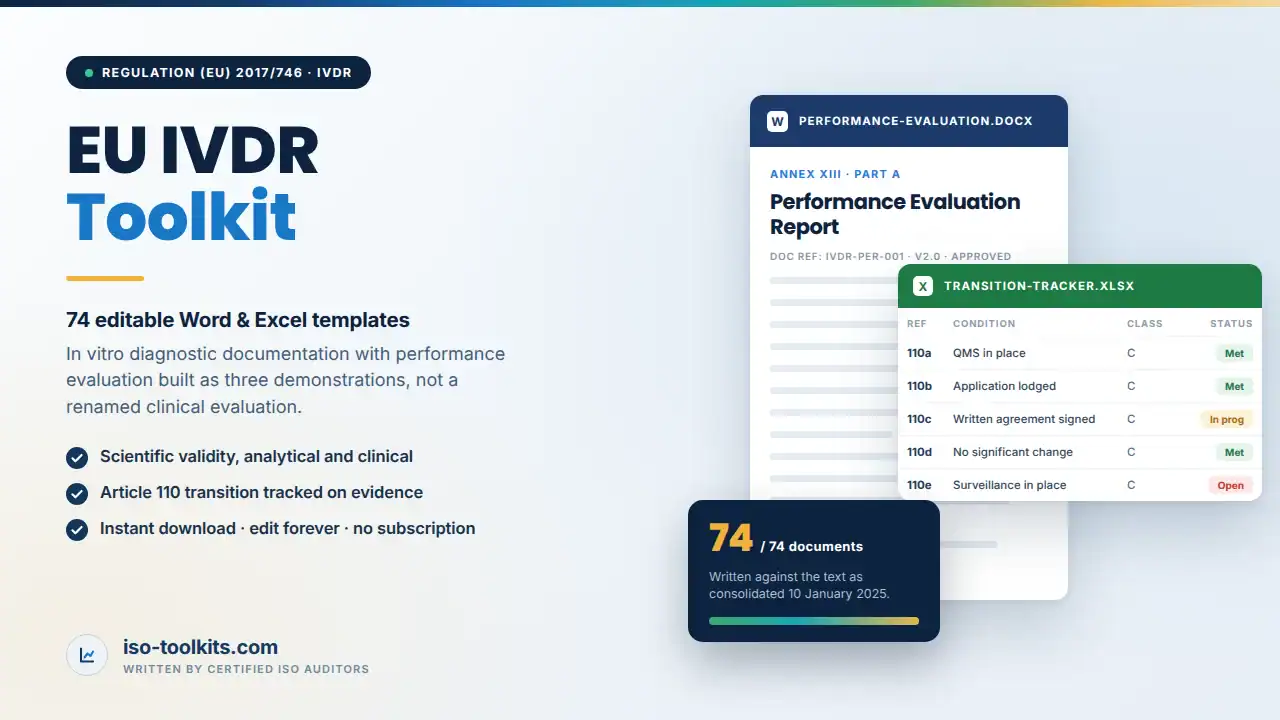
- Transition – the Article 110(3c) conditions as a tracker taking evidence references, with both Annex VII Section 4.3 milestones tracked separately.
- IFU and labelling – including the particulars an MDR template does not contain.
The legacy device condition that closes on a date nobody controls
For class C legacy devices, Article 110(3c)(f) requires the manufacturer and a notified body to have signed a written agreement by 26 September 2026. Not applied for – signed. The application deadline passed on 26 May 2026, and the months between the two dates are not within the manufacturer control, because a notified body has to be willing and able to sign.
If the agreement is not signed, the condition fails and the device can no longer be placed on the market under Article 110 on 27 September, not on 31 December 2028. There is no remediation procedure and no grace period. Class D ran the same gauntlet in 2025; class B and class A sterile reach theirs on 26 May and 26 September 2027.
The transition tracker in this IVDR technical documentation takes evidence references rather than a Yes for each of the six Article 110(3c) conditions, tracks both Annex VII Section 4.3 milestones separately, and carries a worked example of a device whose written agreement is unsigned two months out – the position, the escalation and the supply suspension.
Who the IVDR technical documentation pack is written for
- Manufacturers of in vitro diagnostic medical devices, at any class.
- Authorised representatives, importers and distributors of IVDs.
- Regulatory teams whose files were built from MDR templates and need the IVD-specific evidence.
- Organisations running class B, class C or class A sterile legacy devices against the Article 110 conditions.
What the IVDR technical documentation pack does not do
It is not a quality management system. ISO 13485 sits underneath it and is sold separately.
It does not generate performance data. It supplies the plan, the report structure and the evidence framework; the studies and the literature work are yours.
It is not the MDR pack. If you make medical devices rather than IVDs, the article numbers here are the wrong ones.
Frequently asked questions
How is this different from the MDR pack?
Different regulation, different article numbers, and three genuine divergences: performance evaluation instead of clinical evaluation, the Annex VIII classification rules, and IVD-specific vigilance definitions.
Does it cover the EUDAMED obligations?
Yes, including the dependency on the MDR decision that most IVD manufacturers never find, and the staged follow-on registration of legacy devices.
Do we need the ISO 13485 pack as well?
If you do not already have a quality management system, yes. IVDR expects one underneath the technical documentation.
What formats are the files in?
Native Microsoft Word and Excel, fully editable, with placeholders marked throughout.
Related toolkits
Run it with the ISO 13485 toolkit for the quality system and the ISO 14971 toolkit for risk management. Laboratories running the tests need the ISO 15189 toolkit, and device manufacturers the EU MDR toolkit. The consolidated Regulation is on EUR-Lex.
Implementing for clients? The Consultant Package licenses all 86 toolkits and assessment tools on this site for unlimited client engagements, under one firm-wide licence. One payment of $1,399, no subscription and no per-client fee.
Delivery, format and licence
The IVDR technical documentation pack downloads immediately after checkout as native Microsoft Word and Excel files. Nothing is locked, nothing is a PDF you cannot edit, and no add-on or portal login is needed to open it. Every organisation-specific value is marked as a placeholder so you can see what still has to be decided.
One payment, no subscription and no annual renewal. The source files behind the IVDR technical documentation pack are yours to adapt for your own organisation for as long as you need them, including future revisions of your own documents.


Reviews
There are no reviews yet.