
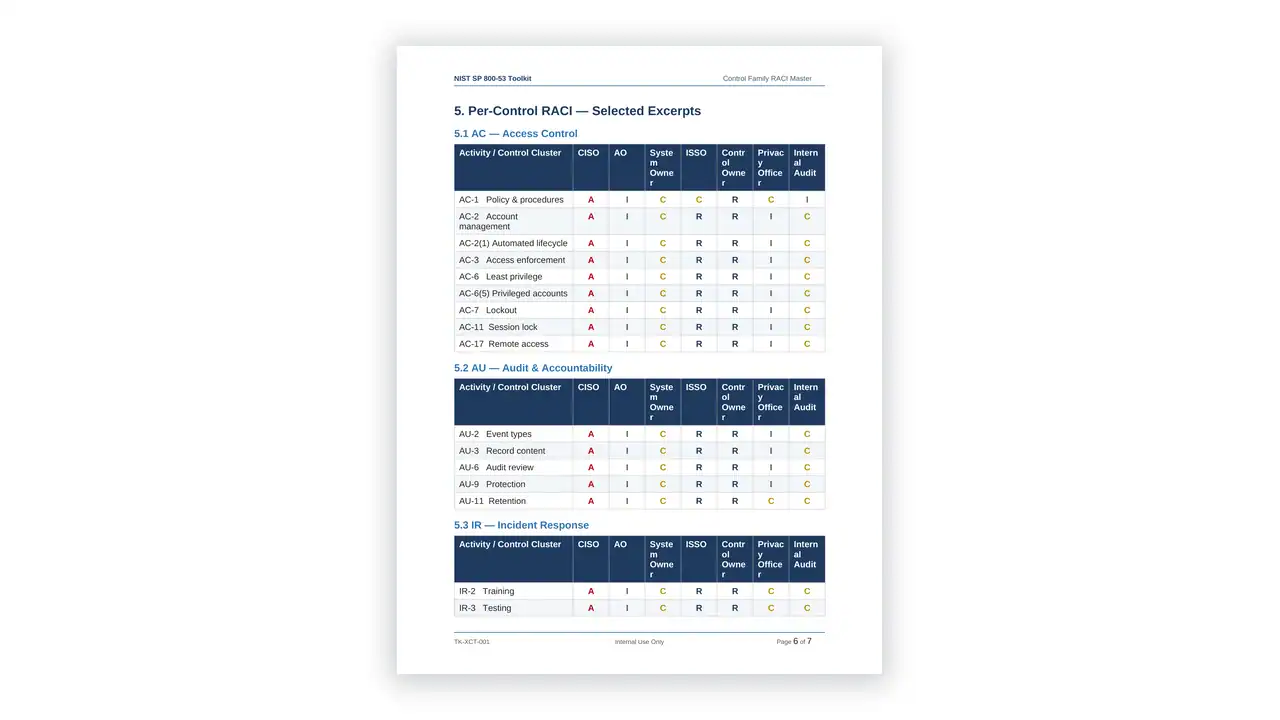
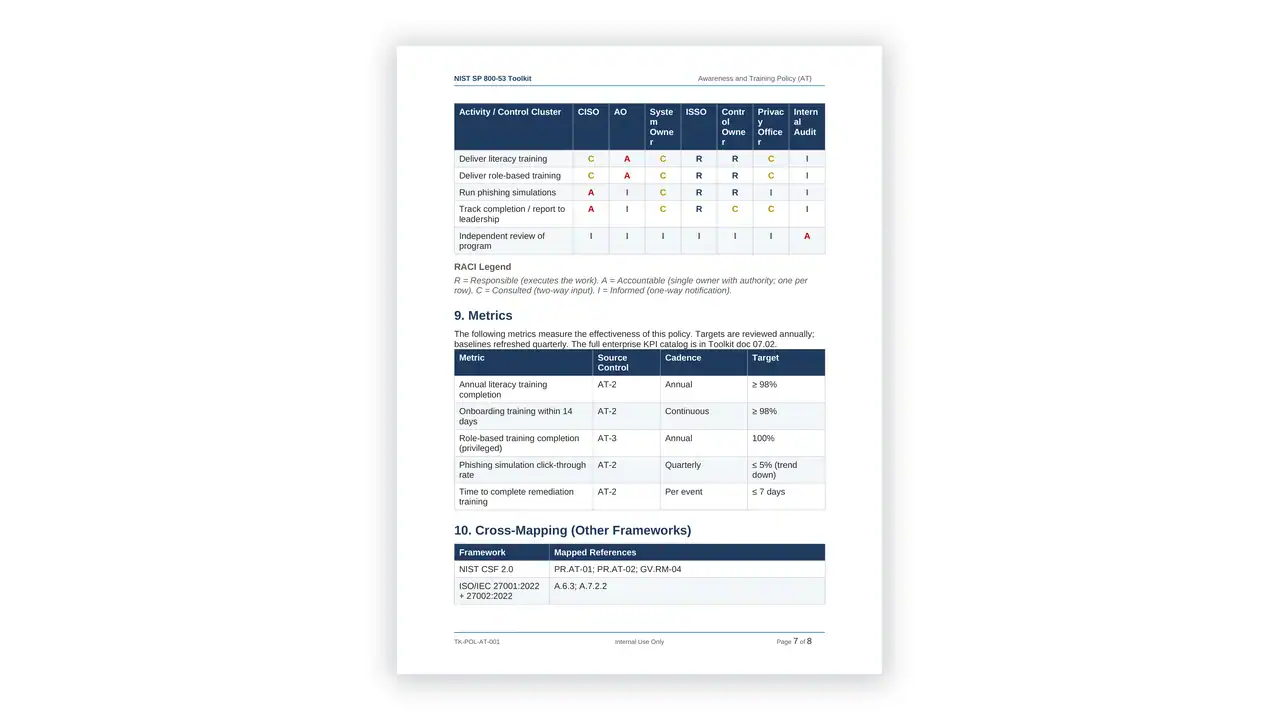
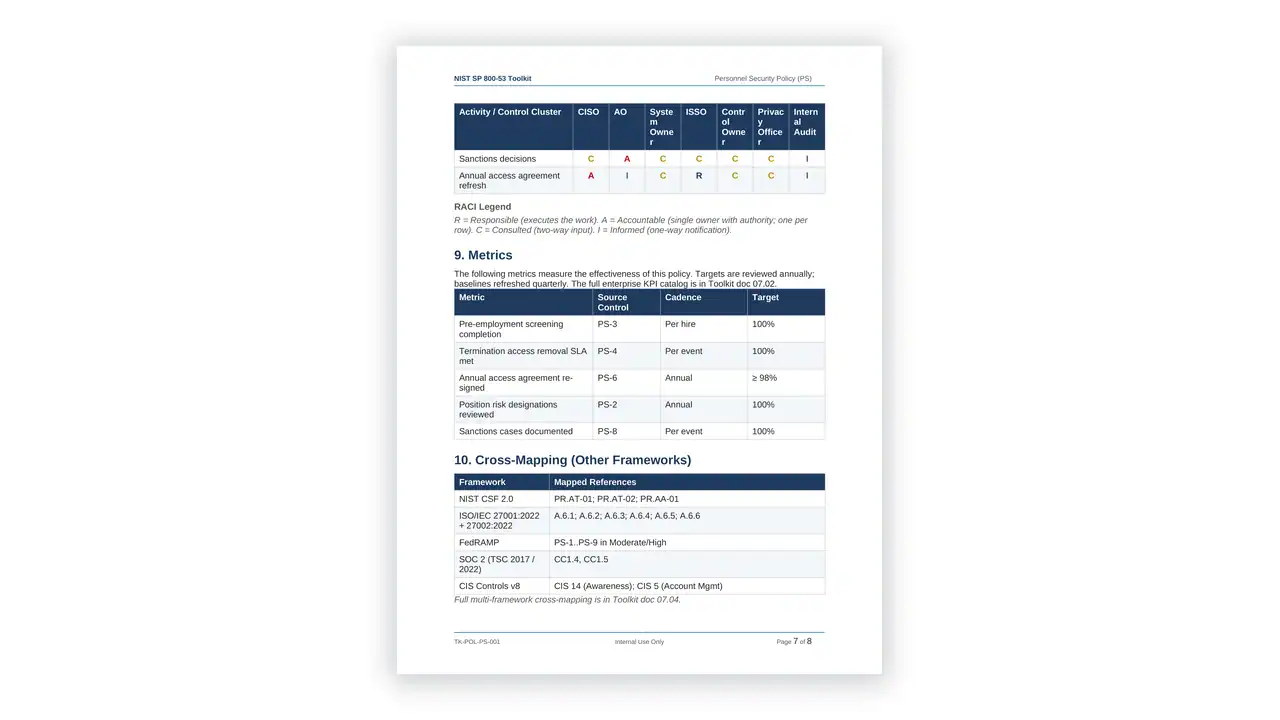
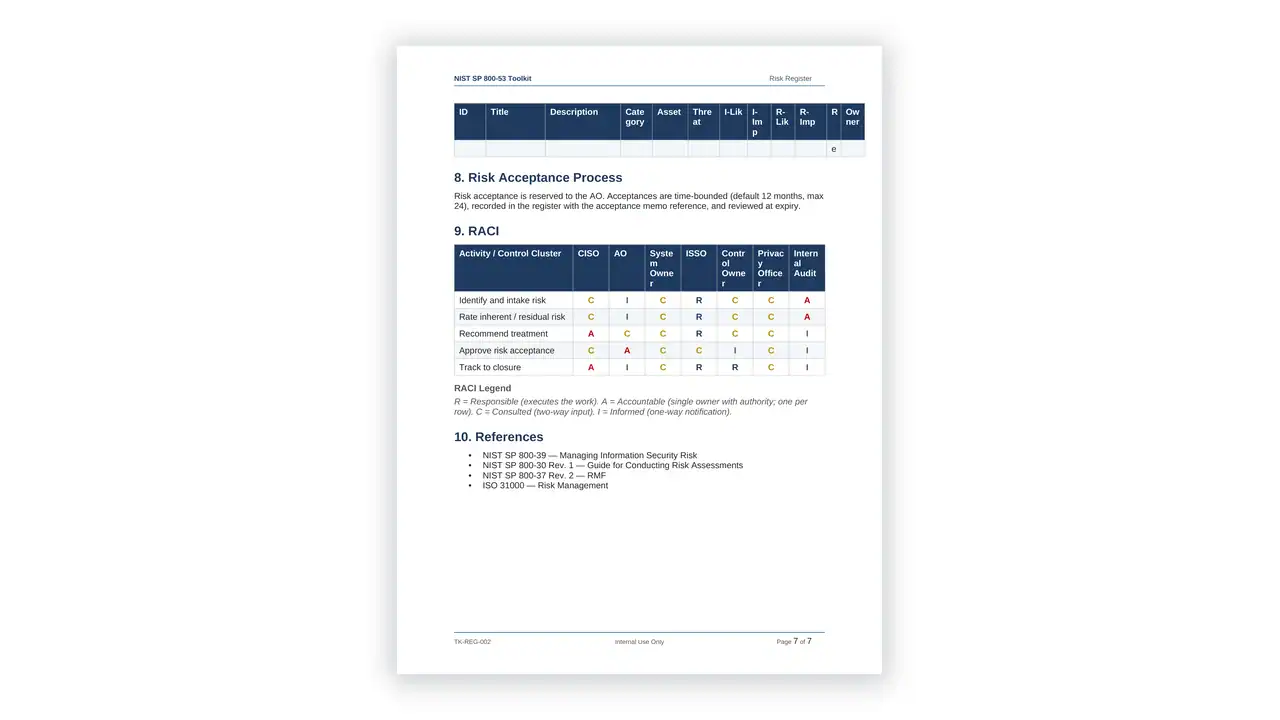
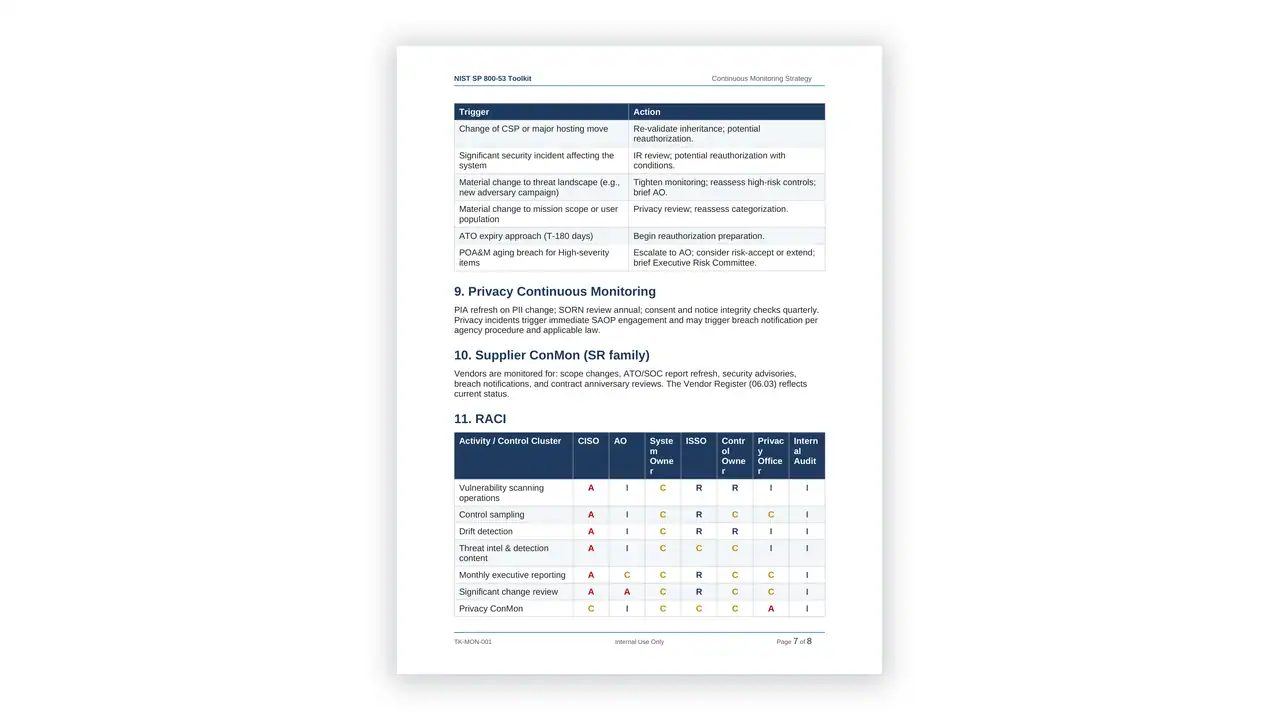
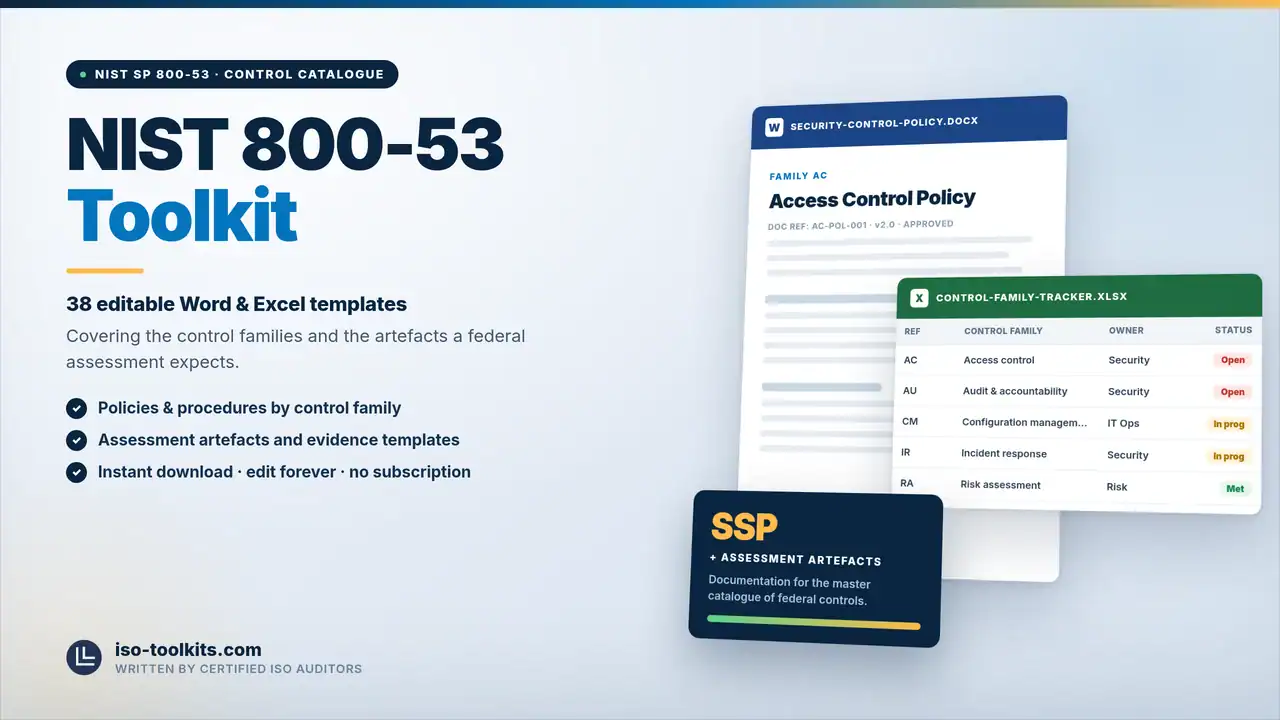
SP 800-53 is a catalogue of over a thousand controls, so nobody implements it whole – you select a baseline, tailor it, and then evidence what you selected. The control implementation summary is the document that records that, control family by control family. 38 editable Word documents across eight sections, downloadable the moment you check out. On this page:
- What is in the control implementation summary pack
- Rev 5 is current, but cite the release not just the revision
- Who needs control implementation summary
- How the documents map to the framework
- Frequently asked questions
- Related toolkits
What is in the control implementation summary pack
Eight numbered sections following the risk management framework sequence:
- 00 Overview – the document map and how the set fits together
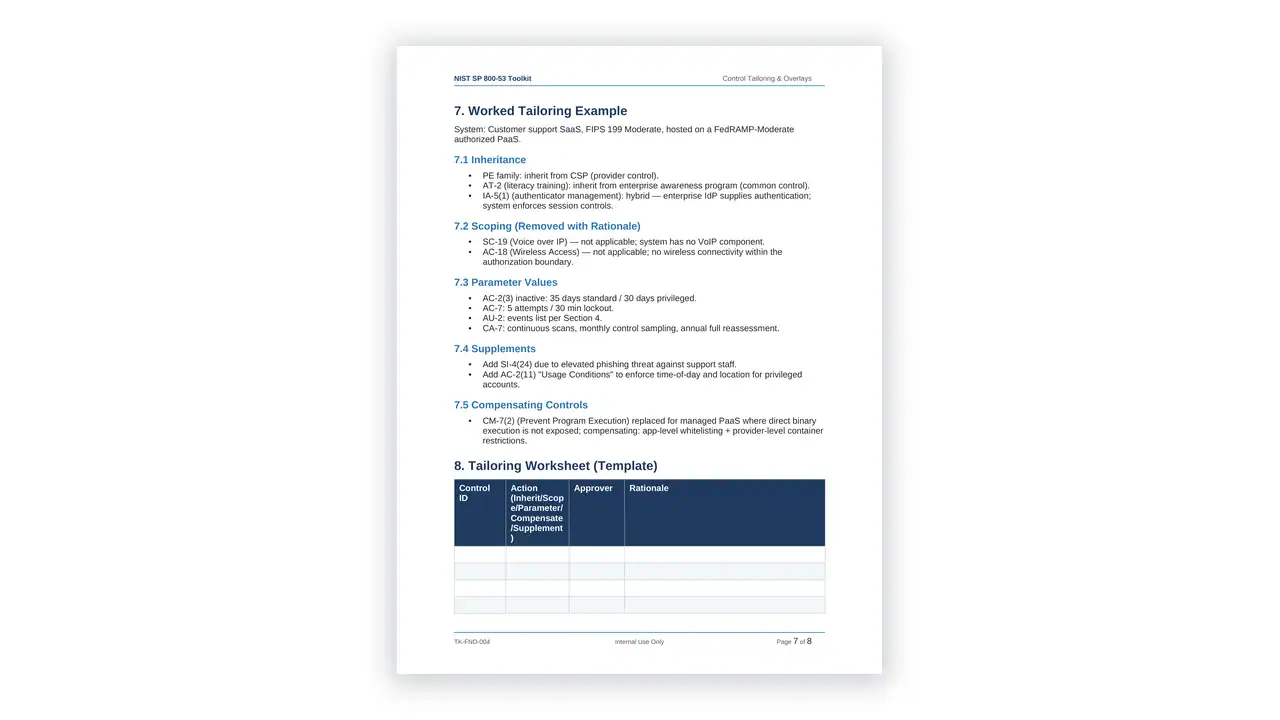
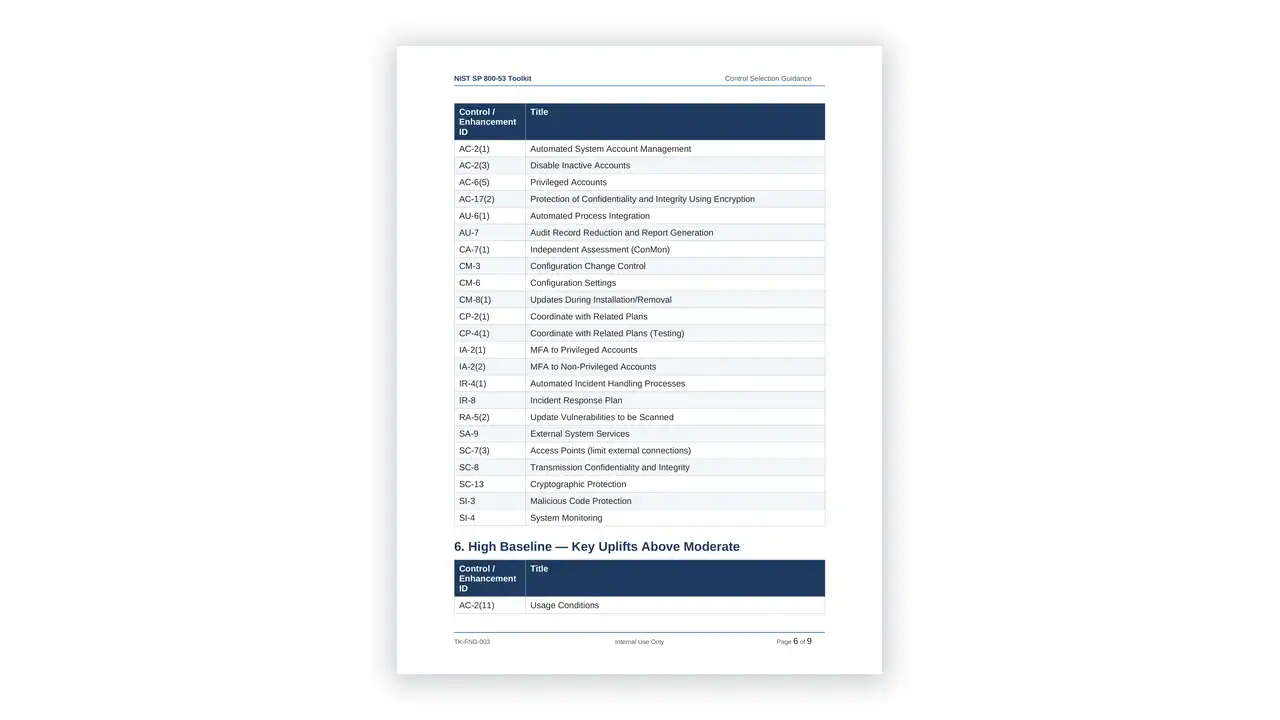
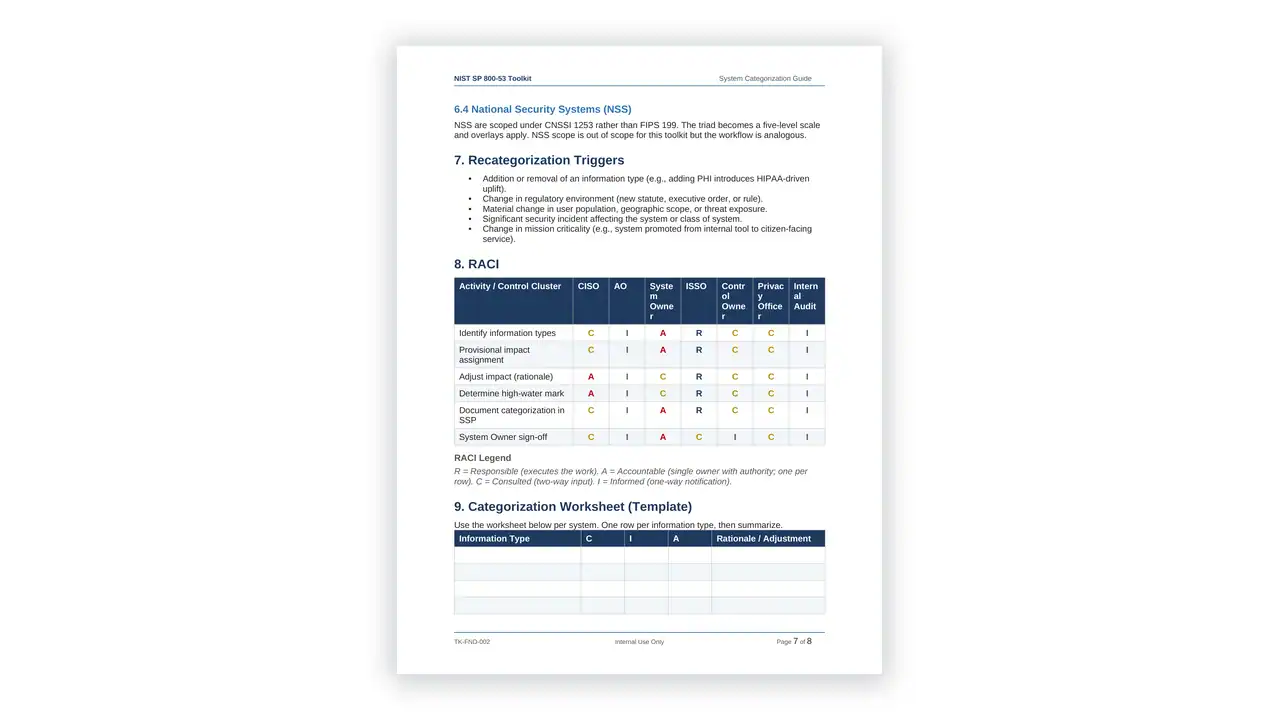
- 01 Foundation – system categorisation under FIPS 199, the information types analysis, baseline selection and the tailoring record that justifies every addition, removal and parameter value
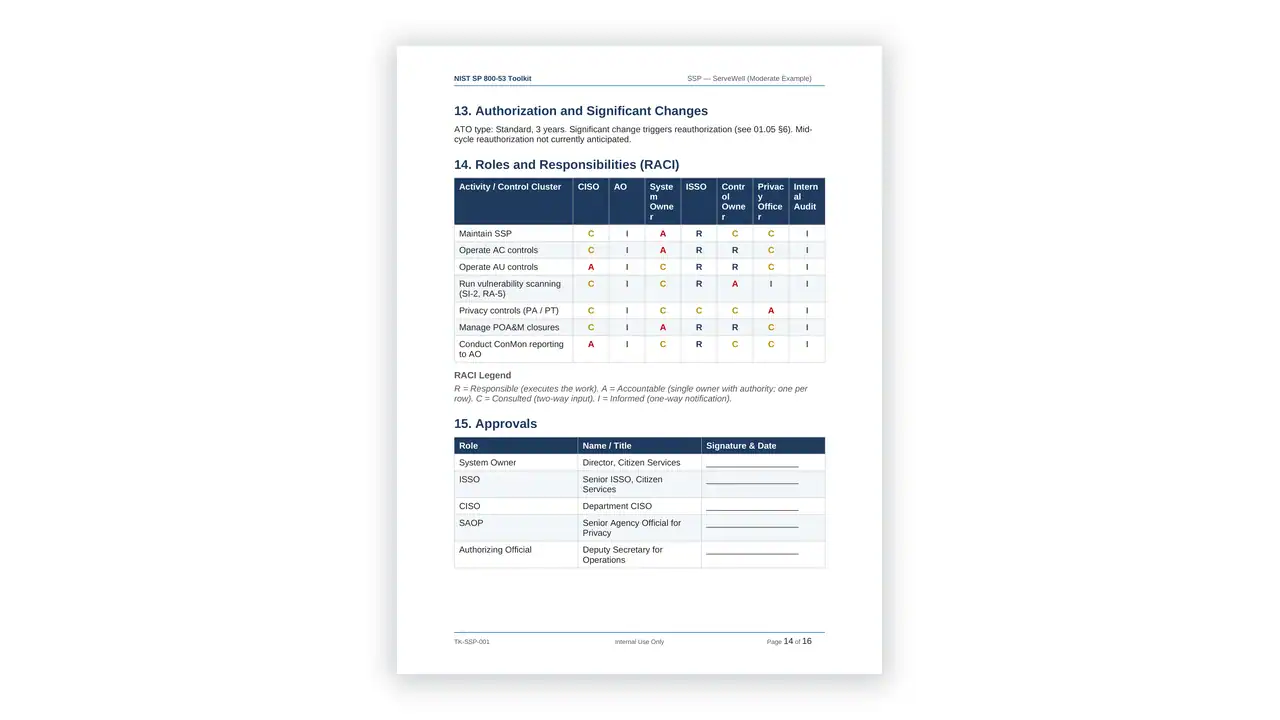
- 02 SSP – the System Security Plan, structured the way an assessor reads it
- 03 Control Family Policies – a policy for each of the twenty control families: AC, AT, AU, CA, CM, CP, IA, IR, MA, MP, PE, PL, PM, PS, PT, RA, SA, SC, SI and SR
- 04 Assessment and Authorization – the security assessment plan and report, and the authorization package material
- 05 Continuous Monitoring – the monitoring strategy, frequencies and the ongoing authorization position
- 06 Registers – the control implementation summary, the POA&M and the supporting inventories
- 07 Cross Cutting – the crosswalks to NIST CSF and to other frameworks you are likely to be assessed against simultaneously
Rev 5 is current, but cite the release not just the revision
NIST moved SP 800-53 to a patch release model, which changes how you should reference it. Revision 5 remains current and there is no Rev 6, but the catalogue is updated within the revision – Release 5.2.0 landed in August 2025 and added controls including SA-15(13), SA-24 and SI-02(07).
The practical consequence is that saying you comply with Rev 5 is now imprecise. An assessor may reasonably ask which release your baseline was drawn from, particularly where newly added controls are relevant to your system. The documents here cite Release 5.2.0 explicitly.
What has not changed is that the control implementation summary carries the weight. SP 800-53 is a catalogue rather than a compliance regime in its own right – it is consumed through FedRAMP, FISMA, CMMC via 800-171, and agency-specific programmes. Whichever route applies, the assessor is reading your tailoring decisions and your evidence, not the catalogue.
Who needs control implementation summary
Federal agencies and their systems owners operating under FISMA. Cloud service providers pursuing FedRAMP or GovRAMP, whose baselines are drawn from this catalogue. Contractors whose agency customers impose 800-53 directly rather than through 800-171. And organisations using it voluntarily as the most comprehensive control catalogue available.
How the control implementation summary maps to the framework
Tailoring is where the professional judgement lives and where assessments are won or lost. A baseline adopted without tailoring is both over-scoped and under-justified; a tailored baseline with a documented rationale for every deviation is defensible even where an assessor disagrees. The tailoring record is kept as a standalone document for exactly that reason.
Frequently asked questions
Which revision and release?
Revision 5, Release 5.2.0 from August 2025. There is no Rev 6. NIST now issues patch releases within a revision, so citing the release is more precise than citing the revision alone.
Do we implement all the controls?
No. You select a baseline appropriate to your system categorisation – low, moderate or high – then tailor it. The foundation section covers categorisation, selection and tailoring.
How does this relate to 800-171?
800-171 derives its CUI requirements from this catalogue but is a much smaller, self-contained set. If your obligation is DFARS or CMMC, start with the NIST SP 800-171 Toolkit.
Does this cover FedRAMP?
It covers the control catalogue FedRAMP baselines are built from. FedRAMP adds its own package structure and process – see the FedRAMP Toolkit.
How many documents are included?
38 editable Word documents across eight sections, plus guidance and a licence file.
Related toolkits
800-53 is consumed through other programmes. See the FedRAMP Toolkit for cloud authorization, the GovRAMP Toolkit for state and local, the NIST SP 800-171 Toolkit for CUI and the CMMC Toolkit for the defense assessment regime. The NIST CSF toolkit sits above this as the framework layer, with crosswalks between the two.
Implementing for clients? The Consultant Package licenses all 86 toolkits and assessment tools on this site for unlimited client engagements, under one firm-wide licence. One payment of $1,399, no subscription and no per-client fee.
Delivery, format and licence
Your control implementation summary downloads immediately after checkout as native Microsoft Word and Excel files. Nothing is watermarked or locked, so you can rebrand the documents, bring them under your own document control and revise them for as long as you need them.
One-time purchase. No subscription and no annual renewal. Because the source files behind the control implementation summary are yours, revising a procedure after an audit finding or a change of scope is an internal edit rather than another purchase.


Reviews
There are no reviews yet.