
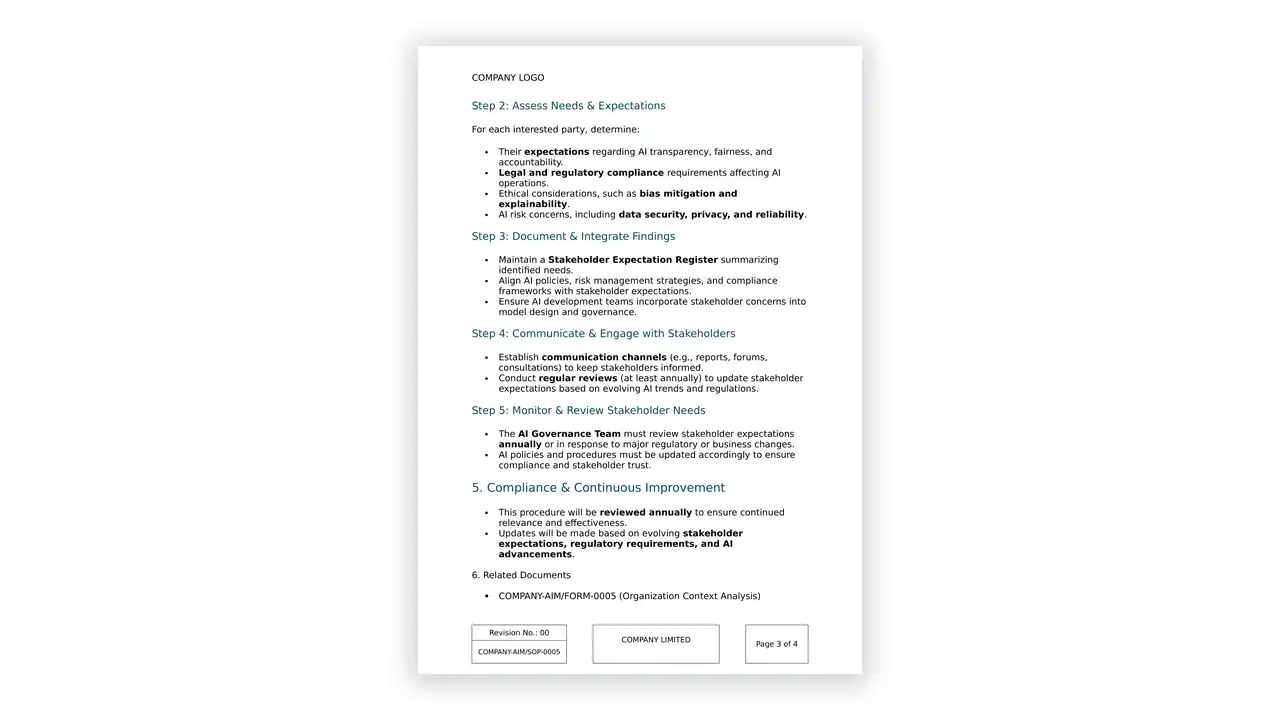
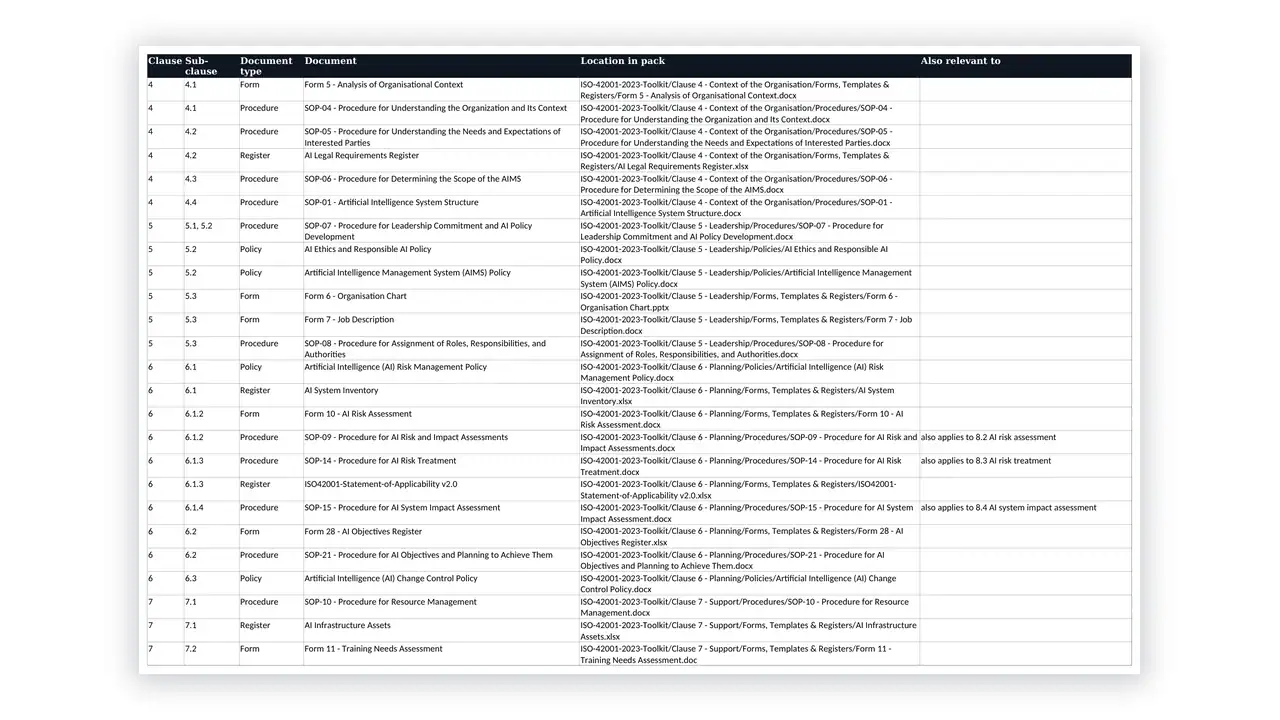
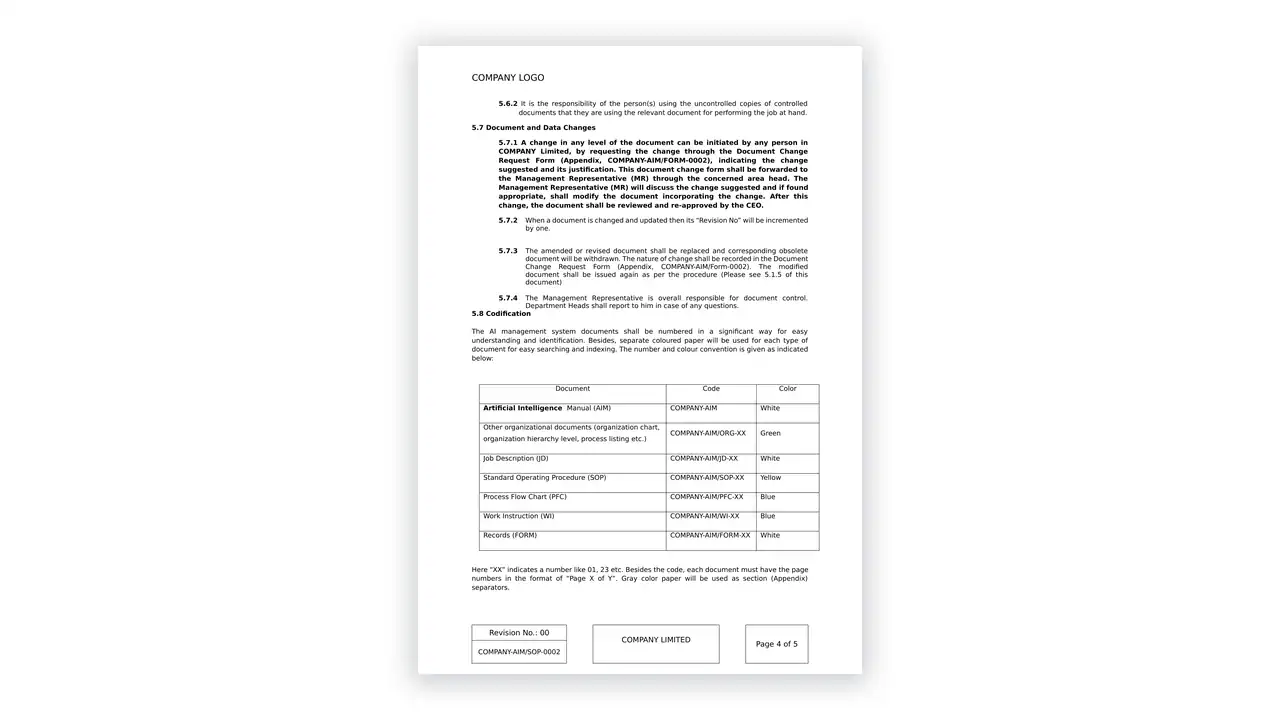
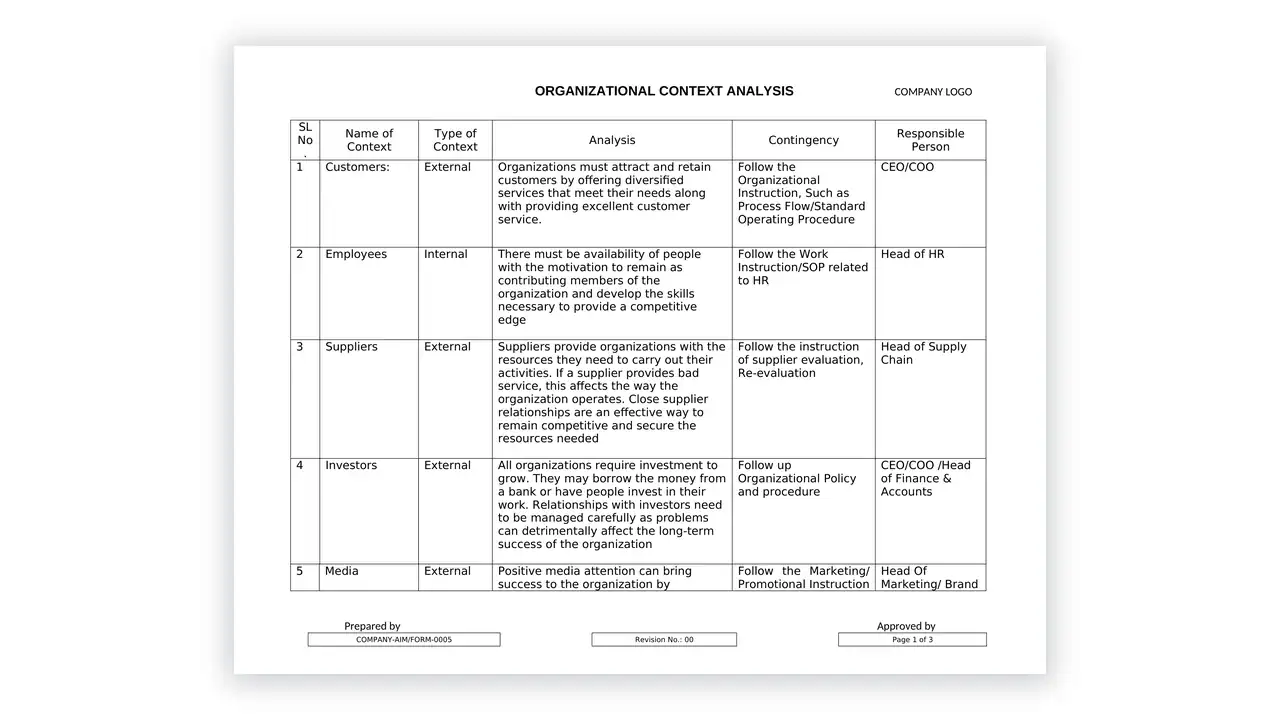
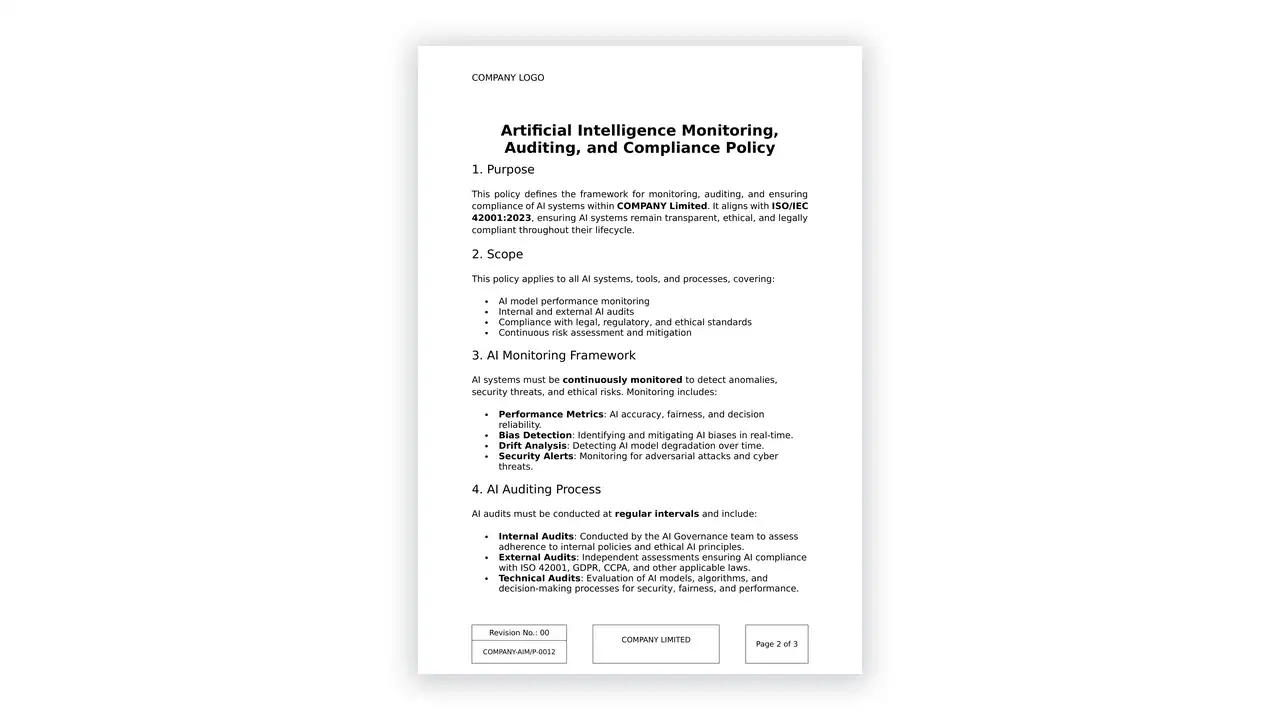
This pack documents an AI management system to ISO/IEC 42001:2023, with every template tied to the clause or the ISO 42001 Annex A controls it satisfies. 69 editable Word, Excel and PowerPoint files organised by clause, downloadable the moment you check out. On this page:
- What is in the toolkit
- Why the ISO 42001 Annex A controls are the part that gets tested
- Who needs ISO 42001 Annex A controls
- How the documents map to the framework
- Frequently asked questions
- Related toolkits
What is in the ISO 42001 Annex A controls pack
The filing follows the standard clause by clause, which is how a certification auditor works through an AIMS. The sections are:
- 00 Cross-Cutting – the AIMS manual, scope statement, AI policy and the documents that span every clause
- Clause 4 Context of the Organisation – internal and external issues, interested parties, the role you play in the AI value chain and the AIMS scope
- Clause 5 Leadership – AI policy, roles and responsibilities, and the accountability structure ISO 42001 expects above the technical team
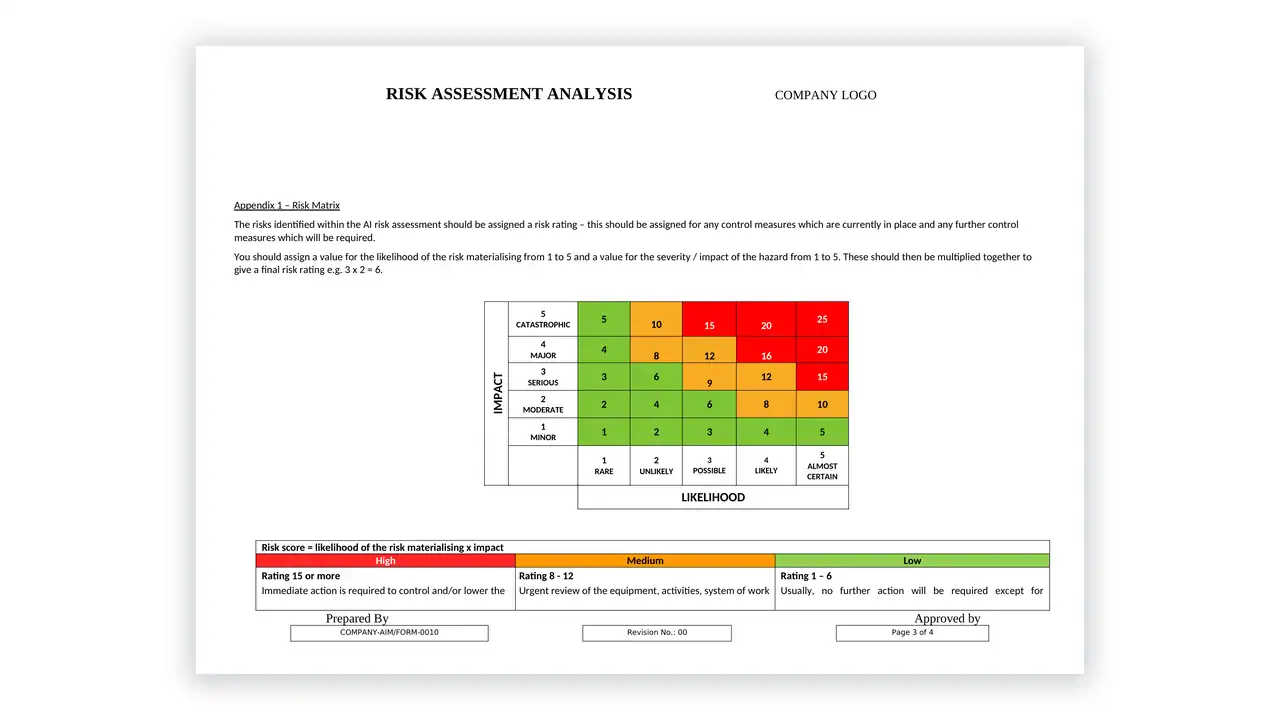
- Clause 6 Planning – AI risk assessment methodology, risk treatment, the AI impact assessment process and AIMS objectives
- Clause 7 Support – resources, competence, awareness, communication and control of documented information
- Clause 8 Operation – operational planning and control, the AI system lifecycle, impact assessment records and third party and supplier handling
- Clause 9 Performance Evaluation – monitoring, internal audit programme and management review
- Clause 10 Improvement – nonconformity, corrective action and continual improvement
Why the ISO 42001 Annex A controls are the part that gets tested
ISO/IEC 42001:2023 remains the first edition, published in December 2023, with no amendments. The clauses will look familiar to anyone who has run an ISO 27001 or ISO 9001 system, because it uses the same management system structure. What is genuinely new is Annex A.
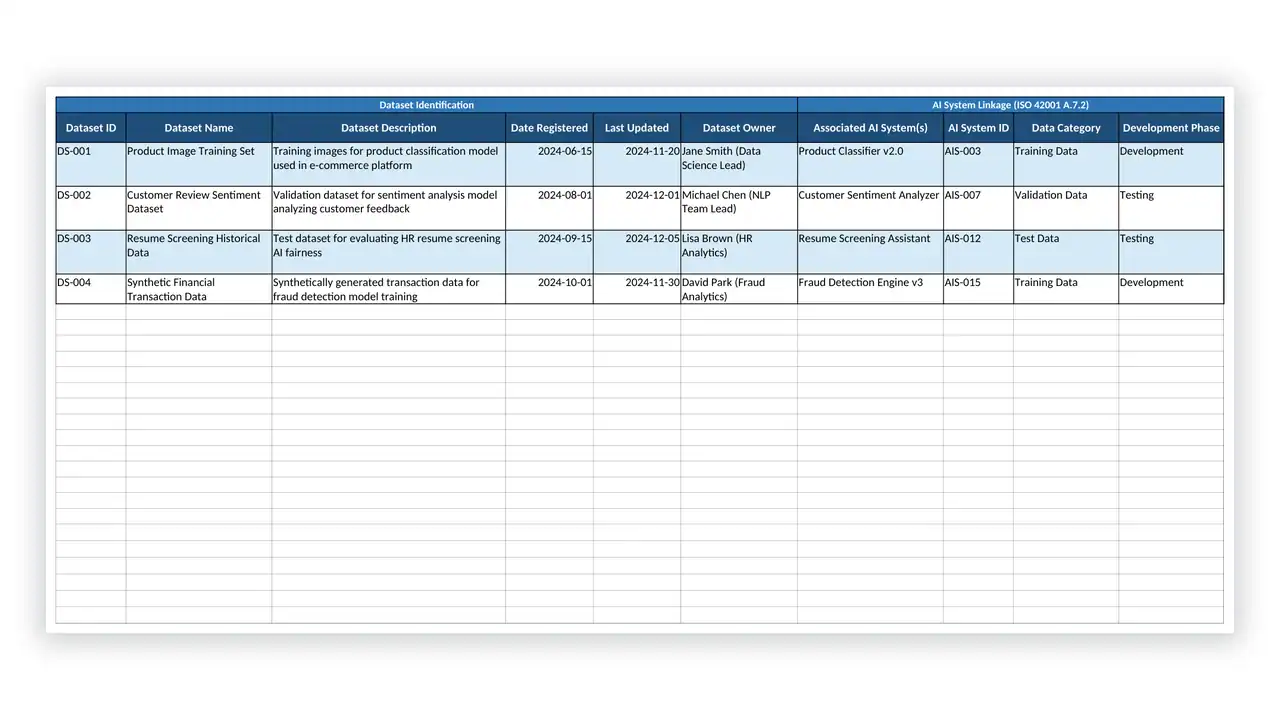
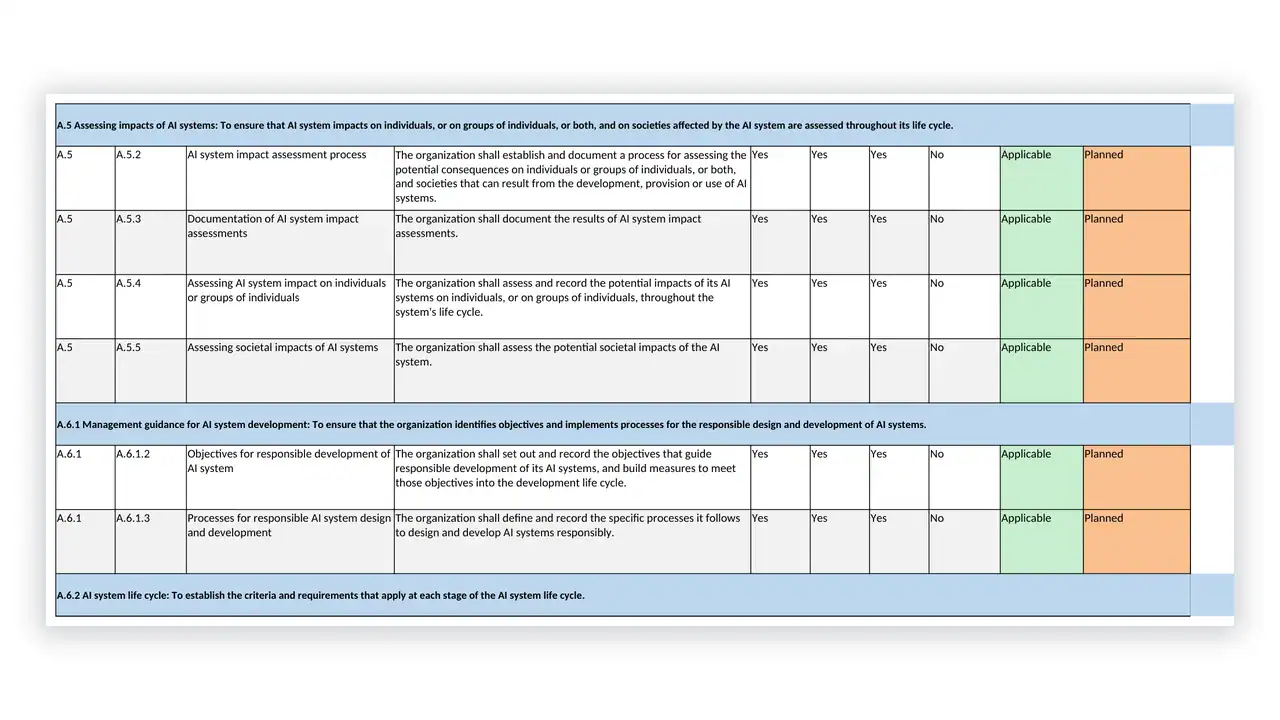
Annex A sets out controls specific to AI: impact assessment, data governance for training and evaluation data, system lifecycle management, transparency to affected parties, human oversight, and responsibilities across the AI value chain where you may be a provider, a deployer or both. These are where organisations run out of existing evidence, because nothing in an ISMS produces them.
The AI impact assessment is the document auditors probe hardest, because it shows you considered effects on individuals and groups rather than only risks to the organisation. It is included here as a worked process with a record template, not as a heading. You can confirm the current edition on the ISO/IEC 42001 page at iso.org.
Who needs ISO 42001 Annex A controls
Organisations building or deploying AI systems whose customers, regulators or boards now ask what governs them. Providers who want a certificate to answer procurement questionnaires rather than completing each one from scratch. Organisations in scope of the EU AI Act looking for a recognised management system to hang their compliance programme on. And teams already certified to ISO 27001 who want to reuse the management system and add only what AI requires.
How the ISO 42001 Annex A controls maps to the framework
Because the clause structure is shared with ISO 27001, an organisation holding both can run one management system with two scopes rather than two systems. The pack is written so the shared clauses can be merged, while the AI-specific material – impact assessment, lifecycle, data governance, human oversight – stays distinct, which is what an auditor needs to see separately.
Frequently asked questions
Which edition is this written to?
ISO/IEC 42001:2023, the first and current edition. No amendments have been published.
Does this cover the EU AI Act?
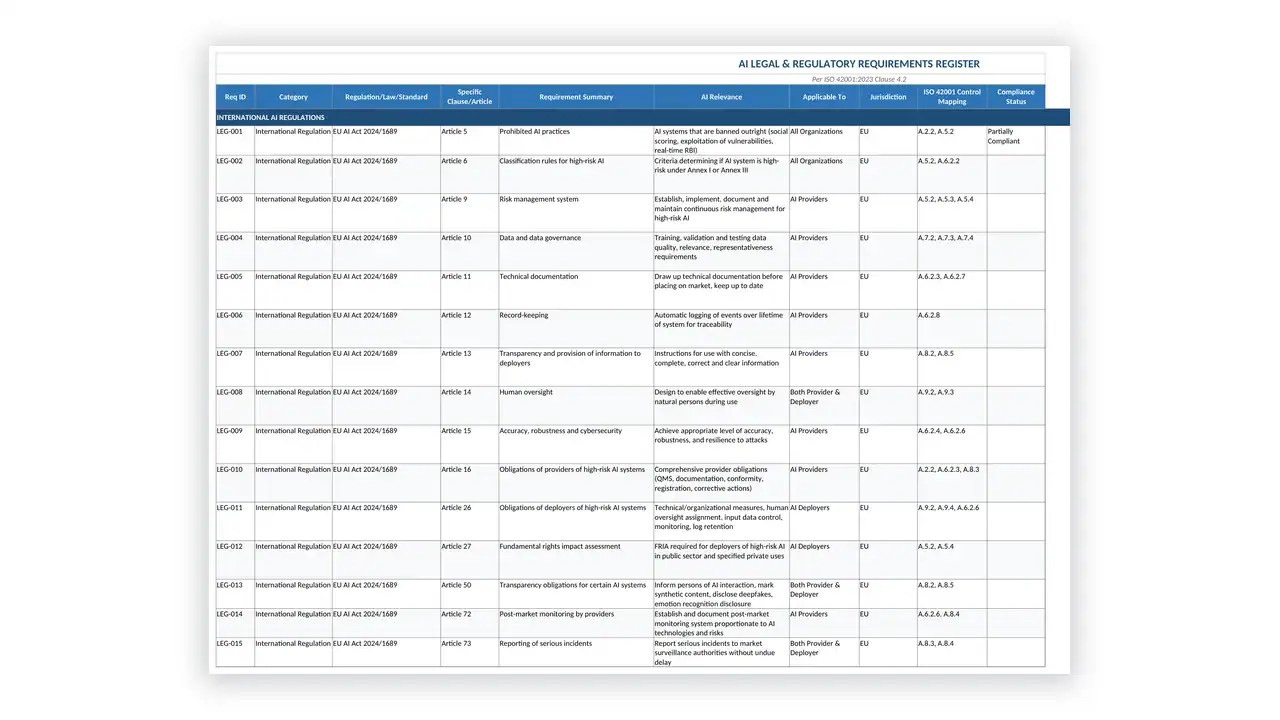
Not directly. ISO 42001 is a management system standard, the AI Act is law. They complement each other, and many organisations use the AIMS as the operating framework for AI Act compliance. For the legal obligations see the EU AI Act Toolkit.
We hold ISO 27001. How much extra work is this?
Less than starting fresh. Clauses 4 to 10 largely mirror what you already run. The new work is Annex A: impact assessment, AI data governance, lifecycle control, transparency and human oversight.
What is an AI impact assessment?
A documented assessment of the effects an AI system may have on individuals and groups, distinct from a risk assessment that looks at risk to the organisation. It is included here as a process with a record template.
How many documents are included?
69 editable templates – 53 Word documents, 15 Excel workbooks and a presentation – plus a read-me and a licence file.
Related toolkits
AI governance rarely sits alone. Pair this with the EU AI Act Toolkit for the European legal obligations, the NIST AI RMF Toolkit for the US risk framework, the ISO 27001 Toolkit for the shared management system and the Data Governance Toolkit for the training data lineage Annex A expects.
Implementing for clients? The Consultant Package licenses all 86 toolkits and assessment tools on this site for unlimited client engagements, under one firm-wide licence. One payment of $1,399, no subscription and no per-client fee.
Delivery, format and licence
Your ISO 42001 Annex A controls downloads immediately after checkout as native Microsoft Word and Excel files. Nothing is watermarked or locked, so you can rebrand the documents, bring them under your own document control and revise them for as long as you need them.
One-time purchase. No subscription and no annual renewal. Because the source files are yours, revising a procedure after an audit finding or a change of scope is an internal edit rather than another purchase.


Reviews
There are no reviews yet