
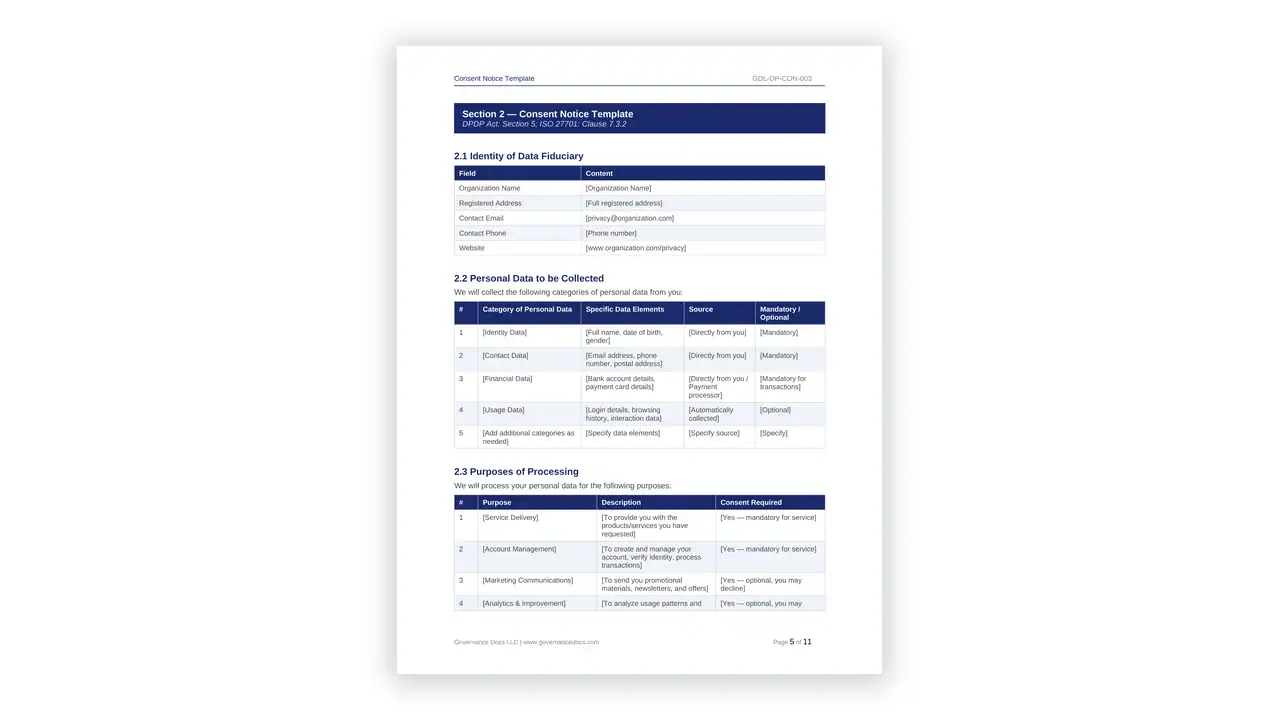
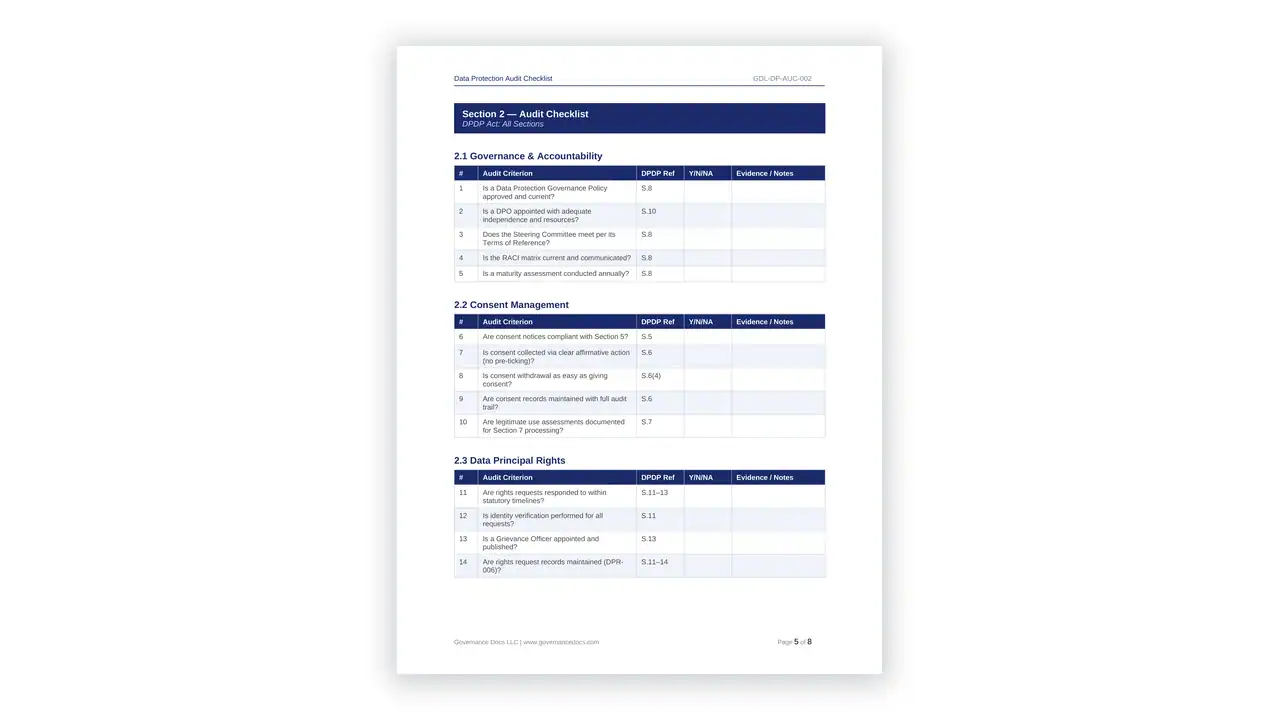
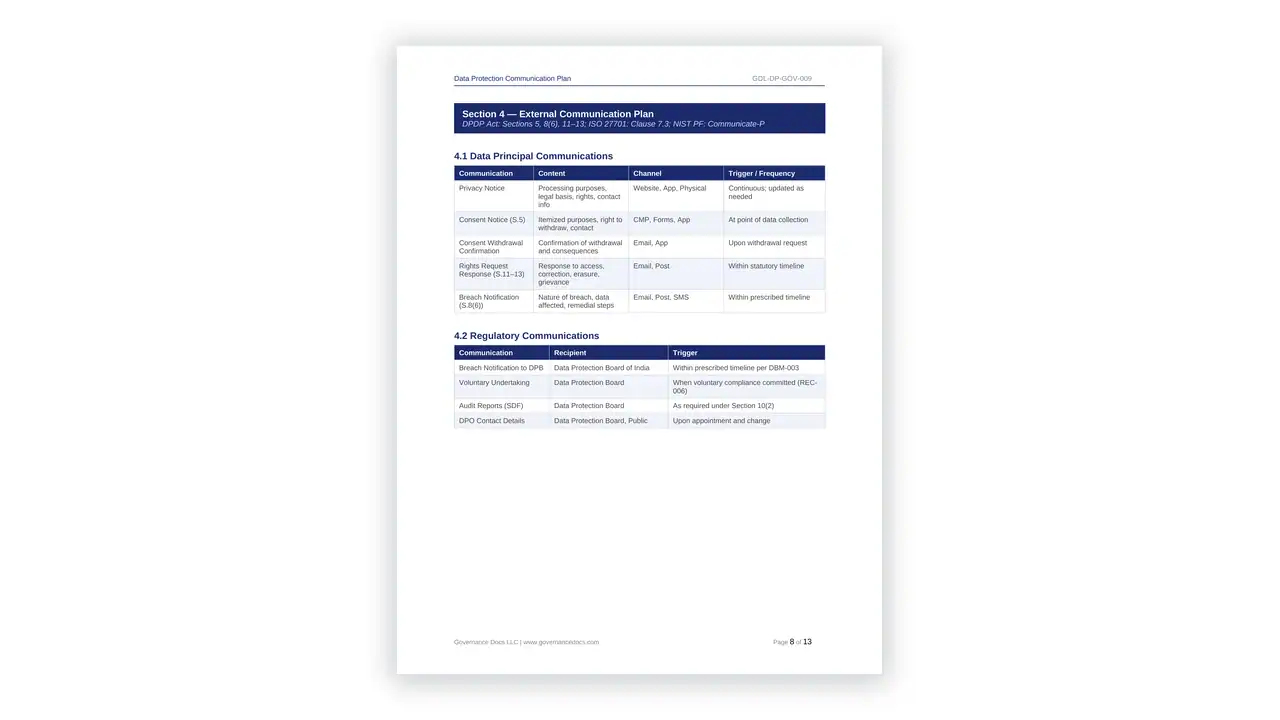
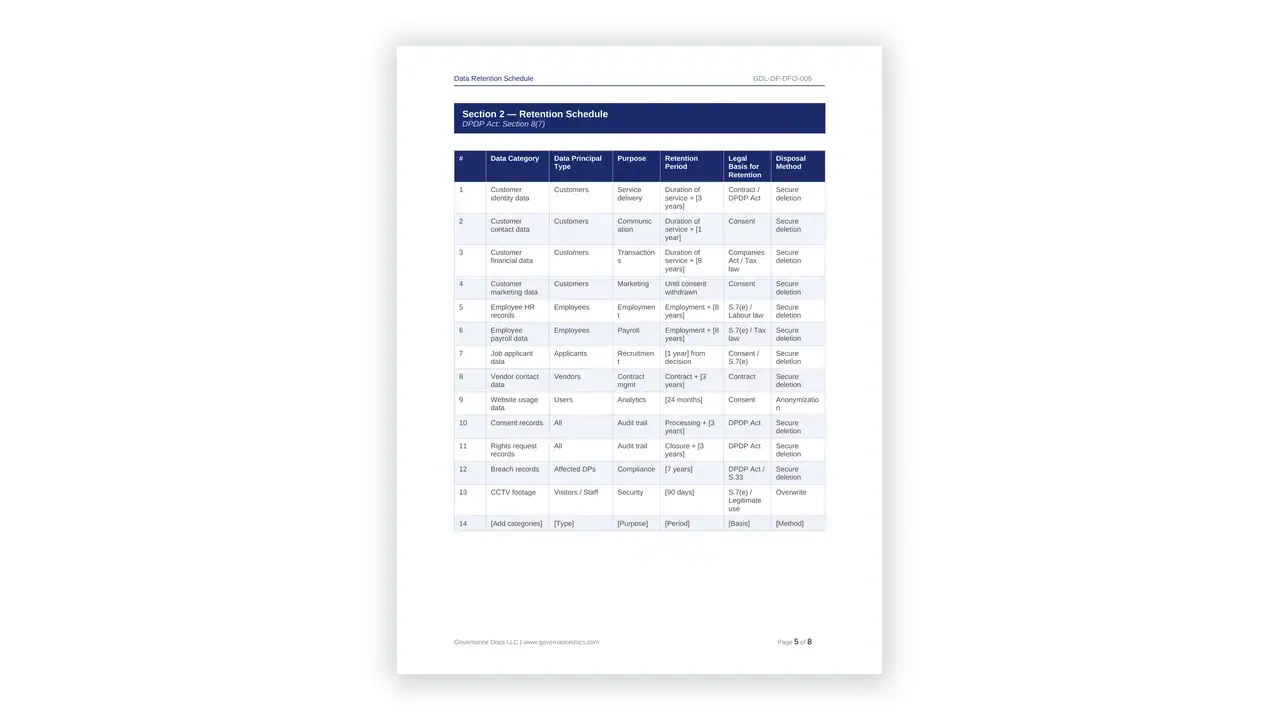
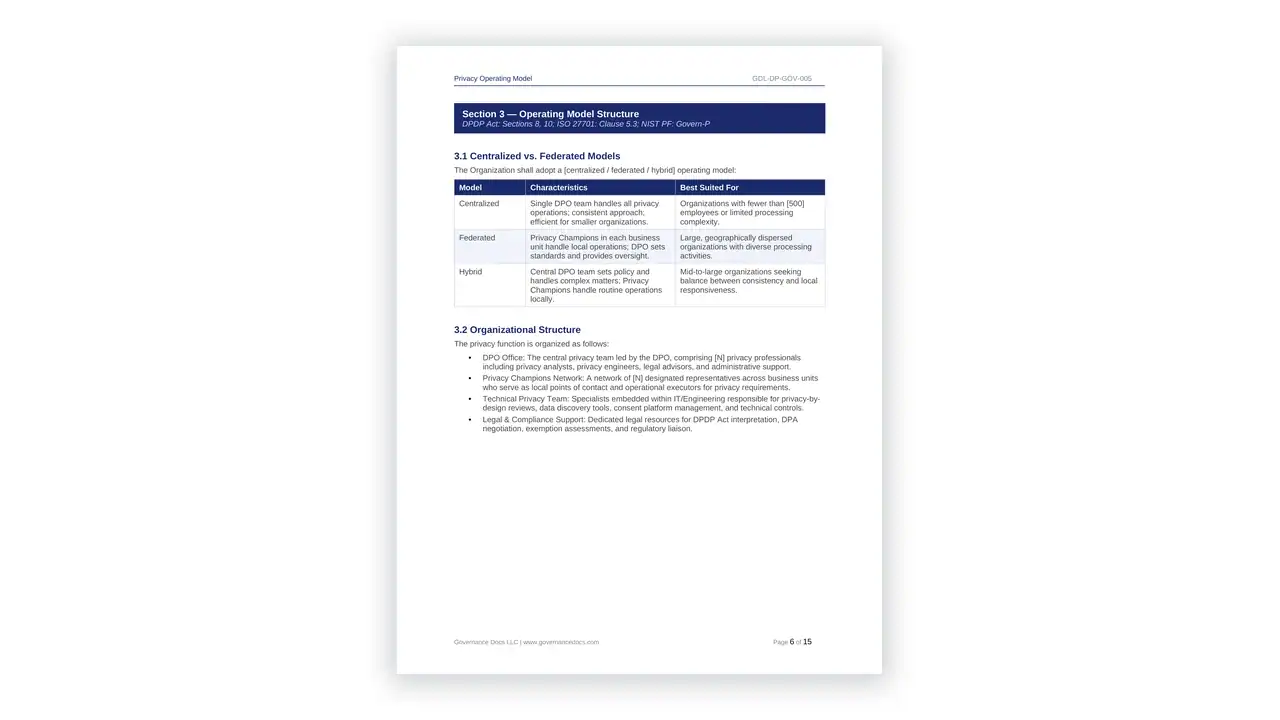
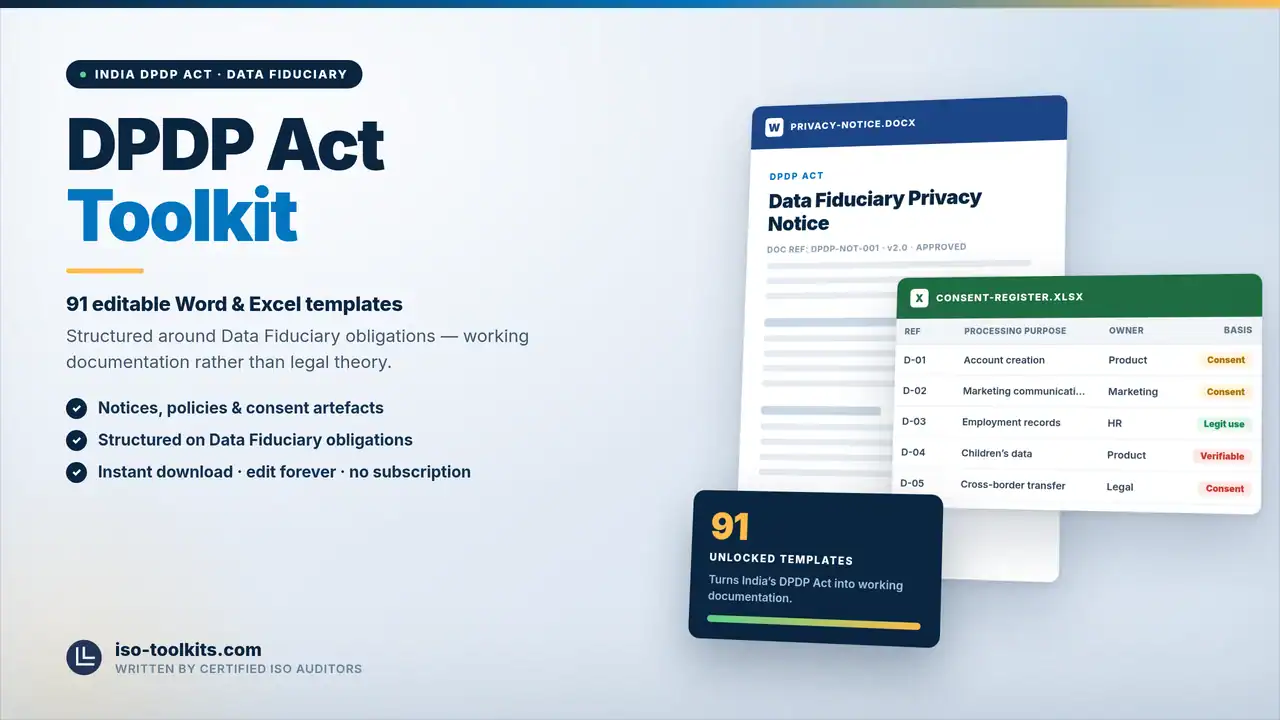
India moved from statute to operable law when the DPDP Rules 2025 were notified on 14 November 2025, putting real dates against obligations that had sat abstract since the Act passed in 2023. This pack is written to those Rules. 92 editable Word documents across fourteen sections, downloadable the moment you check out. On this page:
- What is in the DPDP Rules 2025 pack
- What the DPDP Rules 2025 actually put on the calendar
- Who needs DPDP Rules 2025
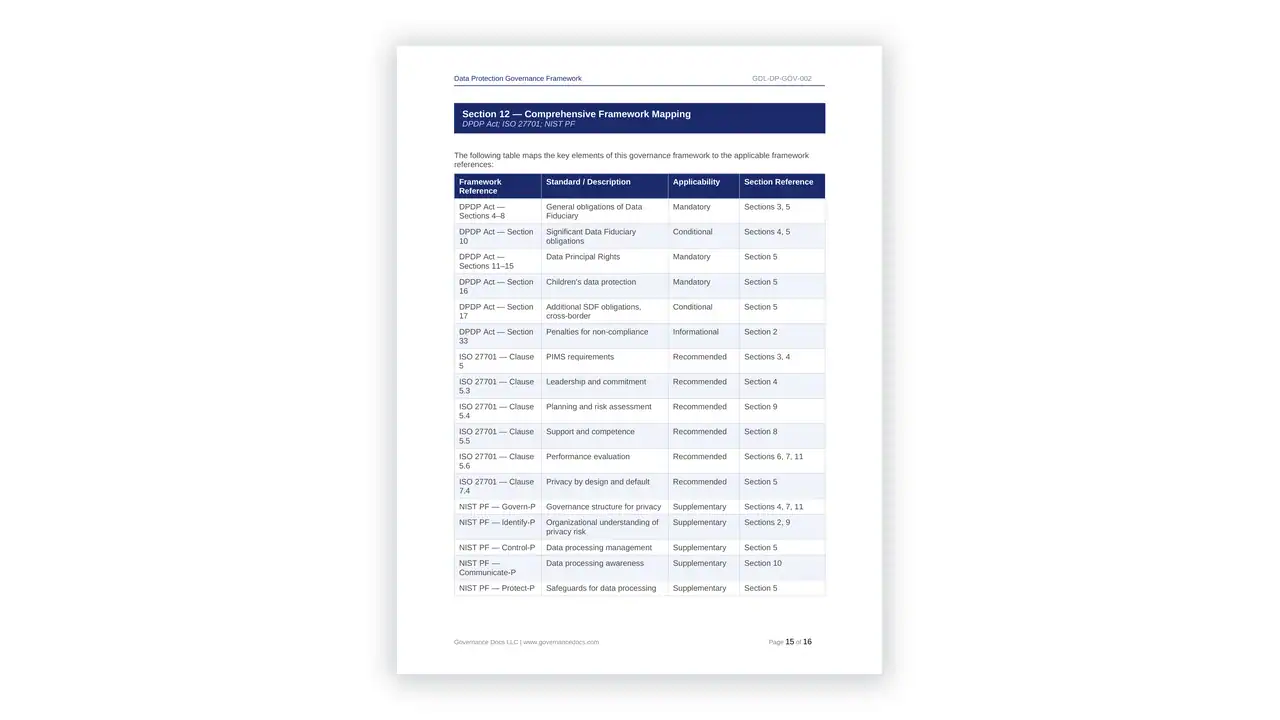
- How the documents map to the framework
- Frequently asked questions
- Related toolkits
What is in the DPDP Rules 2025 pack
Fourteen numbered sections, organised by the duties the Act and Rules impose:
- 1. Governance and Accountability – the privacy programme, the Data Protection Officer position for significant data fiduciaries, and the accountability records
- 2. Consent Management – notice content, consent capture and withdrawal, and the record of consent that the Rules require you to be able to produce
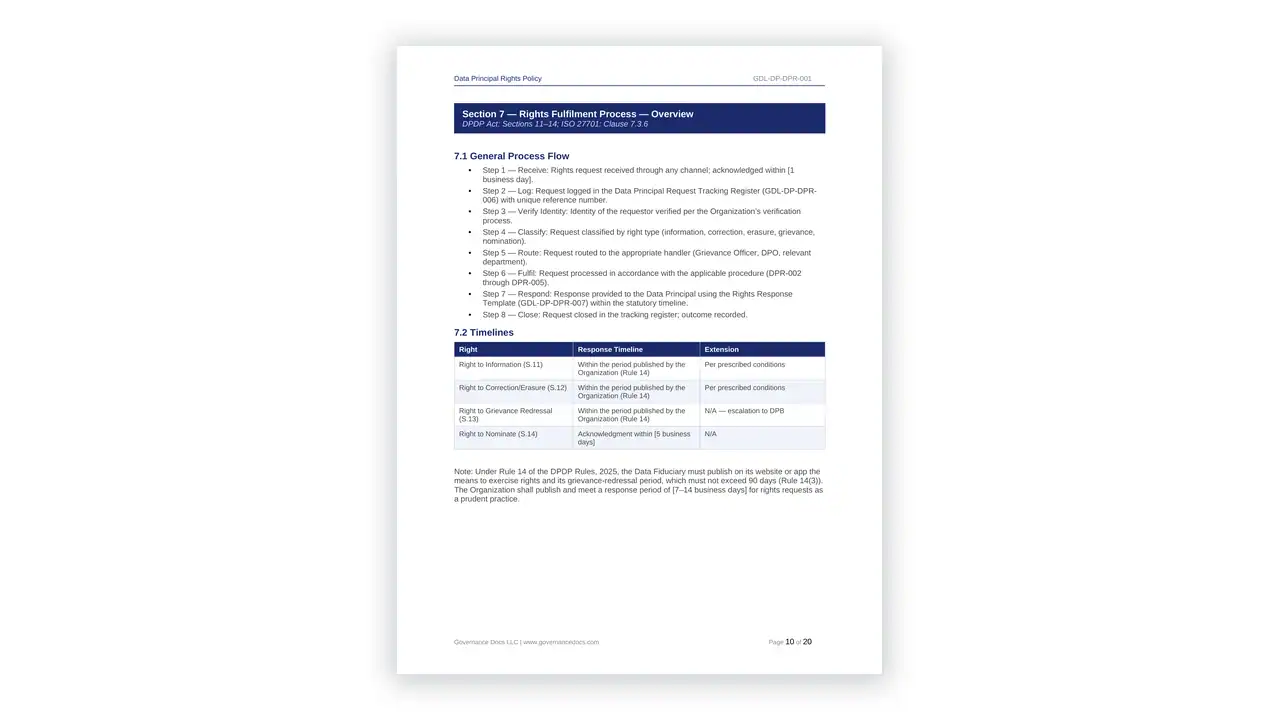
- 3. Data Principal Rights – access, correction, erasure, grievance redressal and nomination, with the response workflows behind each
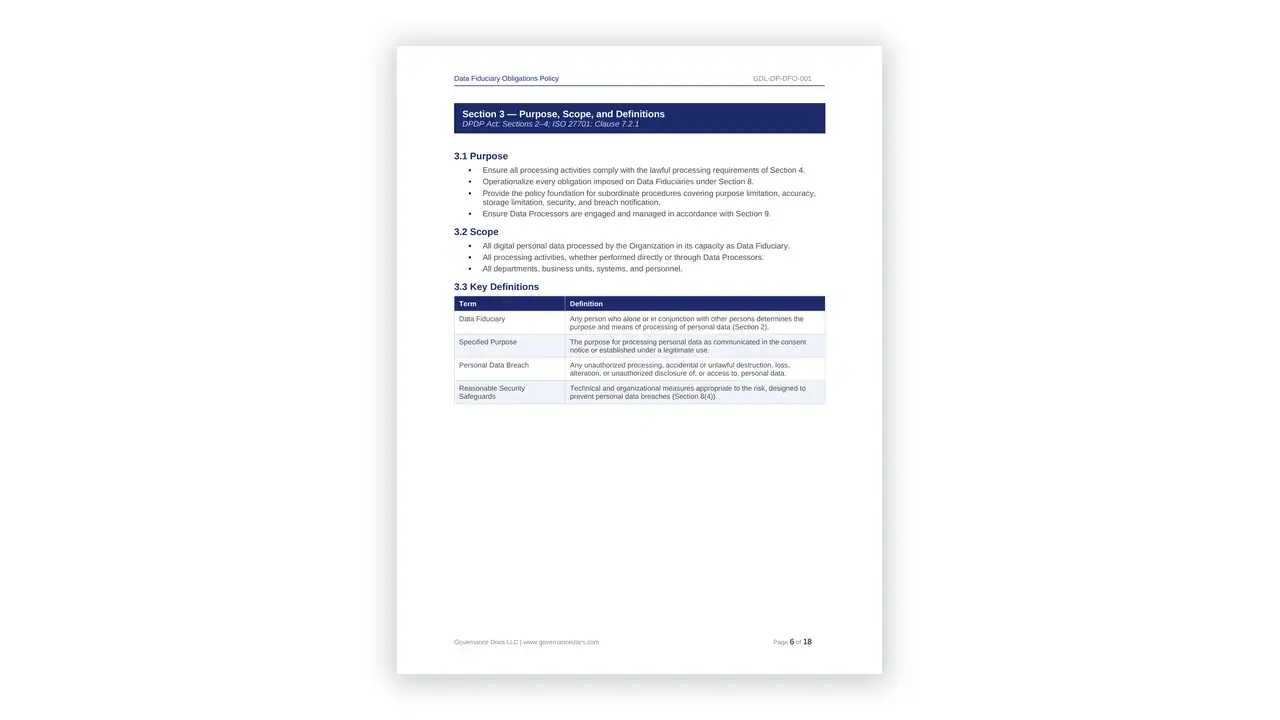
- 4. Data Fiduciary Obligations – purpose limitation, accuracy, retention and erasure duties, and the notice requirements
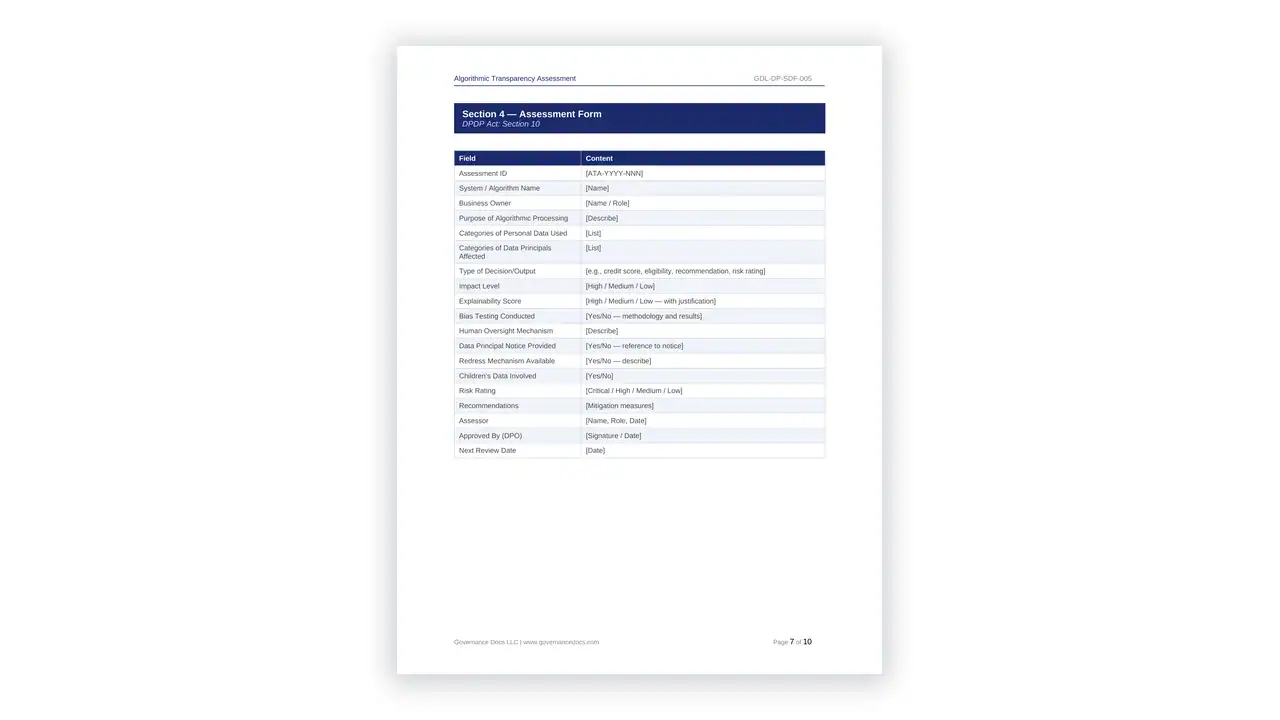
- 5. Significant Data Fiduciary – the additional duties triggered by designation, including DPO appointment, independent data auditor and algorithmic due diligence
- 6. Children Data Protection – verifiable parental consent, the prohibition on tracking and behavioural advertising directed at children
- 7. Cross-Border Data Transfer – the restricted-country position and the transfer documentation
- 8. Data Breach Management – the intimation to affected data principals and to the Data Protection Board, with the timelines the Rules set
- 9. Data Protection Impact Assessment – the assessment significant data fiduciaries must undertake
- 10. Data Processor Management – contractual terms, oversight and the processor register
- 11. Training and Awareness
- 12. Audit and Compliance – the independent data audit that significant data fiduciaries must arrange
- 13. Technical and Organizational Measures – the reasonable security safeguards the Rules specify
- 14. Records and Documentation – the registers that evidence the whole programme
What the DPDP Rules 2025 actually put on the calendar
The Digital Personal Data Protection Act was passed in 2023 but could not be complied with in any operational sense until the Rules arrived. Notified on 14 November 2025, they phase in.
The Data Protection Board was constituted immediately. The Consent Manager framework – the registered intermediary model that is genuinely distinctive to India – applies from 13 November 2026. And full compliance for Data Fiduciaries is required from 13 May 2027.
That last date is the one to plan against. It is far enough away to be ignored and close enough that a programme started late will not be ready, particularly for organisations that must build consent records, grievance redressal and breach intimation processes from nothing. The DPDP Rules 2025 also set out the security safeguards and breach timelines in specific terms, which removes the ambiguity that made earlier preparation difficult.
Who needs DPDP Rules 2025
Organisations processing digital personal data in India, and those outside India offering goods or services to data principals in India. Entities likely to be designated significant data fiduciaries, who face DPO appointment, independent audit and algorithmic due diligence on top of the baseline. And global businesses adding India to an existing GDPR programme, where the consent-led model differs enough to need its own documentation.
How the DPDP Rules 2025 maps to the framework
India is consent-led in a way GDPR is not – there is no broad legitimate interests basis to fall back on, so consent records and notice quality carry more weight. The Consent Manager concept has no European equivalent at all. Documents ported straight from a GDPR programme will not satisfy the Rules, which is why this set is written to the Indian structure rather than adapted.
Frequently asked questions
When do we have to comply?
Full compliance for Data Fiduciaries is required from 13 May 2027, with the Consent Manager framework applying from 13 November 2026. The Data Protection Board is already constituted.
What is a Consent Manager?
A registered intermediary through which data principals can give, manage, review and withdraw consent. It is distinctive to the Indian regime and has no direct GDPR equivalent.
How do we know if we are a significant data fiduciary?
Designation is by the central government on criteria including volume and sensitivity of data and risk to data principals. Section 5 covers the additional duties if you are designated or expect to be.
We already comply with GDPR. Is that enough?
No. The consent-led structure, the Consent Manager model, the grievance redressal duty and the breach intimation requirements all differ. See the GDPR Toolkit for the European side.
How many documents are included?
92 editable Word documents across fourteen sections, plus guidance and a licence file.
Related toolkits
Multi-jurisdiction privacy programmes need more than one set. See the GDPR Toolkit for Europe, the CCPA-CPRA Toolkit for California, the ISO 27701 Toolkit for a certifiable privacy management system that spans regimes, and the ISO 27001 Toolkit for the security safeguards. For the Gulf, the Saudi PDPL toolkit covers the Kingdom, and UK controllers need the UK GDPR toolkit.
Implementing for clients? The Consultant Package licenses all 86 toolkits and assessment tools on this site for unlimited client engagements, under one firm-wide licence. One payment of $1,399, no subscription and no per-client fee.
Delivery, format and licence
Your DPDP Rules 2025 downloads immediately after checkout as native Microsoft Word and Excel files. Nothing is watermarked or locked, so you can rebrand the documents, bring them under your own document control and revise them for as long as you need them.
One-time purchase. No subscription and no annual renewal. Because the source files behind the DPDP Rules 2025 are yours, revising a procedure after an audit finding or a change of scope is an internal edit rather than another purchase.


Reviews
There are no reviews yet.