
Most incident response documentation in circulation was written for a model NIST has retired. Revision 3 of SP 800-61, published on 3 April 2025, replaced the four-phase circle of 2012 with a Community Profile built on the six CSF 2.0 Functions. This incident response documentation is built on the new structure, and its guide translates the old phases for anyone who still asks in those terms.
On this page:
- Why incident response documentation written for Revision 2 no longer fits
- What is inside the incident response documentation pack
- Notification clocks: where incident response documentation usually goes wrong
- Thirteen playbooks and six exercises in the incident response documentation
- Who the incident response documentation pack is written for
- What the incident response documentation pack does not do
- Frequently asked questions
- Related toolkits
Why incident response documentation written for Revision 2 no longer fits
Revision 2 drew Preparation, Detection and Analysis, Containment, Eradication and Recovery, and Post-Incident Activity as a circle. Revision 3 organises incident response around Govern, Identify, Protect, Detect, Respond and Recover, and feeds lessons into improvement continuously rather than saving them for the end. A plan laid out on the four phases that cites “NIST 800-61” was written against the 2012 text.
The profile behind Revision 3 has 134 rows, each rated High, Medium or Low for incident response, and carries 106 Recommendations and 8 Considerations. This incident response documentation answers all 114 of them with a named document, and every one of the 51 High-priority rows as well. NIST publications are works of the United States Government, so each Word document opens with NIST’s own wording and the clause that answers it, not a paraphrase.
What is inside the incident response documentation pack
The incident response documentation pack is 93 editable templates across 14 sections, following the structure of Revision 3 rather than the old lifecycle.
- Programme foundation (4) – the guide and Rev 2 to Rev 3 transition, the Community Profile workbook with all 134 rows, the charter and the traceability register.
- Govern (9) – policy, roles and authorities, RACI, team operating model, supplier clauses and the obligations register.
- Identify and Protect (9) – asset and dependency prioritisation, risk criteria, role-based training, backup readiness, logging requirements and the jump kit.
- Detect (5) – monitoring coverage, alert triage and the criteria for declaring an incident.
- Respond (26) – the incident response plan, severity matrix, escalation, root cause analysis, chain of custody, communications, containment authority and eradication.
- Recover (6) – recovery plan, restoration integrity checks, sequencing, the end of recovery declaration and the after-action report.
- Playbooks (14) – a blank playbook framework plus 13 scenarios.
- Lessons learned (5) – post-incident review, the improvement register, a programme self-assessment and performance measures.
- Exercises (10) – exercise programme, facilitator guide, 6 scenarios, a briefing deck with speaker notes and the evaluation plan.
- Forms and logs (5) – report form, handling checklist, handler logbook, call tree and bridge call decision log.
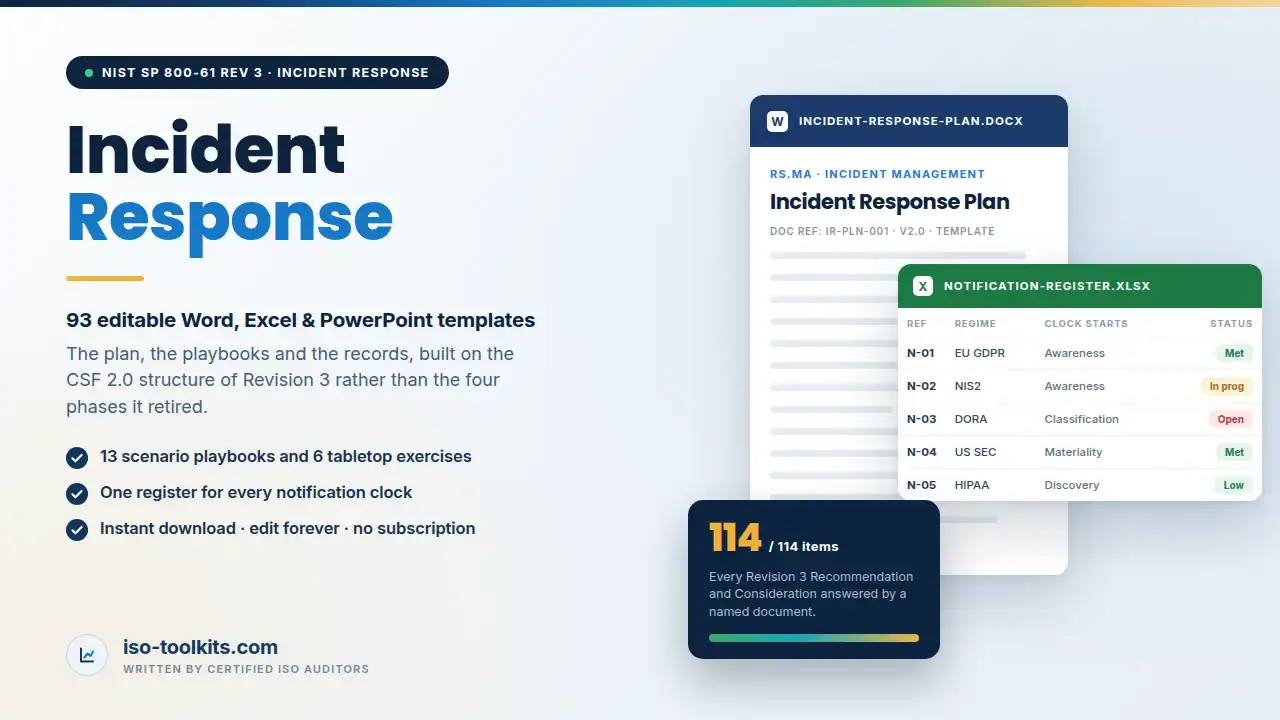
Notification clocks: where incident response documentation usually goes wrong
Notification deadlines do not all start from the same event. One runs from becoming aware, another from classifying the incident, another from determining materiality, and some count business days. A procedure that says “notify within N hours of the incident” cannot be right for all of them.
So no procedure in this incident response documentation states a statutory deadline. Every procedure points to one incident notification obligations register that records the trigger, the event the clock starts from and the deadline in separate columns. It ships with 17 worked examples covering EU GDPR, UK GDPR, NIS2, DORA, US SEC rules for public companies, HIPAA and the FTC Safeguards Rule, each read against the primary legal text on 22 October 2026.
Thirteen playbooks and six exercises in the incident response documentation
Revision 3 recommends documenting procedures for the incidents you are most likely to face. Every playbook follows one structure: first-hour actions and owners, decision points with criteria, evidence to preserve and notification triggers. The scenarios are ransomware, business email compromise, phishing and account takeover, data breach and exfiltration, malware outbreak, denial of service, insider threat, cloud and SaaS compromise, supplier compromise, web application compromise, lost or stolen device, exploited critical vulnerability, and identity platform compromise. The last exists because Revision 3 names redeploying the primary authentication platform as its example of an urgently needed procedure.
Any decision to pay or deal with a threat actor is reserved to the accountable executive with legal counsel, in every ransomware playbook example and related scenario that could raise it.
The tabletop exercise scenarios cover ransomware, business email compromise, cloud data breach, malicious insider, supplier compromise and an executive crisis decision.
Who the incident response documentation pack is written for
- Security teams replacing a plan that still follows the 2012 phases.
- Organisations whose customers, insurers or regulators ask to see the plan, the playbooks and evidence that they have been exercised.
- Teams under NIS2, DORA, HIPAA or SEC disclosure rules that need notification decisions recorded.
- Consultancies standing up an incident response capability for clients.
What the incident response documentation pack does not do
It does not make you “800-61 compliant”, because no such status exists. SP 800-61 is guidance with no certificate and no accredited assessor. The accurate phrase is NIST 800-61 Rev 3 alignment, and the pack gives you the decisions, logs, exercise results and improvement actions that show it working.
It is not legal advice. The notification register records worked examples; your counsel confirms what applies to you. It is also not a framework-specific toolkit, and does not map itself to ISO 27001 Annex A or the SOC 2 criteria.
Frequently asked questions
Is this based on SP 800-61 Revision 2 or Revision 3?
Revision 3, published 3 April 2025, which superseded Revision 2. The guide maps the old phases onto the new structure.
Do I need to buy SP 800-61?
No. It is free from NIST, and the wording of every Recommendation and Consideration is reproduced in the pack with attribution.
I already own the NIST CSF pack. Is this duplication?
Partly, and it is better to say so. The CSF pack includes an incident response plan and policy written to the CSF outcomes. This is the operational layer underneath: playbooks, exercises, severity and declaration criteria, forms, logs and the notification register.
What formats are the files in?
Native Microsoft Word, Excel and PowerPoint, fully editable, with no locked PDFs and no macros.
Related toolkits
It pairs naturally with the NIST CSF 2.0 pack for the wider framework, the ISO 27001 toolkit for a certifiable system, and the DORA toolkit and NIS2 toolkit where reporting is regulated. NIST publishes SP 800-61 Revision 3 free of charge.
Implementing for clients? The Consultant Package licenses all 93 toolkits and assessment tools on this site for unlimited client engagements, under one firm-wide licence. One payment of $1,399, no subscription and no per-client fee.
Delivery, format and licence
The incident response documentation pack downloads immediately after checkout as native Microsoft Word, Excel and PowerPoint files. Nothing is locked, nothing is a PDF you cannot edit, and no add-on or portal login is needed to open them. Every organisation-specific value is marked as a placeholder so you can see what still has to be decided.
One payment, no subscription and no annual renewal. The source files are yours to adapt for your own organisation for as long as you need them, including future revisions of your own documents.


Reviews
There are no reviews yet