
Medical laboratories are accredited, not certified. An accreditation body assesses you against ISO 15189:2022 and grants accreditation for a defined scope: named examinations, on named sample types, by named methods, at named locations. This ISO 15189 documentation set is built around that reality.
On this page:
- Clause 4.3 runs to the patient, and it is where packs quietly skip the work
- What is inside the ISO 15189 documentation pack
- The fourth edition changed three things, and the clause 8 decision comes first
- Who the ISO 15189 documentation pack is written for
- What the ISO 15189 documentation pack does not do
- Frequently asked questions
- Related toolkits
Clause 4.3 runs to the patient, and it is where packs quietly skip the work
The standard states its objective as the welfare of the patient, and clause 4.3 places obligations on the laboratory that run to the patient rather than to the clinician who requested the examination. That clause has no equivalent in ISO/IEC 17025. A laboratory pack adapted from a testing-laboratory template will have nothing behind it.
An examination outside your accredited schedule is not accredited work, however well it is performed. So the schedule itself – what you are accredited for, on which sample types, by which methods, at which locations – is the document everything else has to stay consistent with, and it is kept as a live register here rather than as a static appendix.
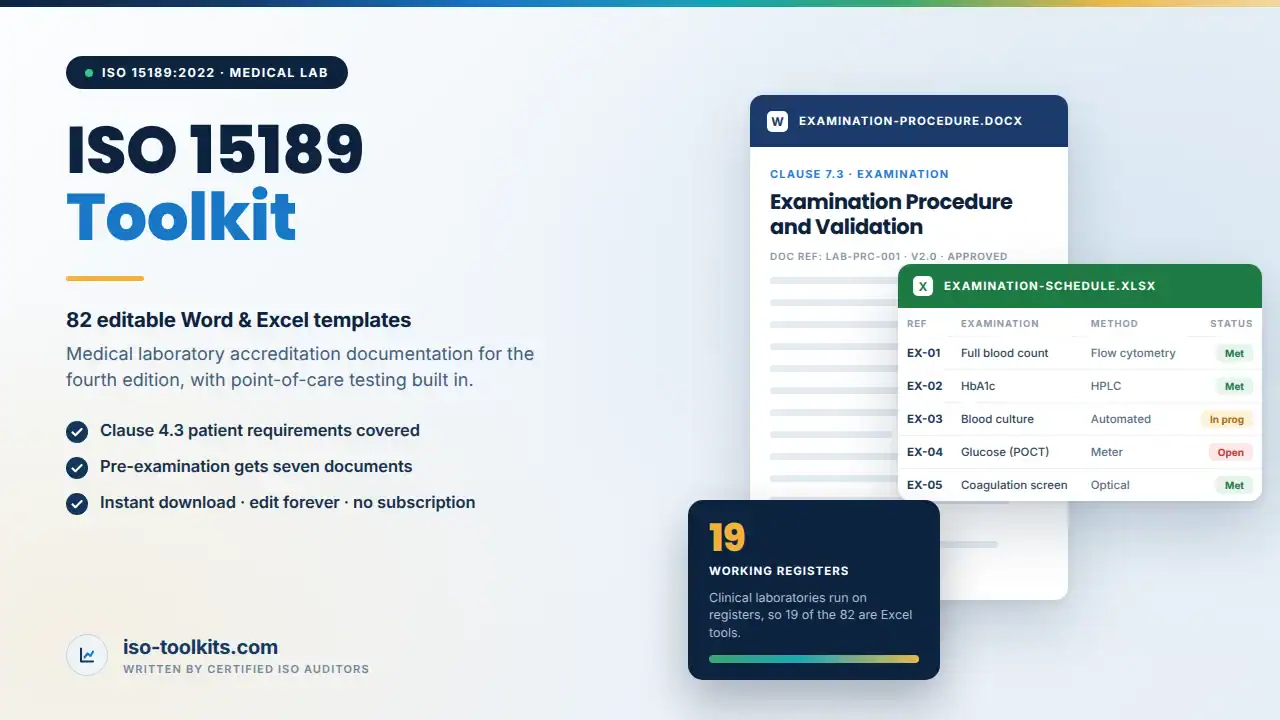
Clinical laboratories run on registers: examination schedules, competence authorisations, calibration status, reagent lots, sample rejections, critical value notifications, point-of-care devices and operators. That is why 19 of the 82 documents in this ISO 15189 documentation are working Excel tools rather than prose.
What is inside the ISO 15189 documentation pack
82 templates following the 2022 clause order, so the folder list reads as an implementation sequence rather than a translation exercise.
- Clause 4 – impartiality, confidentiality and the requirements relating to patients, which is where the standard differs most from 17025.
- Clause 5 – structure and governance, including risk management, which sits among the governance documents because that is where clause 5.6 puts it.
- Clause 6 – resource requirements: personnel and competence, facilities, equipment, calibration and metrological traceability, reagents and consumables, and service agreements.
- Pre-examination – seven documents rather than one, covering request, collection, transport, receipt, acceptance and rejection, and pre-examination storage.
- Examination – method selection, verification and validation, measurement uncertainty, biological reference intervals and quality control.
- Post-examination – review, release, critical result notification, reporting and retained sample handling.
- Nonconforming work – identification, control, corrective action and the reporting that follows.
- Point-of-care testing – its own section covering the Annex A requirements absorbed from the withdrawn ISO 22870:2016.
- Clause 8 – the management system, with the Option A and Option B decision taken first.
- Nineteen registers – schedules, authorisations, calibration status, reagent lots, rejections, notifications and POCT device and operator records.
The fourth edition changed three things, and the clause 8 decision comes first
ISO 15189:2022 is the fourth edition, published December 2022. It withdrew both ISO 15189:2012 and ISO 22870:2016, the separate point-of-care testing standard, whose requirements were absorbed into it. ISO own summary of the changes names three: alignment with ISO/IEC 17025:2017, which moved the management requirements to the end of the document; the incorporation of point-of-care testing; and increased emphasis on risk management.
All three shape how this ISO 15189 documentation is built. Risk management sits among the governance documents, point-of-care testing gets its own section rather than a paragraph, and the clause order follows the 2022 structure.
The clause 8 decision comes before anything else is drafted, because it governs how much of the management system you write yourself. A determination procedure records the choice and the evidence for it, and only then does the management system section get populated.
Who the ISO 15189 documentation pack is written for
- Medical and clinical laboratories seeking or holding accreditation to ISO 15189:2022.
- Laboratories transitioning from the 2012 edition, or from ISO 22870 for point-of-care testing.
- Hospital laboratory managers and quality officers preparing for an assessment visit.
- Point-of-care testing coordinators who now sit inside the main standard rather than beside it.
What the ISO 15189 documentation pack does not do
It does not accredit you. An accreditation body does that, after assessment.
It does not validate your methods. The ISO 15189 documentation supplies the validation and verification templates and the records structure; the analytical work is yours.
It is not ISO 17025. Testing and calibration laboratories have a different standard and a different pack, and clause 4.3 is the clearest reason the two are not interchangeable.
Frequently asked questions
Does it cover point-of-care testing?
Yes, as its own section, covering the Annex A requirements that came in when ISO 22870:2016 was withdrawn.
We are accredited to the 2012 edition. What changes?
The management requirements moved to the end, point-of-care testing came in, and risk management got much more emphasis. The pack is built on the 2022 structure so the transition reads as a sequence rather than a remapping exercise.
Can we use the ISO 17025 pack instead?
Not really. Clause 4.3 on requirements relating to patients has no 17025 equivalent, and it is assessed.
What formats are the files in?
Native Microsoft Word and Excel, fully editable, with placeholders marked throughout.
Related toolkits
Testing and calibration laboratories need the ISO 17025 toolkit instead. Laboratories running in vitro diagnostics under the EU regime also use the EU IVDR toolkit, and many add the ISO 9001 toolkit for the wider organisation. ISO publishes the standard at iso.org.
Implementing for clients? The Consultant Package licenses all 86 toolkits and assessment tools on this site for unlimited client engagements, under one firm-wide licence. One payment of $1,399, no subscription and no per-client fee.
Delivery, format and licence
The ISO 15189 documentation pack downloads immediately after checkout as native Microsoft Word and Excel files. Nothing is locked, nothing is a PDF you cannot edit, and no add-on or portal login is needed to open it. Every organisation-specific value is marked as a placeholder so you can see what still has to be decided.
One payment, no subscription and no annual renewal. The source files behind the ISO 15189 documentation pack are yours to adapt for your own organisation for as long as you need them, including future revisions of your own documents.


Reviews
There are no reviews yet.