
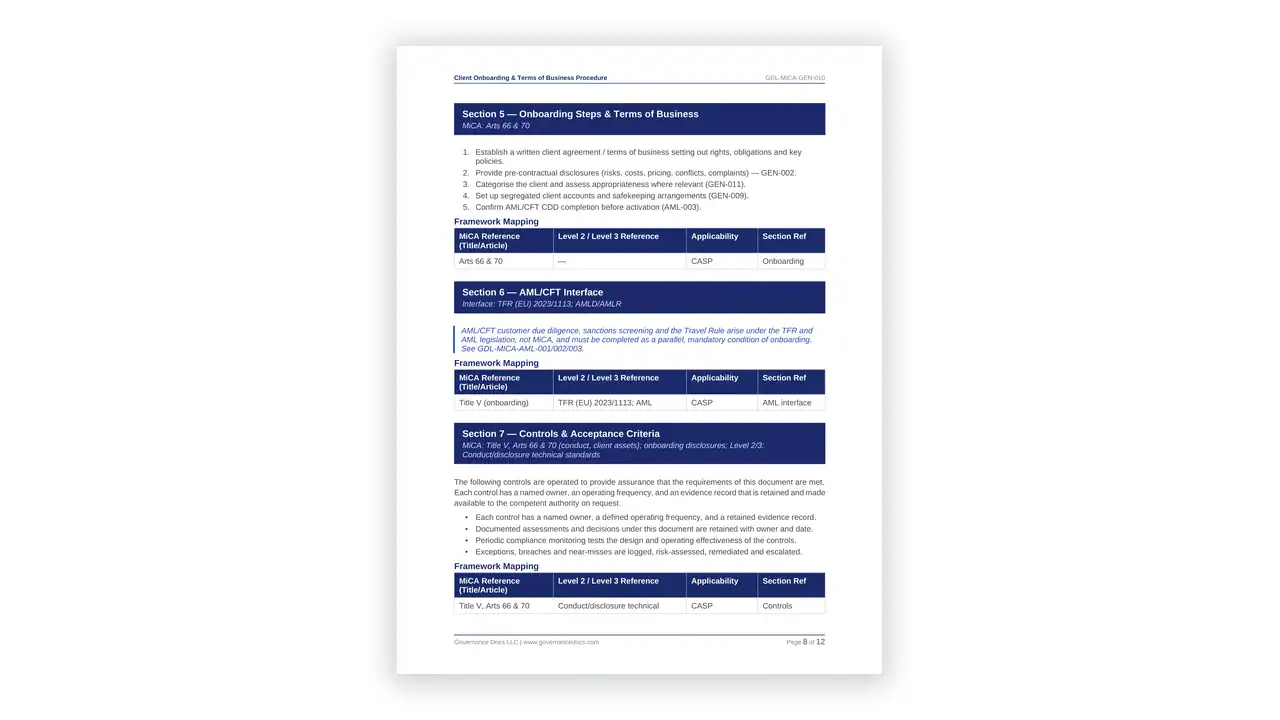
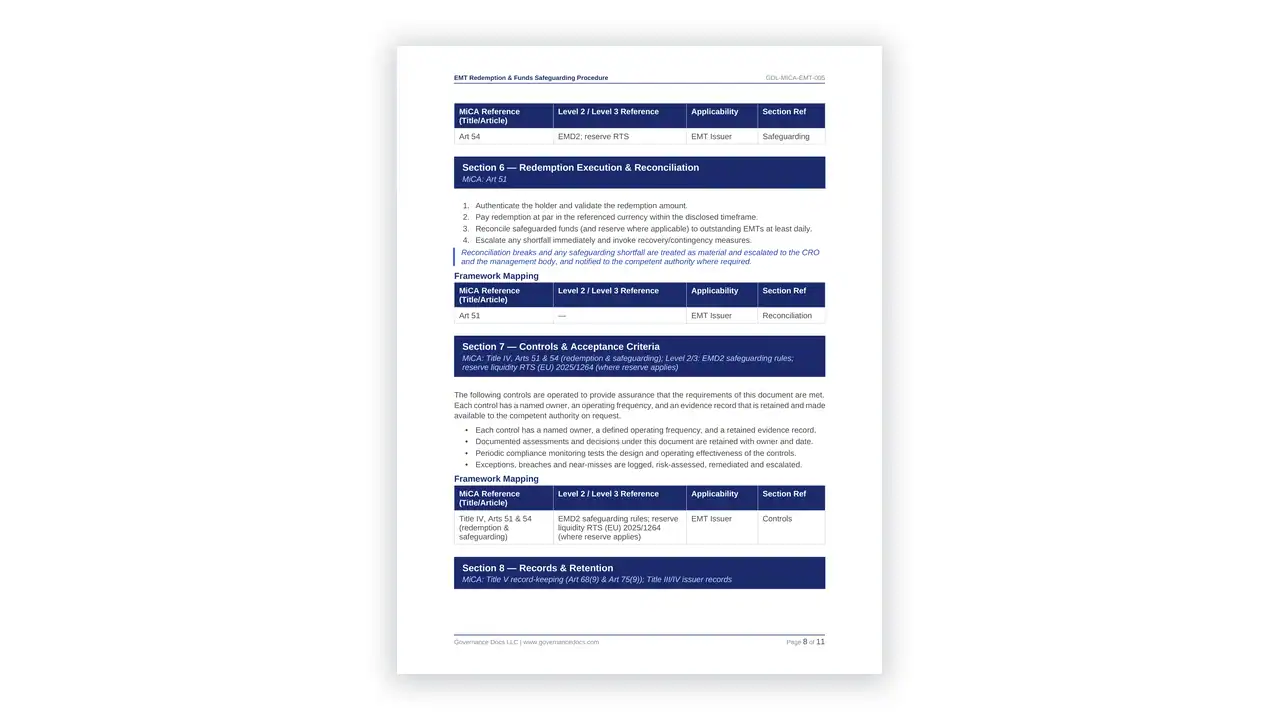
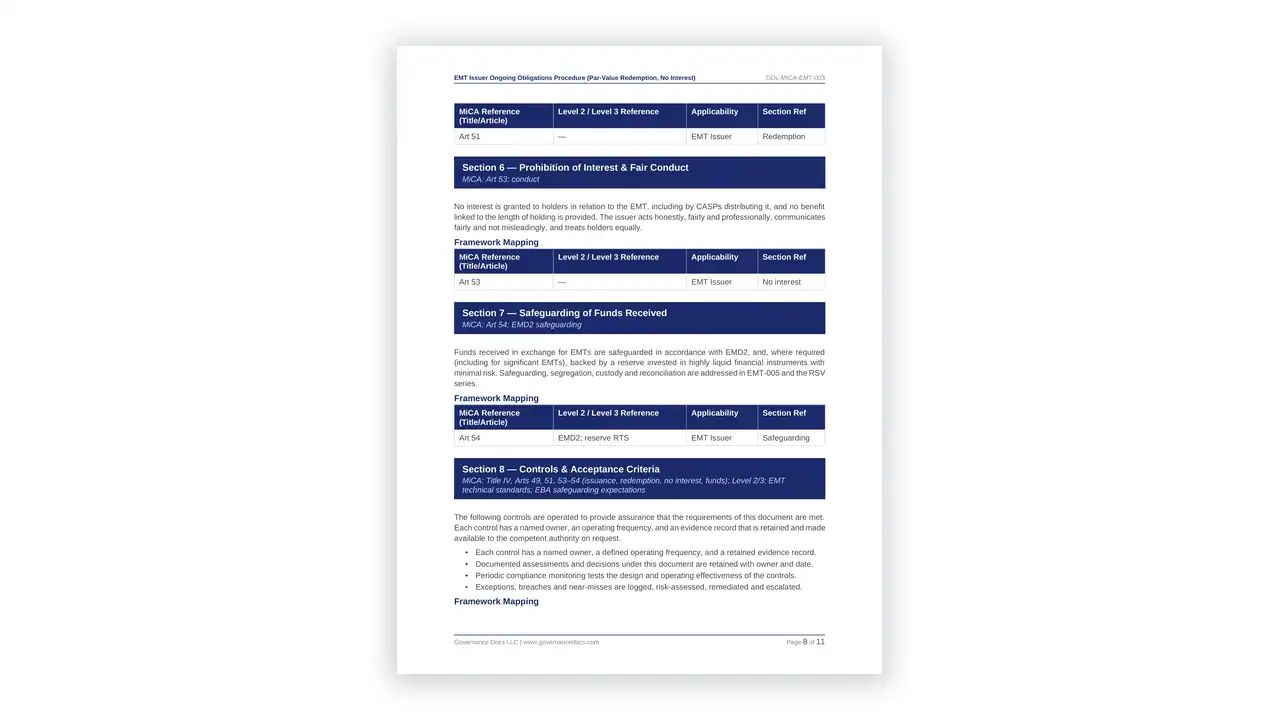
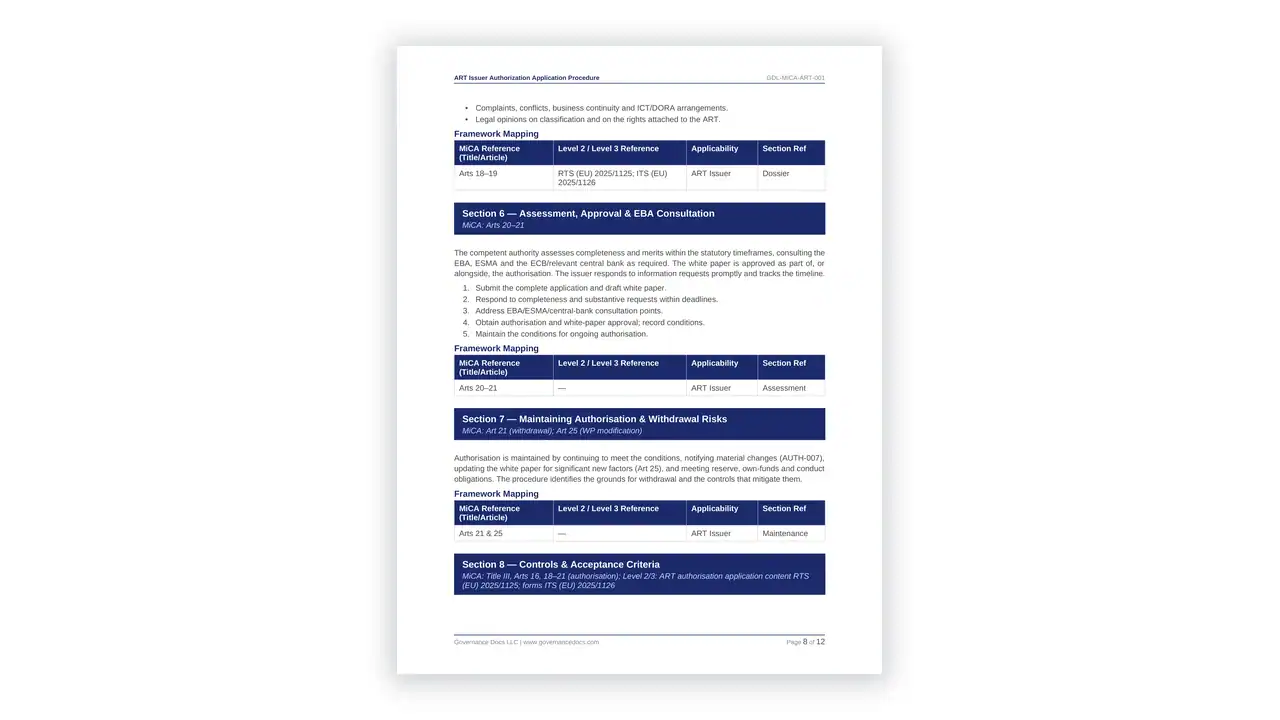
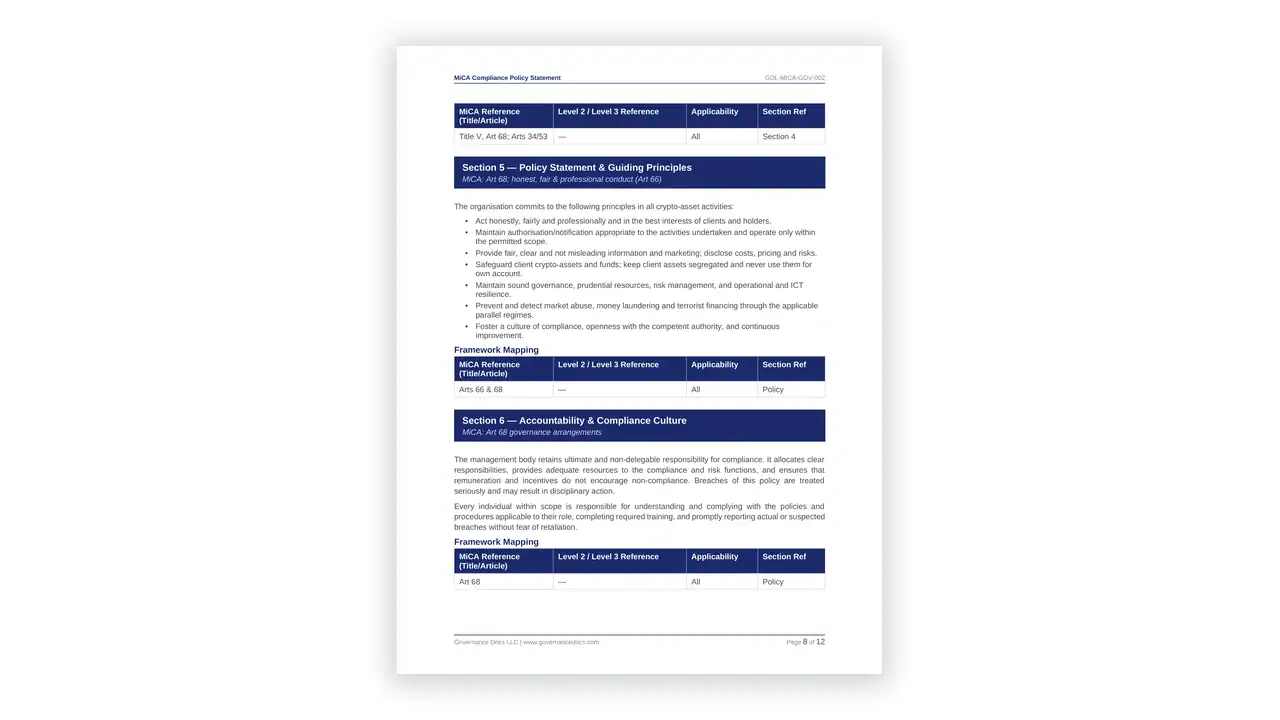
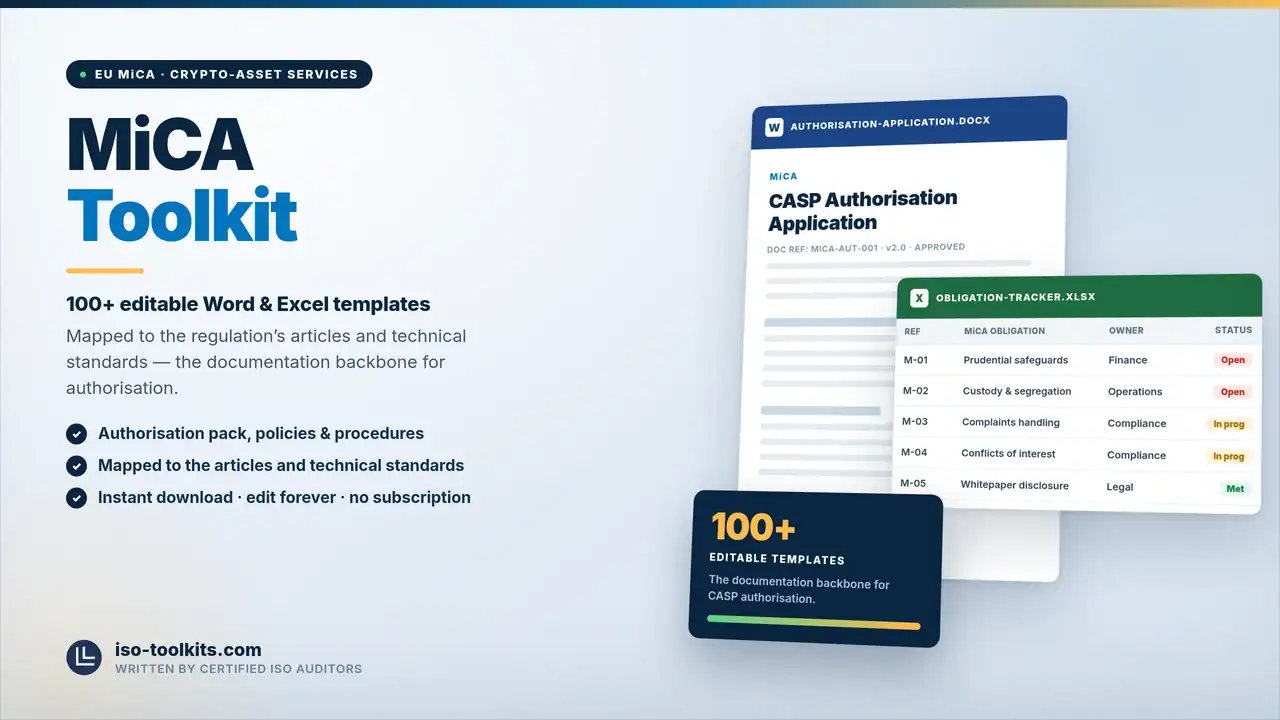
The transitional period closed on 1 July 2026, so operating as a crypto-asset service provider in the EU now means holding an authorisation. This pack provides the CASP authorisation dossier and the operating documentation that has to sit behind it. 104 editable documents across nineteen sections, downloadable the moment you check out. On this page:
- What is in the CASP authorisation dossier pack
- The MiCA transitional period has ended
- Who needs CASP authorisation dossier
- How the documents map to the framework
- Frequently asked questions
- Related toolkits
What is in the CASP authorisation dossier pack
The sections follow the Titles of the Regulation and then the individual CASP service types, because your obligations depend on which services you are authorised for:
- 01 Programme Foundation and Governance – governance arrangements, fit and proper assessments, organisational structure and the conflicts of interest policy
- 02 White Paper and Public Offering, Title II – crypto-asset white paper content, notification and the marketing communications rules
- 03 Asset-Referenced Tokens, Title III – the ART authorisation and ongoing obligations
- 04 E-Money Tokens, Title IV – the EMT position and its interaction with e-money rules
- 05 Reserve of Assets and Issuer Prudential – reserve composition, custody, segregation and the own funds requirements for issuers
- 06 CASP Authorization and Notification, Title V – the authorisation dossier itself, plus the notification route for entities already authorised under other regimes
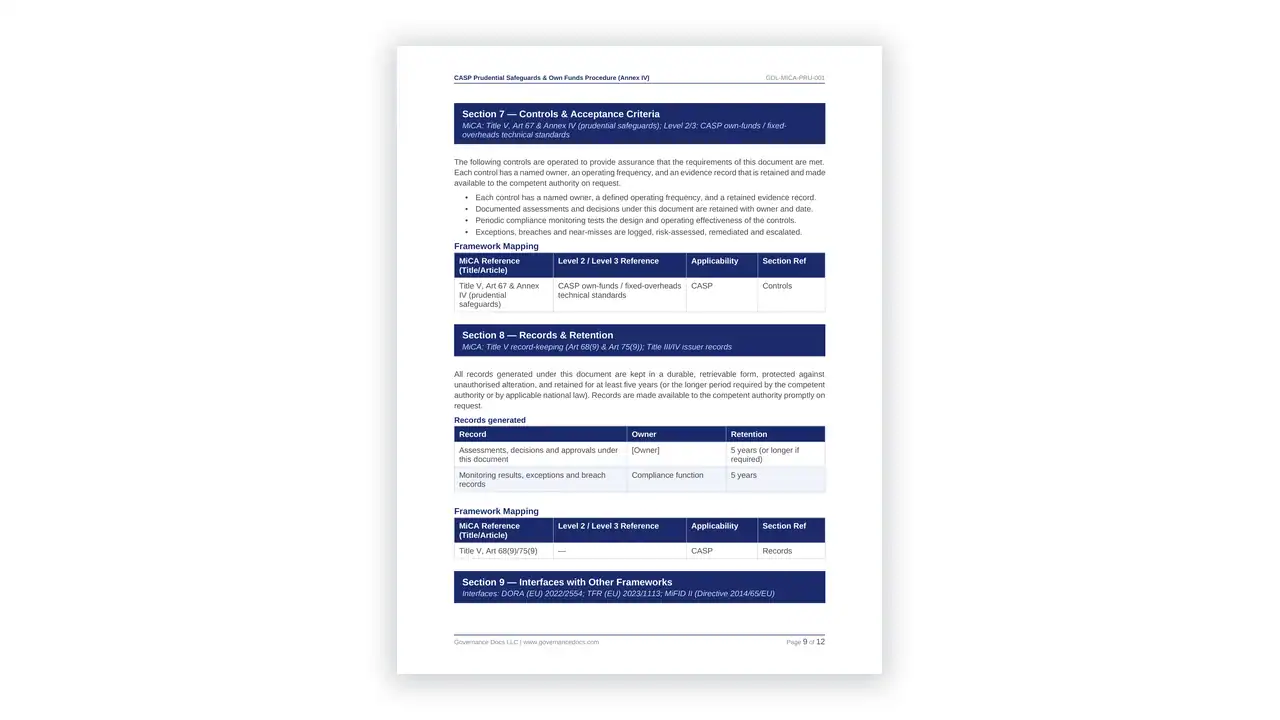
- 07 CASP Prudential and Own Funds – the permanent minimum capital and the fixed overheads calculation
- 08 CASP Common Operating Conditions – the duties every CASP owes regardless of service: honest and fair conduct, information to clients, safeguarding, complaints, outsourcing
- 09 Custody and Administration – the segregation, custody policy and liability position
- 10 Operation of a Trading Platform – operating rules, market surveillance and settlement
- 11 Exchange Services – pricing policy and execution
- 12 Order Handling – execution, reception and transmission, and placing
- 13 Advice and Portfolio Management – suitability, competence and reporting
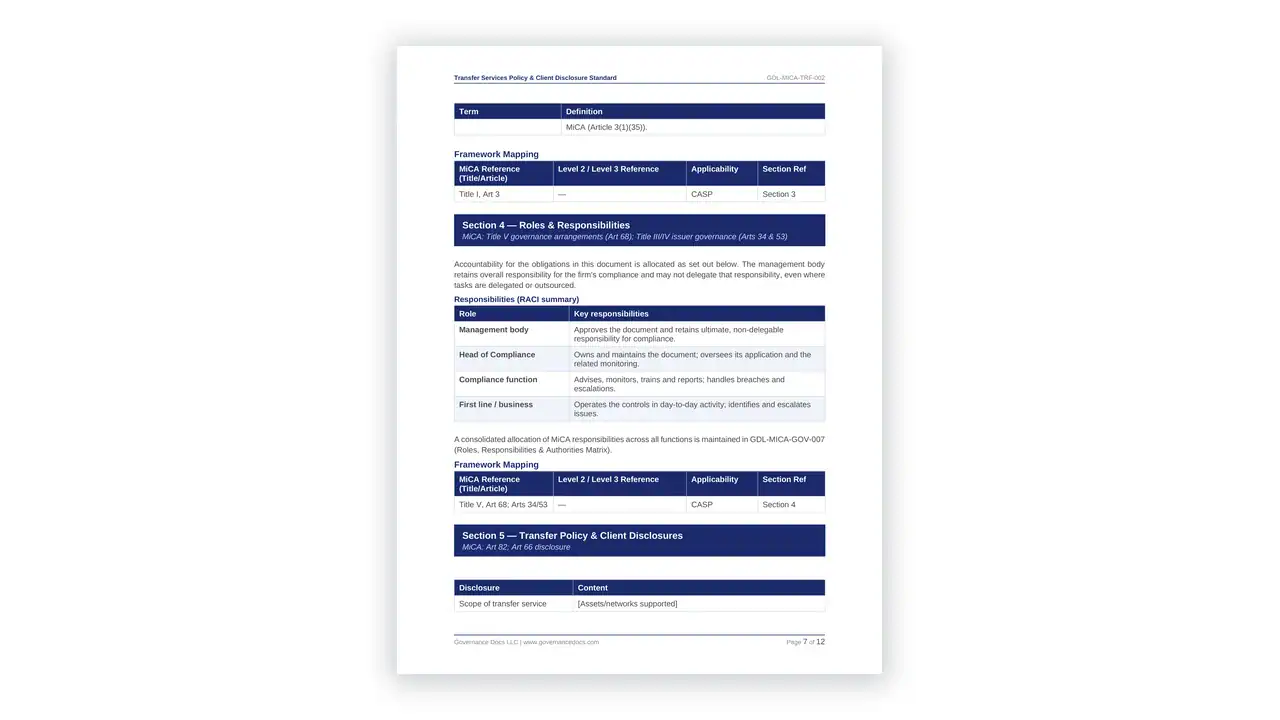
- 14 Transfer Services
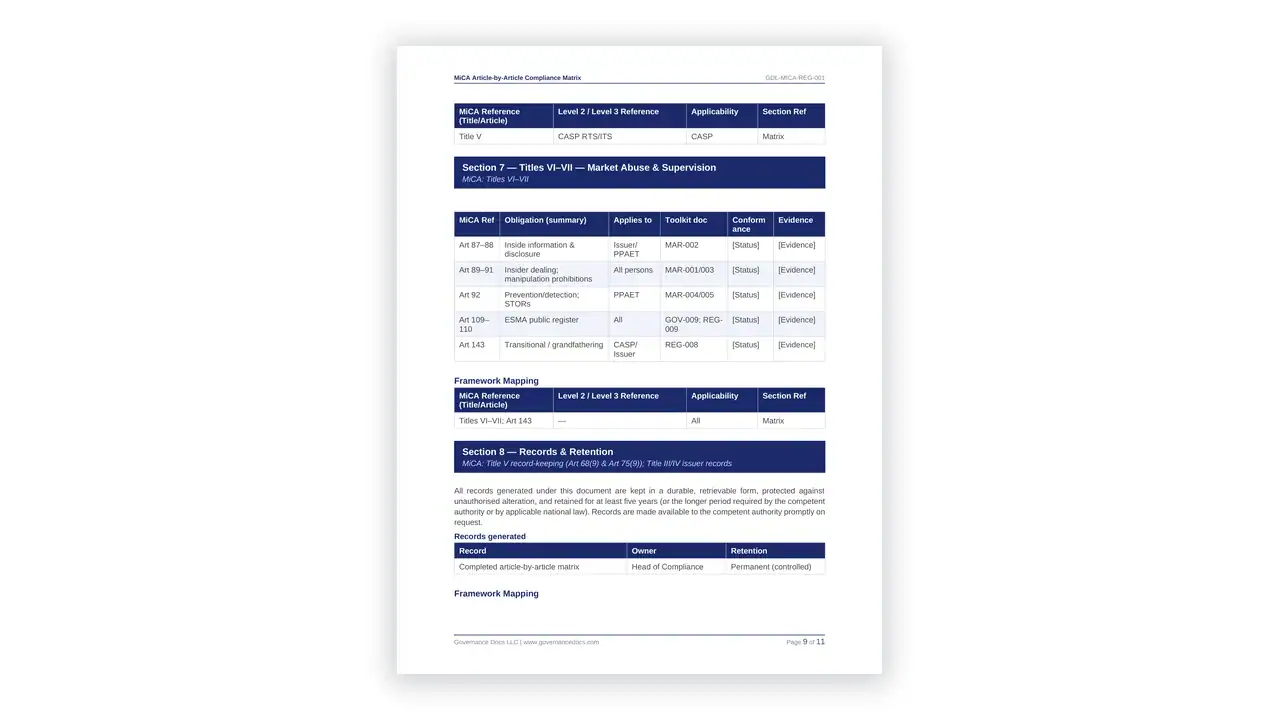
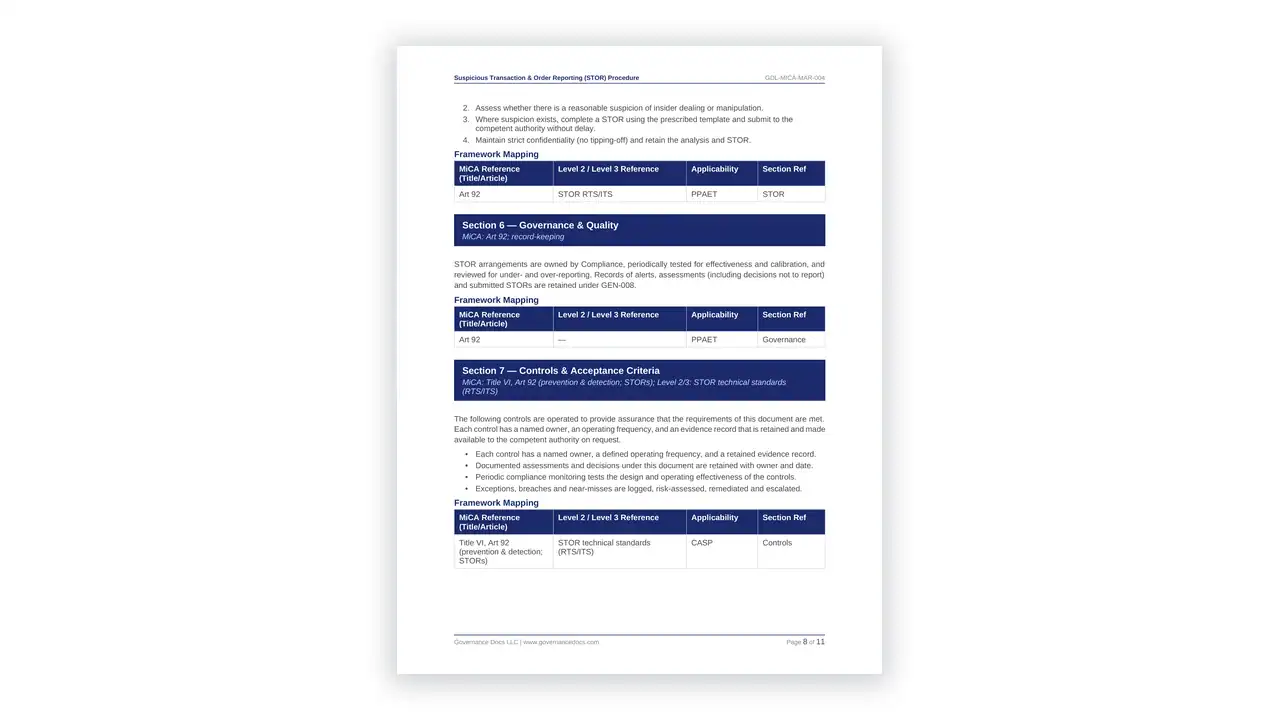
- 15 Market Abuse Prevention, Title VI – insider dealing, unlawful disclosure and market manipulation controls, with the detection and reporting arrangements
- 16 AML-CFT and Travel Rule Interface – the interaction with the Transfer of Funds Regulation
- 17 ICT and Operational Resilience Interface – the DORA obligations that apply to CASPs in parallel
- 18 Regulatory Mapping and Assessment – article traceability and the readiness assessment
- 19 Toolkit Guidance
The MiCA transitional period has ended
Regulation (EU) 2023/1114 phased in through 2024 and 2025, and member states could allow existing providers to continue under national regimes during a transitional window. ESMA confirmed that window closed on 1 July 2026 across the EU.
The practical effect is that grandfathering arguments are gone. A provider serving EU clients either holds a MiCA authorisation, is passporting one held elsewhere in the EU, or has ceased. Supervisory attention has moved from application processing to conduct of authorised firms.
That shifts what a CASP authorisation dossier has to do. It is no longer only an application document – the policies inside it are the ones a supervisor will test in operation, which is why this pack carries the full set of common operating conditions and per-service documentation rather than an application pack alone.
Who needs CASP authorisation dossier
Crypto-asset service providers seeking authorisation or passporting into additional member states. Issuers of asset-referenced or e-money tokens, whose obligations under Titles III and IV are separate and heavier. Traditional financial institutions adding crypto-asset services under the notification route. And providers already authorised who now need the operating documentation their supervisor is testing.
How the CASP authorisation dossier maps to the framework
MiCA obligations stack by service. A firm authorised for custody, exchange and order handling carries three sets of service-specific duties on top of the common operating conditions, and a single generic policy set will not evidence any of them properly. The per-service sections exist so you document only what you are authorised for, and can add a service later without rebuilding.
Frequently asked questions
Is the transitional period really over?
Yes. ESMA confirmed the transitional and grandfathering arrangements ended on 1 July 2026 across the EU. Unauthorised providers should have ceased serving EU clients.
Do we need all nineteen sections?
No. Sections 01, 06, 07, 08 and 15 to 19 apply to every CASP. The token sections and the per-service sections apply only if you issue those tokens or provide those services.
How does DORA fit in?
CASPs are financial entities under DORA, so ICT risk management, incident reporting and third-party requirements apply in parallel. Section 17 covers the interface; see the DORA Toolkit for the full framework.
Does this cover AML obligations?
It covers the interface with the Transfer of Funds Regulation and the travel rule. Full AML-CFT programmes sit outside MiCA and outside this pack.
How many documents are included?
104 editable documents – 103 Word files and an Excel workbook – plus a licence file.
Related toolkits
Crypto-asset firms carry several regimes at once. See the DORA Toolkit for operational resilience, the ISO 27001 Toolkit for the ISMS supervisors expect, the Basel III Toolkit where prudential requirements apply and the ISO 22301 Toolkit for continuity. Issuers also need the EU AMLR toolkit, and those operating in the United States the GENIUS Act toolkit for payment stablecoins.
Implementing for clients? The Consultant Package licenses all 86 toolkits and assessment tools on this site for unlimited client engagements, under one firm-wide licence. One payment of $1,399, no subscription and no per-client fee.
Delivery, format and licence
Your CASP authorisation dossier downloads immediately after checkout as native Microsoft Word and Excel files. Nothing is watermarked or locked, so you can rebrand the documents, bring them under your own document control and revise them for as long as you need them.
One-time purchase. No subscription and no annual renewal. Because the source files behind the CASP authorisation dossier are yours, revising a procedure after an audit finding or a change of scope is an internal edit rather than another purchase.


Reviews
There are no reviews yet.