
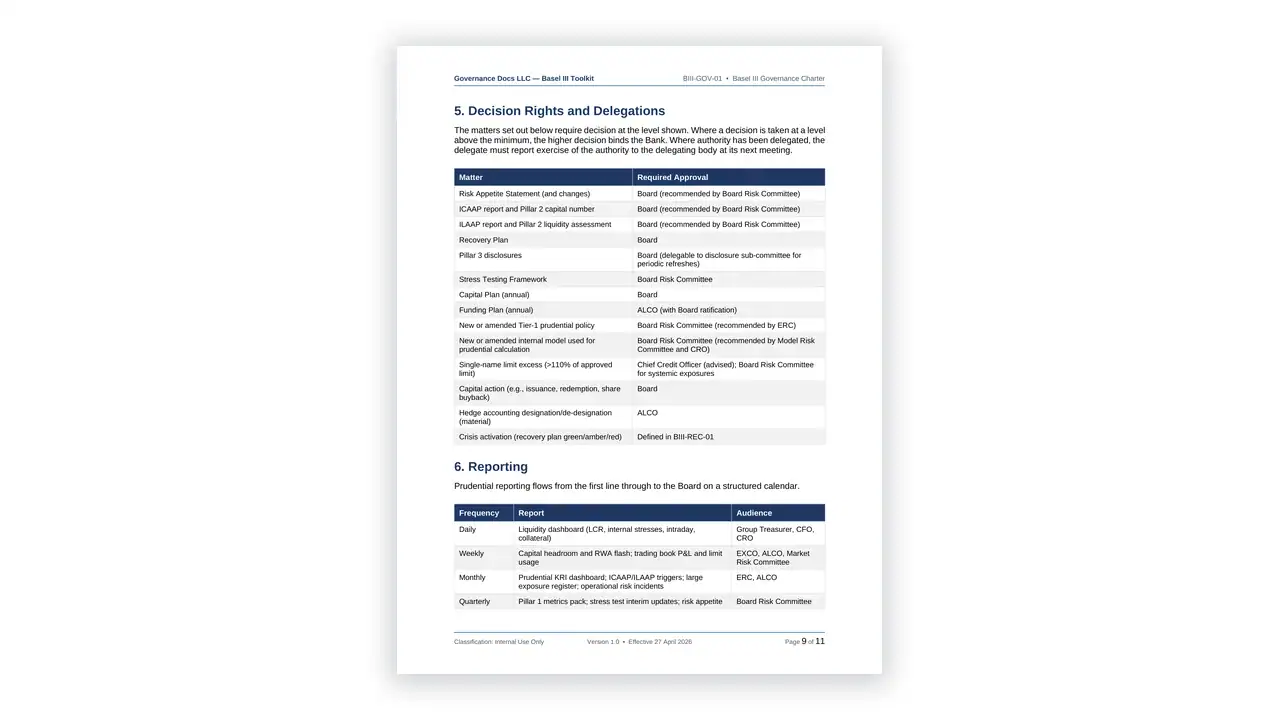
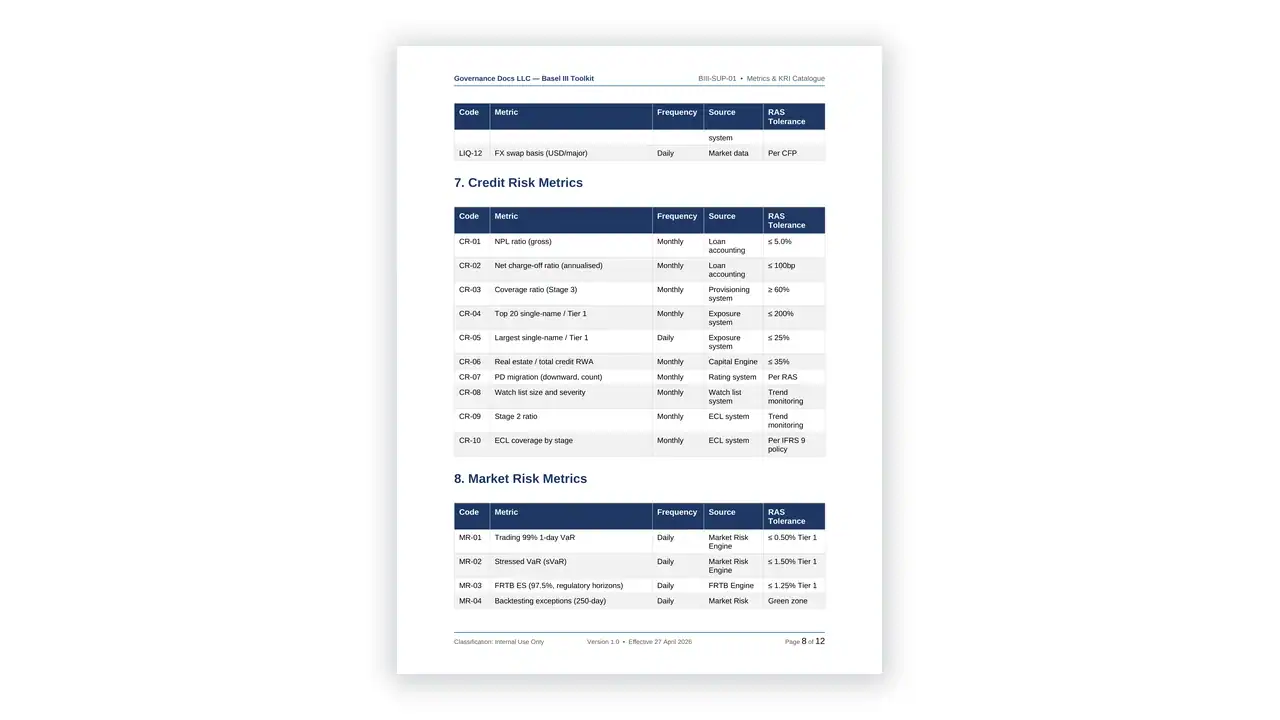
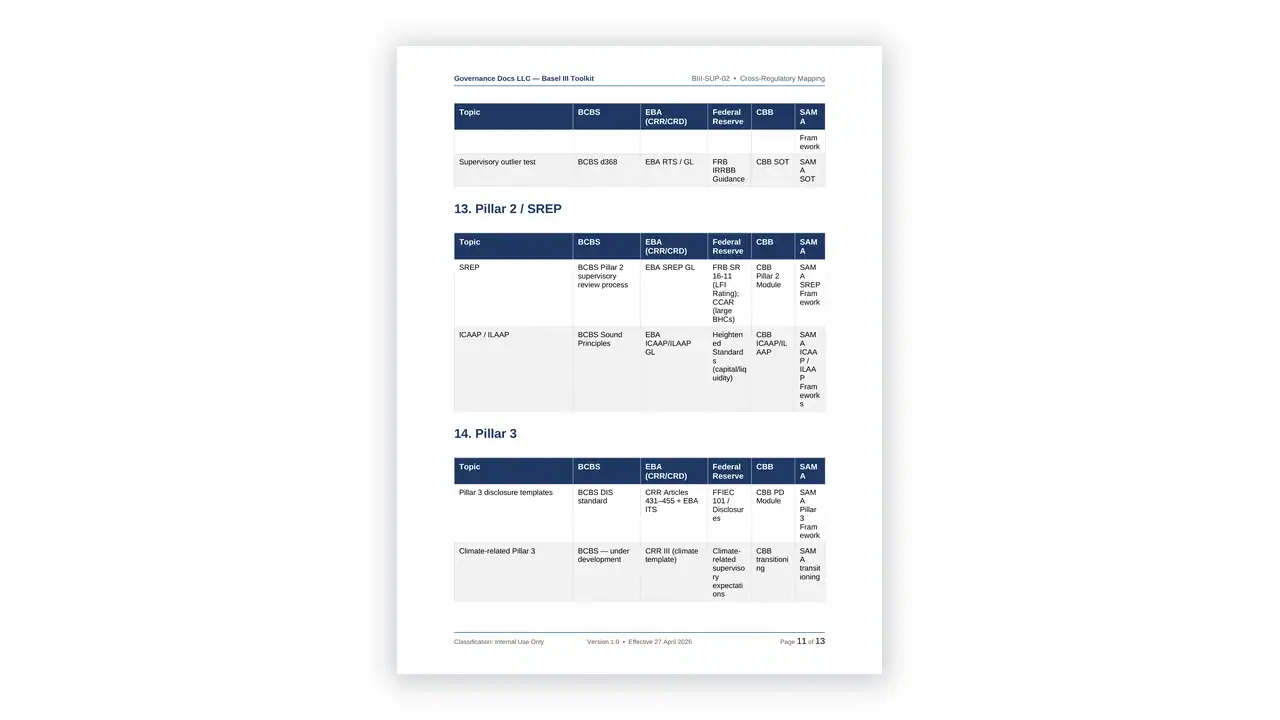
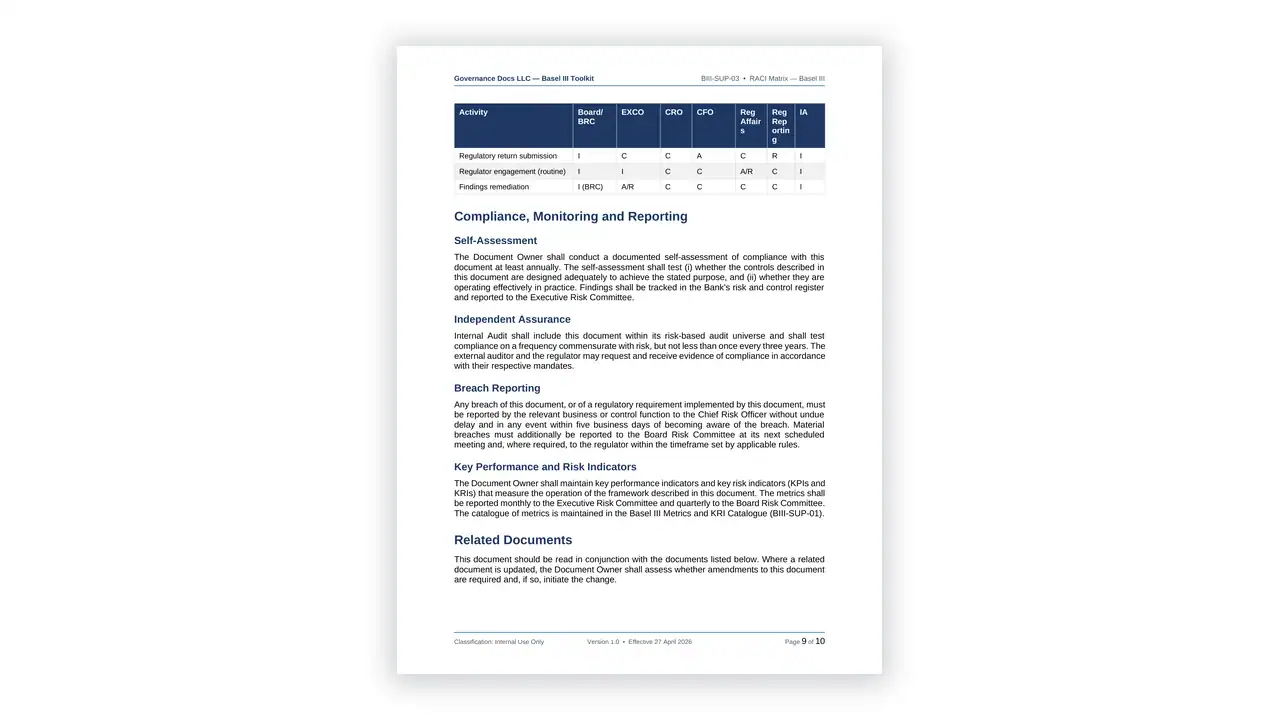
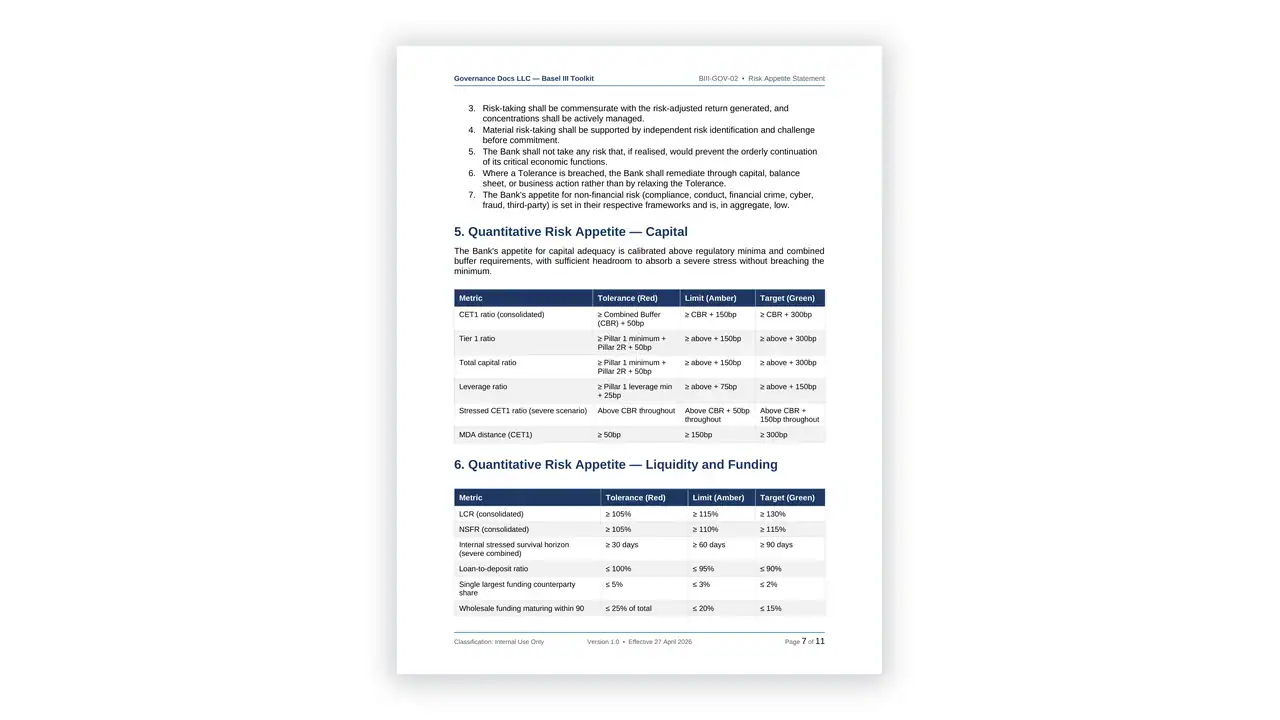
Two documents carry most of the supervisory weight in a prudential framework: the internal capital adequacy assessment and its liquidity counterpart. This pack is built around that ICAAP and ILAAP documentation and the policy set that supports it. 25 editable Word documents, downloadable the moment you check out. On this page:
- What is in the ICAAP and ILAAP documentation pack
- Basel 3.1 dates are now fixed in the UK, and unresolved in the US
- Who needs ICAAP and ILAAP documentation
- How the documents map to the framework
- Frequently asked questions
- Related toolkits
What is in the ICAAP and ILAAP documentation pack
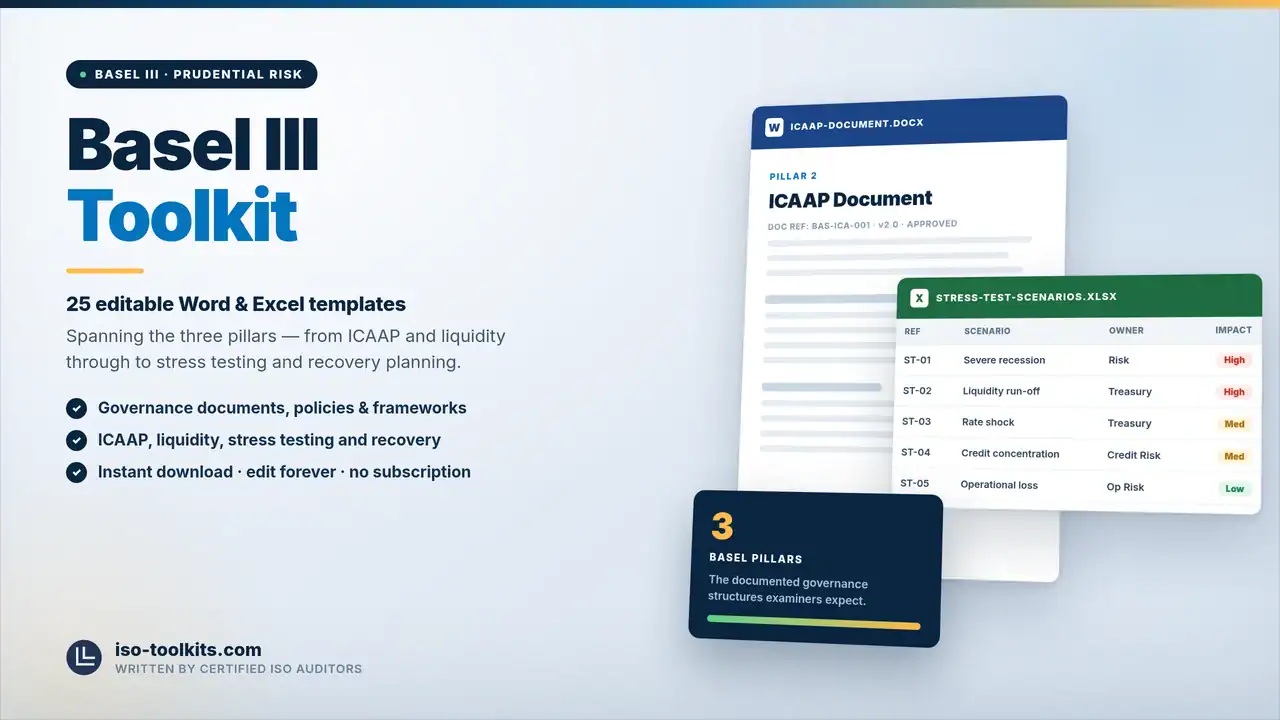
Documents carry a BIII reference code and a master register sits at the front. What is covered:
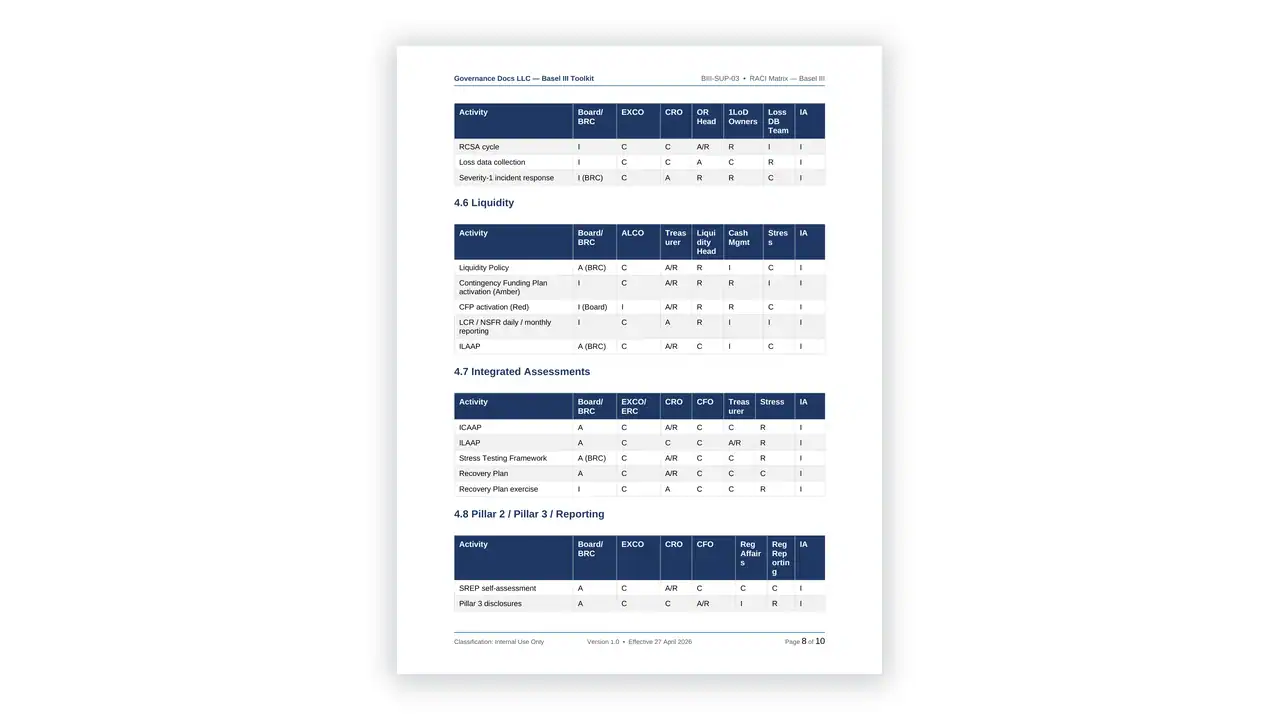
- Governance – the Basel III governance charter, the risk appetite statement and an implementation roadmap
- ICAAP – the internal capital adequacy assessment process, covering material risk identification, capital planning under stress and the link to risk appetite
- ILAAP – the internal liquidity adequacy assessment process, covering liquidity risk drivers, buffers and the funding plan
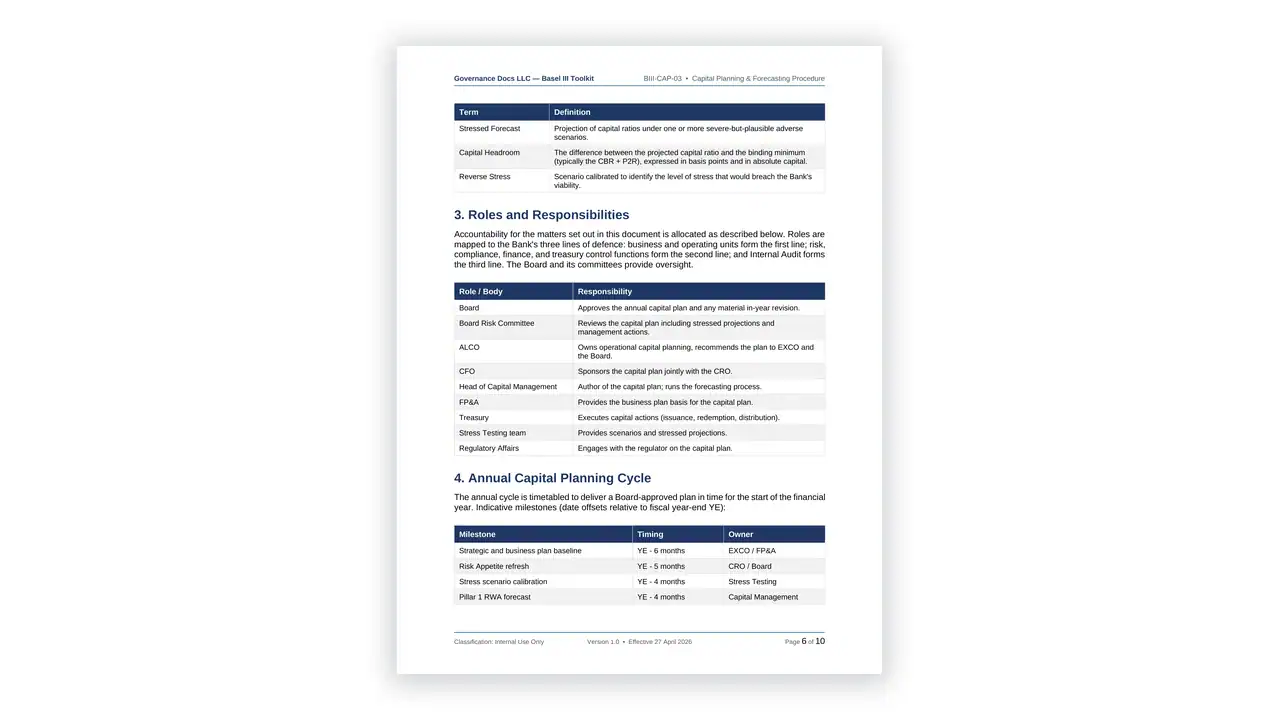
- Capital – capital management policy, RWA calculation standard and the capital planning and forecasting procedure
- Credit risk – credit risk management policy and the exposure classification approach
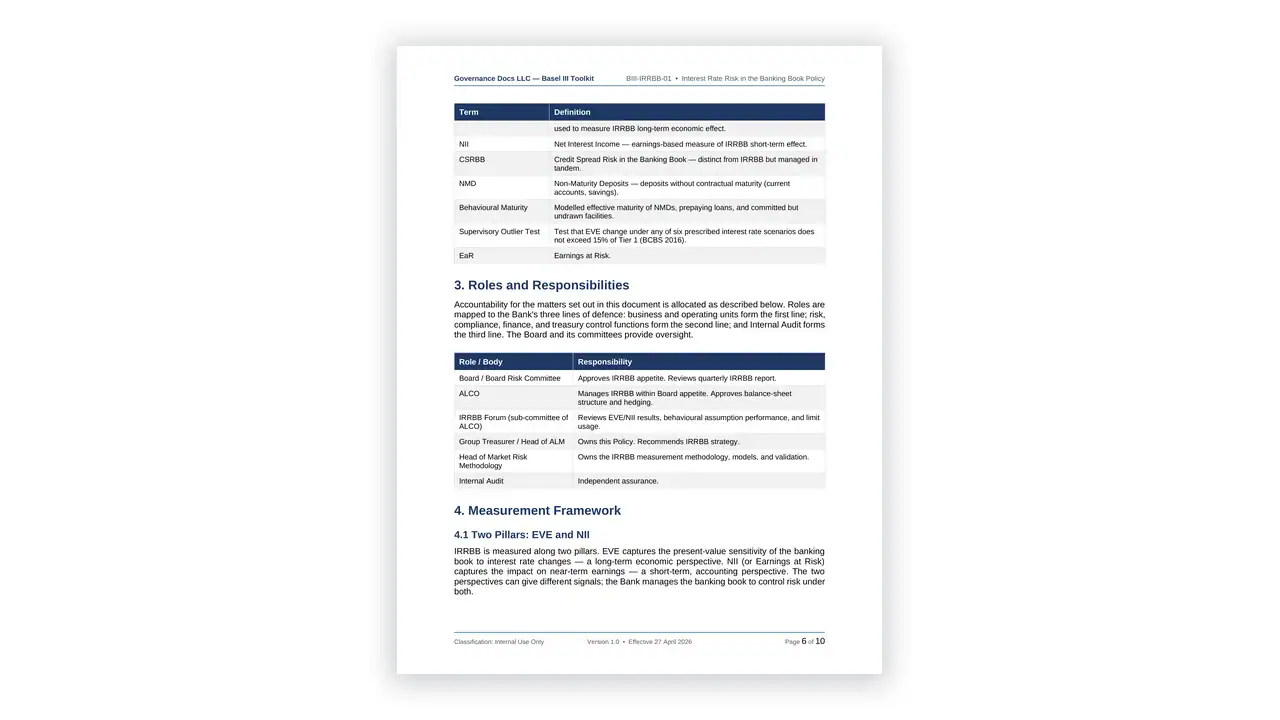
- Interest rate risk in the banking book – the IRRBB policy and measurement approach
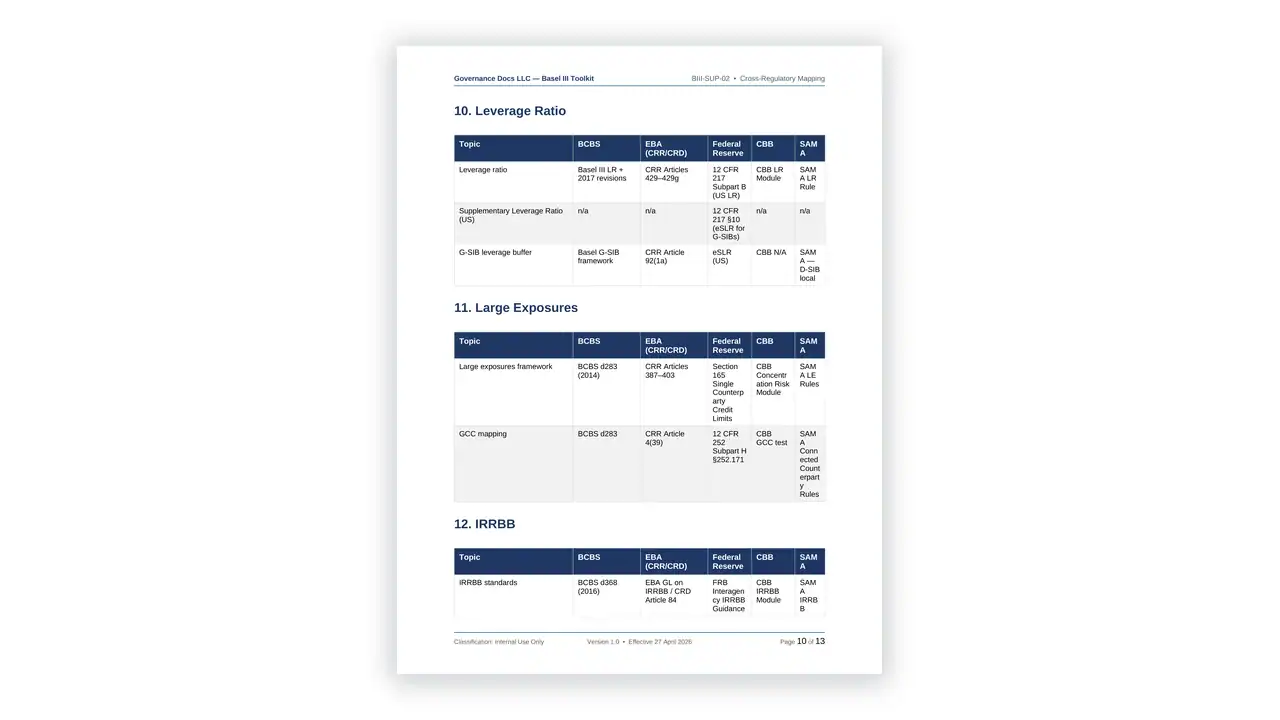
- Large exposures – the large exposures policy and limit framework
- Liquidity and funding – LCR and NSFR positions and the contingency funding plan
- Stress testing – scenario design, severity calibration and the reverse stress testing position
- Reporting and disclosure – the Pillar 3 disclosure structure and the internal reporting pack
Basel 3.1 dates are now fixed in the UK, and unresolved in the US
Basel III is a set of international standards implemented differently by each jurisdiction, so the dates that matter are national rather than global.
In the UK, the Prudential Regulation Authority published its final rules in Policy Statement PS1/26 in January 2026. The Basel 3.1 package takes effect on 1 January 2027, with the internal model approach for the Fundamental Review of the Trading Book deferred to 1 January 2028. Firms therefore have a firm date to plan against.
In the US the endgame proposals remain unresolved. The ICAAP and ILAAP documentation here is written to the Basel framework itself rather than to one jurisdiction implementation, so the core assessment processes hold while the calibration follows your regulator. Confirm your own regulator current requirements before finalising the calculation standards.
Who needs ICAAP and ILAAP documentation
Banks and investment firms subject to prudential capital and liquidity requirements. Firms preparing for a supervisory review and evaluation process where the ICAAP and ILAAP are the primary submissions. Newly authorised institutions building a prudential framework from nothing. And risk functions in smaller institutions where proportionality applies but documentation is still expected.
How the ICAAP and ILAAP documentation maps to the framework
Supervisors read the ICAAP as evidence of whether the board understands the risks it is taking, not as a capital calculation. The material risk identification and the link from risk appetite through to capital planning are what get scrutinised. The pack keeps those as explicit, separately reviewable documents rather than burying them inside a calculation annex.
Frequently asked questions
Which jurisdiction is this written for?
The Basel framework itself, so the assessment processes hold across jurisdictions. Calibration and reporting formats follow your own regulator – the UK timetable is set by PS1/26, the US endgame is unresolved.
When does UK Basel 3.1 take effect?
1 January 2027, with the FRTB internal model approach deferred to 1 January 2028, per PRA Policy Statement PS1/26 published January 2026.
Does this include stress testing?
Yes – scenario design, severity calibration and the reverse stress testing position, which supervisors increasingly probe alongside the base ICAAP.
Is this suitable for a smaller firm?
Yes. Proportionality applies to depth rather than to whether the documents exist. The structure supports a simplified assessment without omitting the components a supervisor expects.
How many documents are included?
25 editable Word documents indexed by a master register, plus guidance and a licence file.
Related toolkits
Prudential frameworks sit alongside operational obligations. See the DORA Toolkit for EU operational resilience, the ISO 31000 Toolkit for the enterprise risk framework, the SAMA Toolkit for Saudi-regulated institutions and the SWIFT CSP Toolkit for payment messaging security. Banks preparing for the 2027 anti-money-laundering regime need the EU AMLR toolkit.
Implementing for clients? The Consultant Package licenses all 86 toolkits and assessment tools on this site for unlimited client engagements, under one firm-wide licence. One payment of $1,399, no subscription and no per-client fee.
Delivery, format and licence
Your ICAAP and ILAAP documentation downloads immediately after checkout as native Microsoft Word and Excel files. Nothing is watermarked or locked, so you can rebrand the documents, bring them under your own document control and revise them for as long as you need them.
One-time purchase. No subscription and no annual renewal. Because the source files behind the ICAAP and ILAAP documentation are yours, revising a procedure after an audit finding or a change of scope is an internal edit rather than another purchase.


Reviews
There are no reviews yet.