
Safety systems tend to be reviewed after an incident, which is the point at which a gap has already cost something. An ISO 45001 self-assessment run while things are quiet identifies the same gaps at a far lower price.
On this page:
- Find the gaps before an auditor or an incident does
- What is inside the ISO 45001 self-assessment pack
- What an ISO 45001 self-assessment is for
- Who the ISO 45001 self-assessment pack is written for
- What the ISO 45001 self-assessment pack does not do
- Frequently asked questions
- Related toolkits
Find the gaps before an auditor or an incident does
The document walks the management system in clause order – context, leadership and worker participation, planning, support, operation, performance evaluation and improvement – and asks what evidence exists for each. Where the answer is nothing, that is a gap, and it is recorded as one rather than noted and forgotten.
Worker participation is where this differs most from a generic quality assessment, and it is where ISO 45001 puts unusual weight. Consultation and participation of workers is a clause in its own right, and a safety system that has policies but no evidence of consultation fails on something that cannot be retrofitted quickly.
The output is a prioritised view rather than a pass or fail, which is what makes it useful for a budget conversation. Non-compliance in occupational health and safety is expensive in more ways than one, and knowing which gaps to close first is the point of the exercise.
What is inside the ISO 45001 self-assessment pack
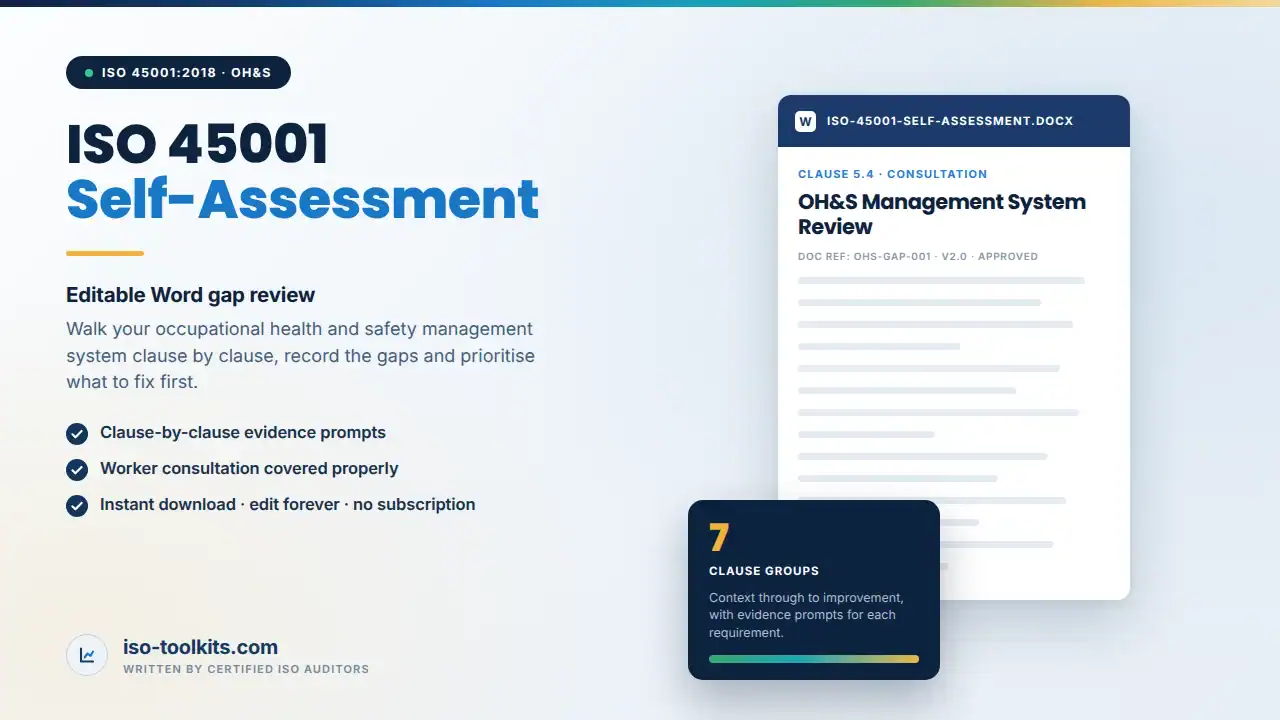
One editable Word document, immediately usable, covering the full management system structure.
- Clause-by-clause review – across the whole ISO 45001 structure.
- Evidence prompts – what would have to exist for each requirement to be met.
- Gap recording – so findings are captured rather than noted verbally.
- Prioritisation – targeting improvement where the exposure is greatest.
- Editable Word – adapt the wording to your operations, your sites and your terminology.
What an ISO 45001 self-assessment is for
It is for sizing the work before committing to a certification timetable, and for giving a management team something concrete to act on. It scales down to a small enterprise and up to a multi-site operation because the clause structure is the same either way; what changes is how many times you run it.
It is not an audit and it is not evidence for a certification body. It also does not produce the documentation – if the review shows you need a hazard identification procedure, a legal compliance register, worker consultation records and an incident investigation process, the ISO 45001 documentation pack is what builds them.
Most buyers use it in that order: the ISO 45001 self-assessment to decide where to start, the full pack to do the work.
Who the ISO 45001 self-assessment pack is written for
- Organisations considering ISO 45001 certification and sizing the effort.
- Health and safety managers who need a structured review rather than an opinion.
- Multi-site operations wanting a consistent assessment method across locations.
- Consultants running a first-visit gap review with a client.
What the ISO 45001 self-assessment pack does not do
It is not an audit, and it does not certify anything.
It does not replace hazard identification or risk assessment for actual work activities.
It does not produce documentation. It shows what is missing; building it is the documentation pack.
Frequently asked questions
What format is it?
A single editable Microsoft Word document, so you can adapt the wording to your sites and operations.
Is this enough to get certified?
No. It sizes the gap. Certification needs a documented management system and an audit by an accredited body.
Does it work for a small business?
Yes. The clause structure is the same at any size; a small operation simply has fewer processes to review.
Can we move to the full toolkit afterwards?
Yes, and the review tells you which clauses to prioritise.
Related toolkits
When the review shows the gaps, the ISO 45001 toolkit is the documentation set that closes them. Organisations running safety alongside quality and environment use the integrated management system toolkit, and site teams the QHSE documentation bundle. ISO publishes the standard at iso.org.
Implementing for clients? The Consultant Package licenses all 86 toolkits and assessment tools on this site for unlimited client engagements, under one firm-wide licence. One payment of $1,399, no subscription and no per-client fee.
Delivery, format and licence
The ISO 45001 self-assessment pack downloads immediately after checkout as a single native Microsoft Word document. Nothing is locked, nothing is a PDF you cannot edit, and no add-on or portal login is needed to open it. Every organisation-specific value is marked as a placeholder so you can see what still has to be decided.
One payment, no subscription and no annual renewal. The source files behind the ISO 45001 self-assessment pack are yours to adapt for your own organisation for as long as you need them, including future revisions of your own documents.


Reviews
There are no reviews yet.