
This NQA-1 quality assurance program documentation set is written to ASME NQA-1-2024 and covers the full programme a nuclear supplier, facility or service provider has to have in place before a customer audit. 105 editable Word procedures across four sections, downloadable the moment you check out. On this page:
- What is in the toolkit
- Why an NQA-1 quality assurance program is structured the way it is
- Who needs NQA-1 quality assurance program
- How the documents map to the framework
- Frequently asked questions
- Related toolkits
What is in the NQA-1 quality assurance program pack
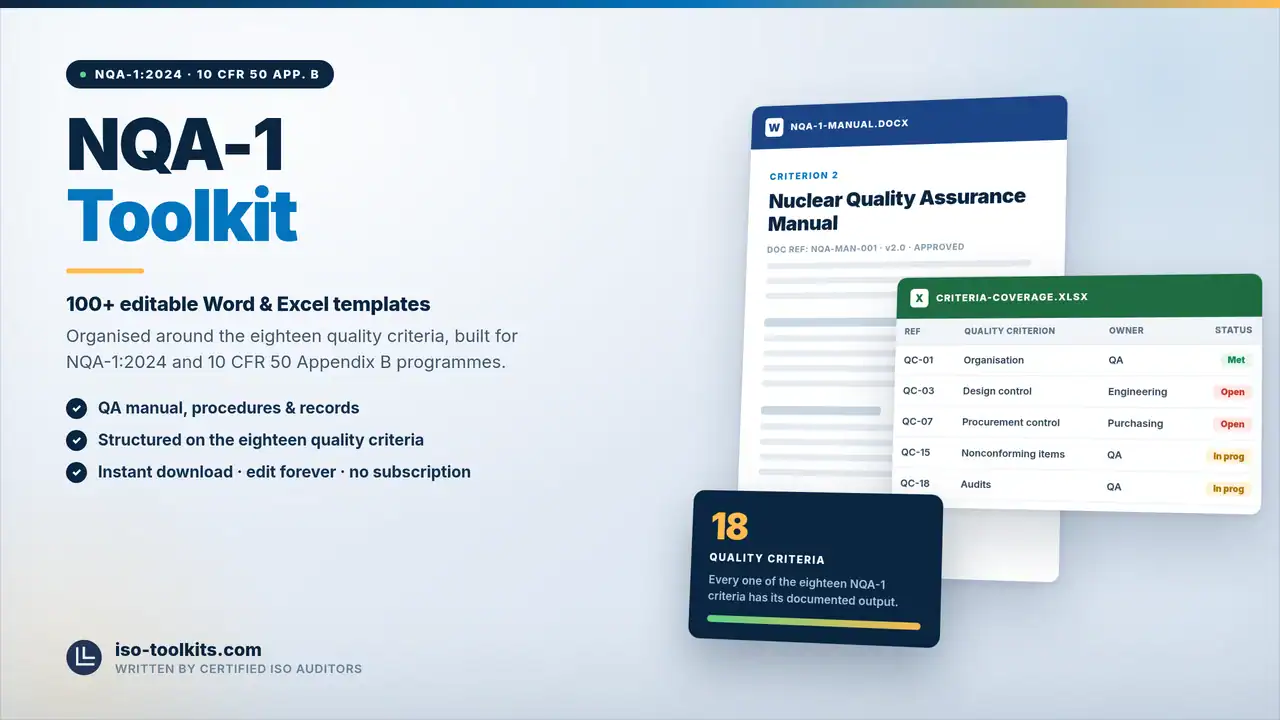
NQA-1 is structured as 18 Part I requirements plus Part II supplemental subparts, and the pack follows that structure exactly so an auditor can be walked through it in the order they audit. The four sections:
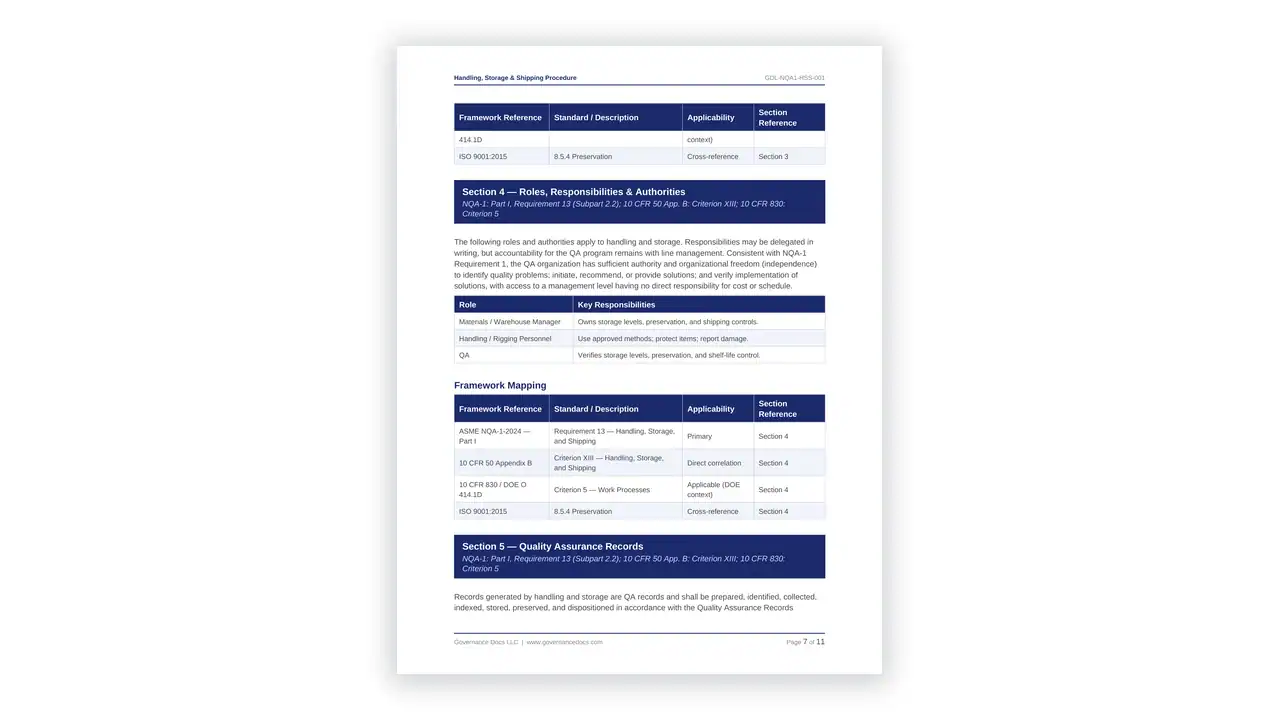
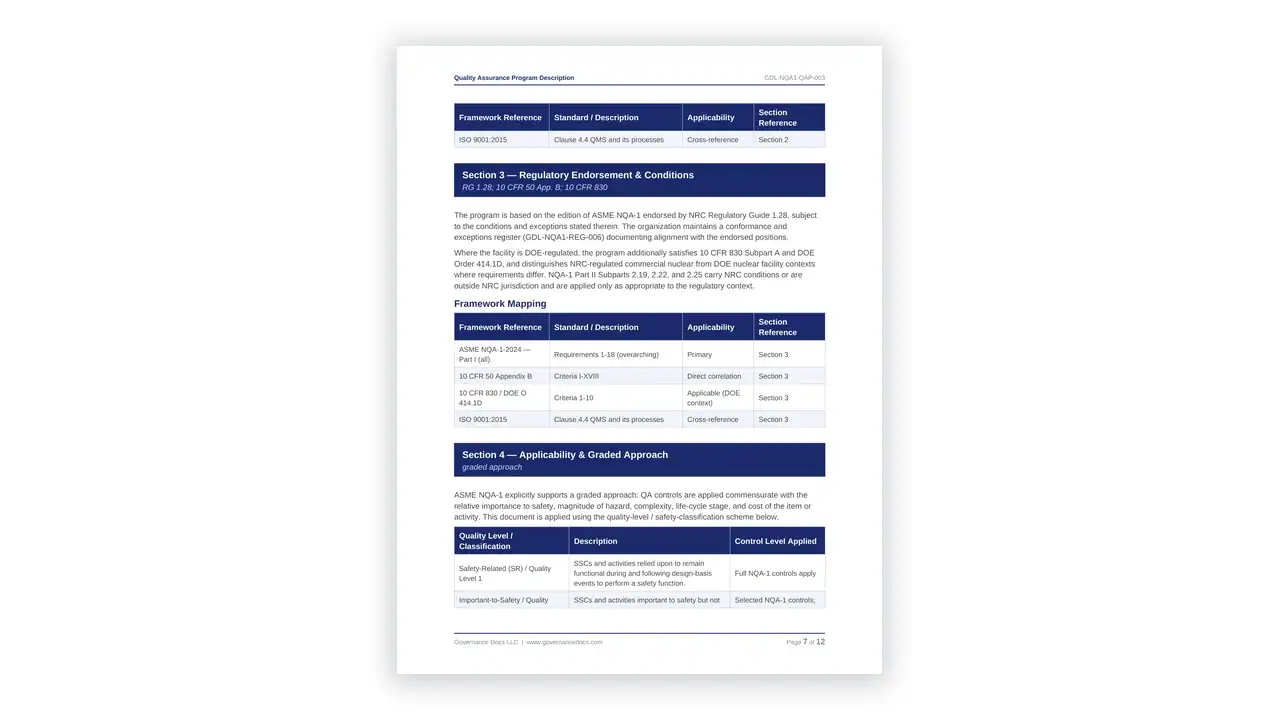
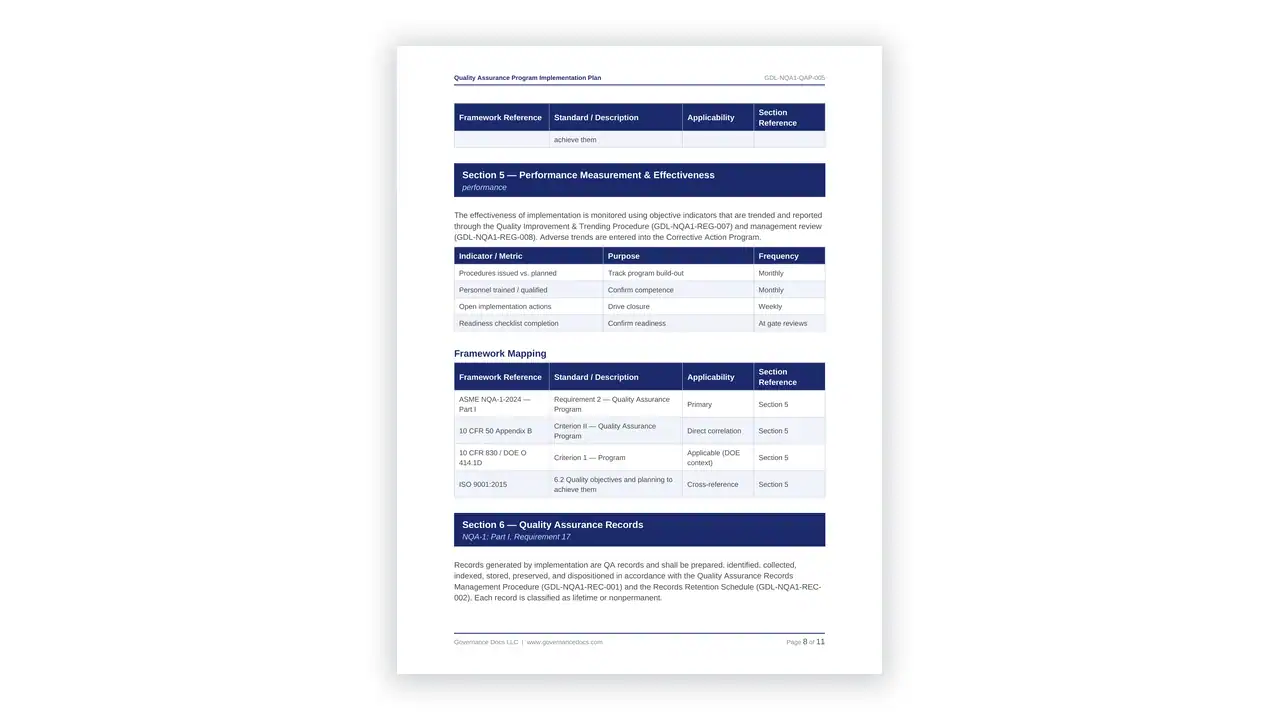
- 01 Program Foundation and Governance – the Nuclear Quality Assurance Program Manual, QA policy statement, programme description, graded approach procedure, Q-List safety classification, QA RACI matrix and a stop work authority procedure
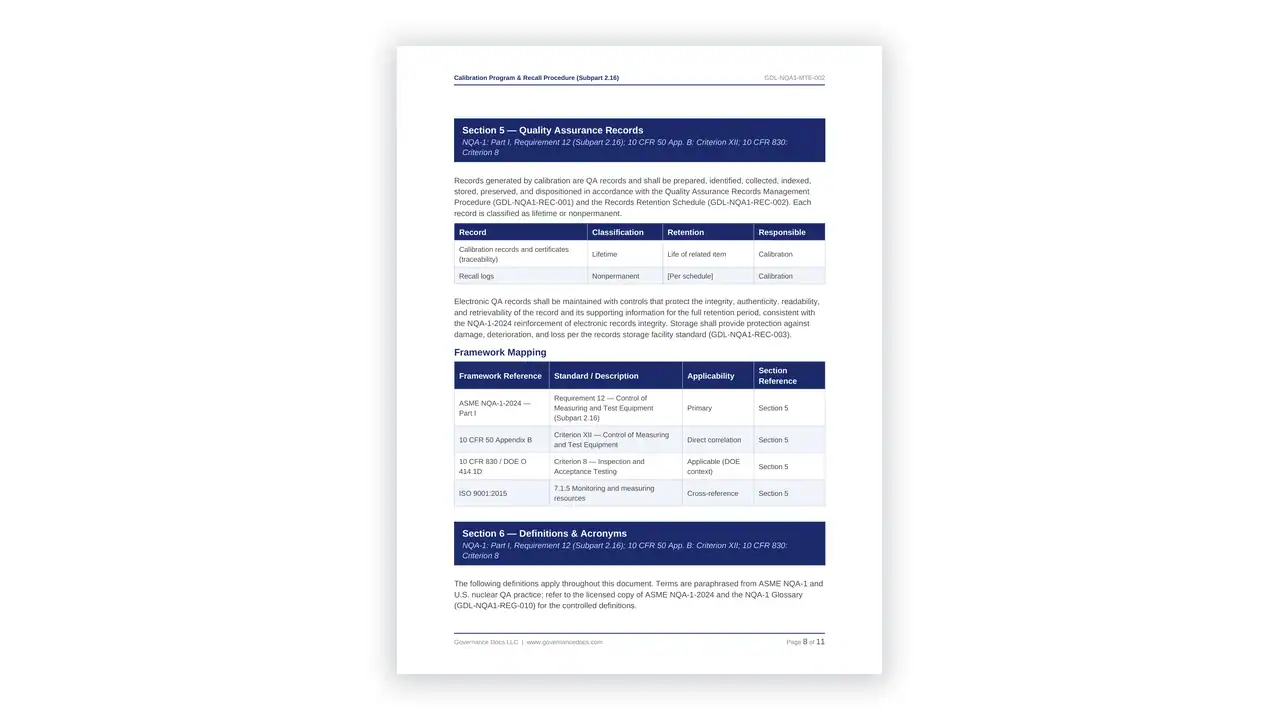
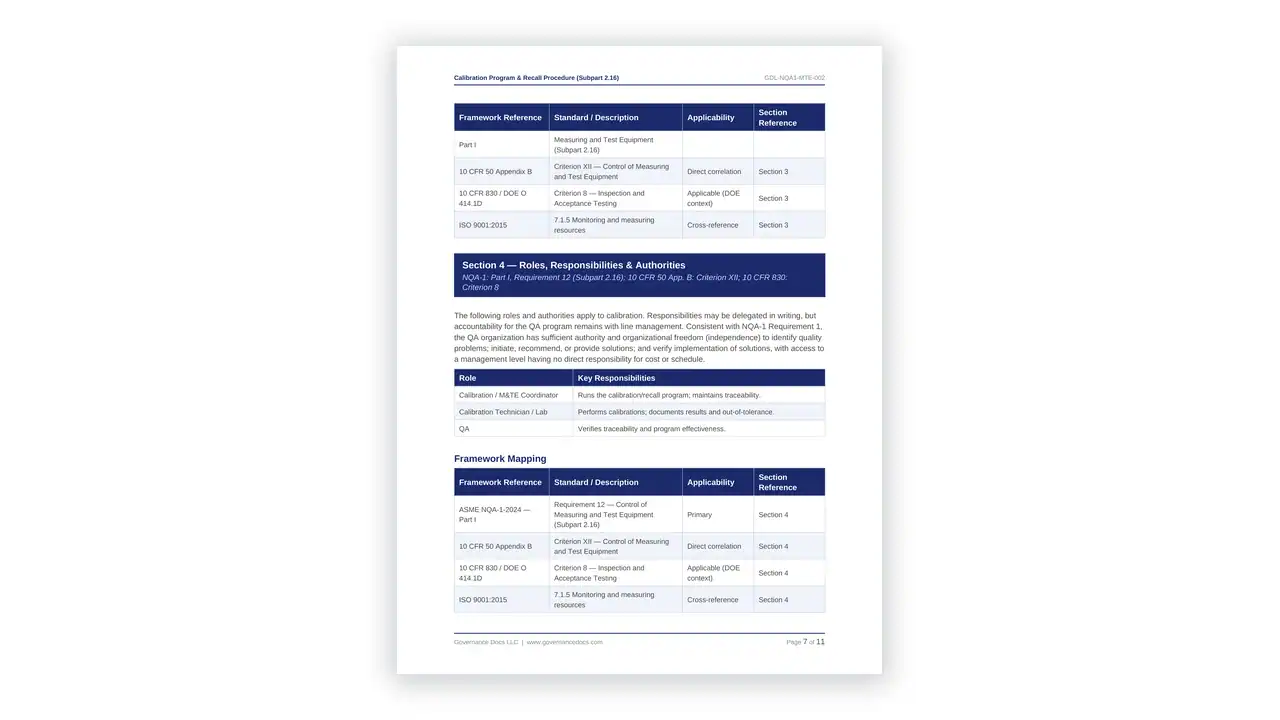
- 02 Part I, The 18 Requirements – organization and independence, QA programme, design control, procurement document control, instructions and procedures, document control, control of purchased items and services, identification and control of items, control of special processes, inspection, test control, measuring and test equipment, handling and storage, inspection and test status, nonconforming items, corrective action, QA records and audits
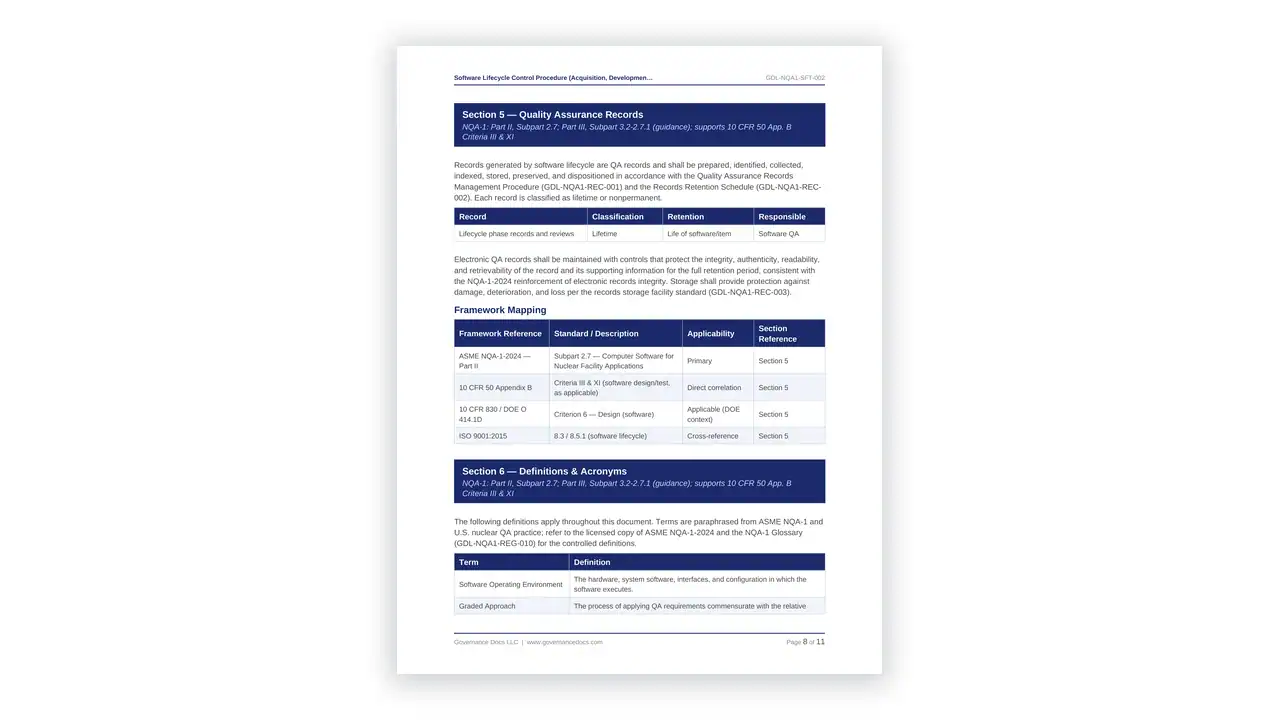
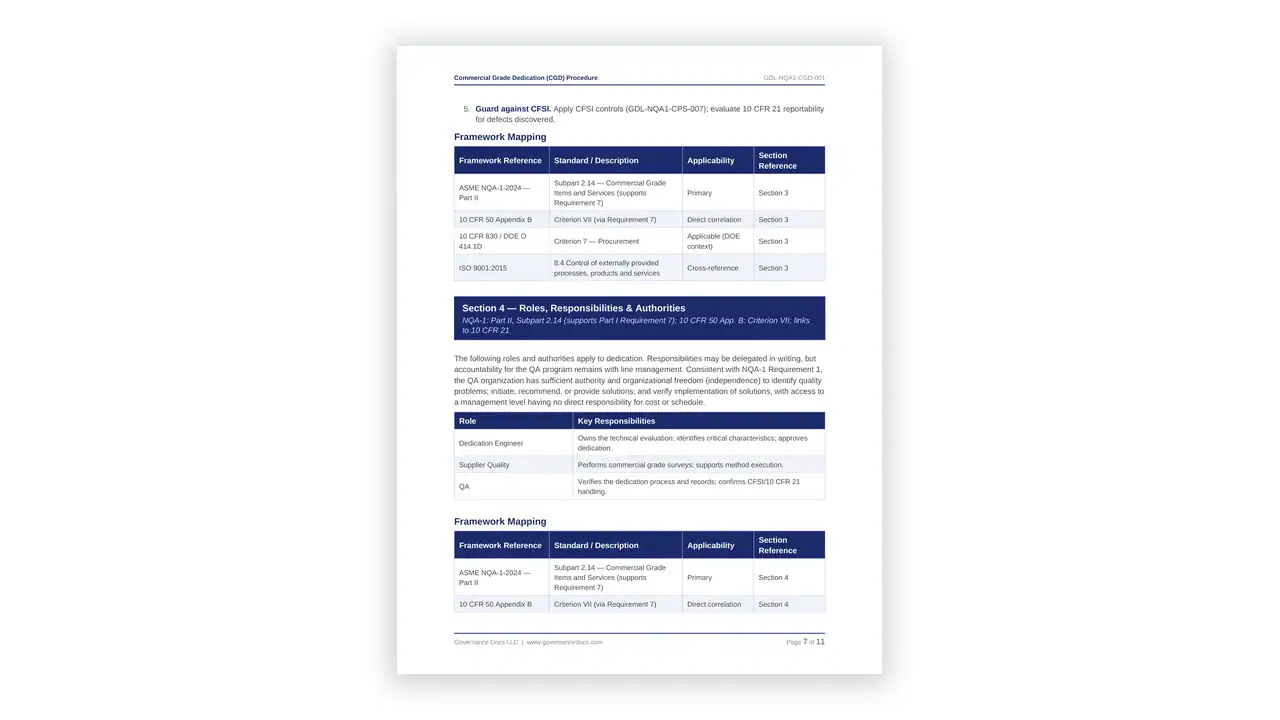
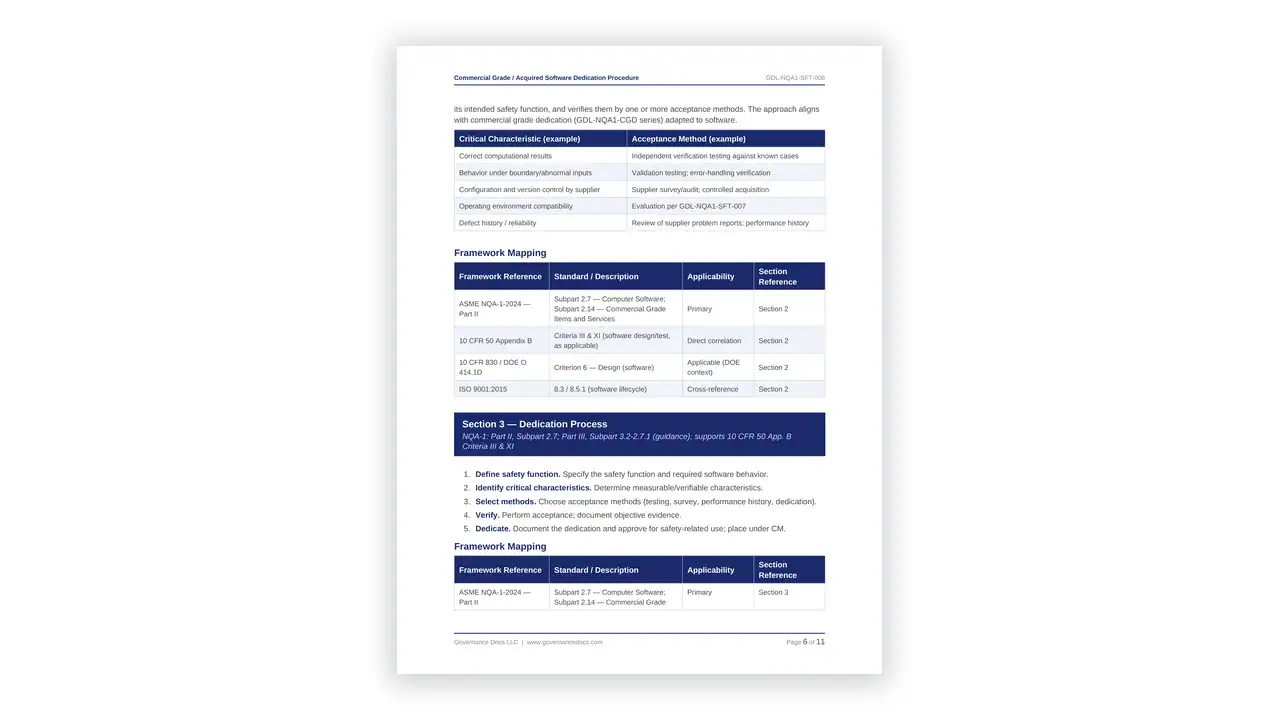
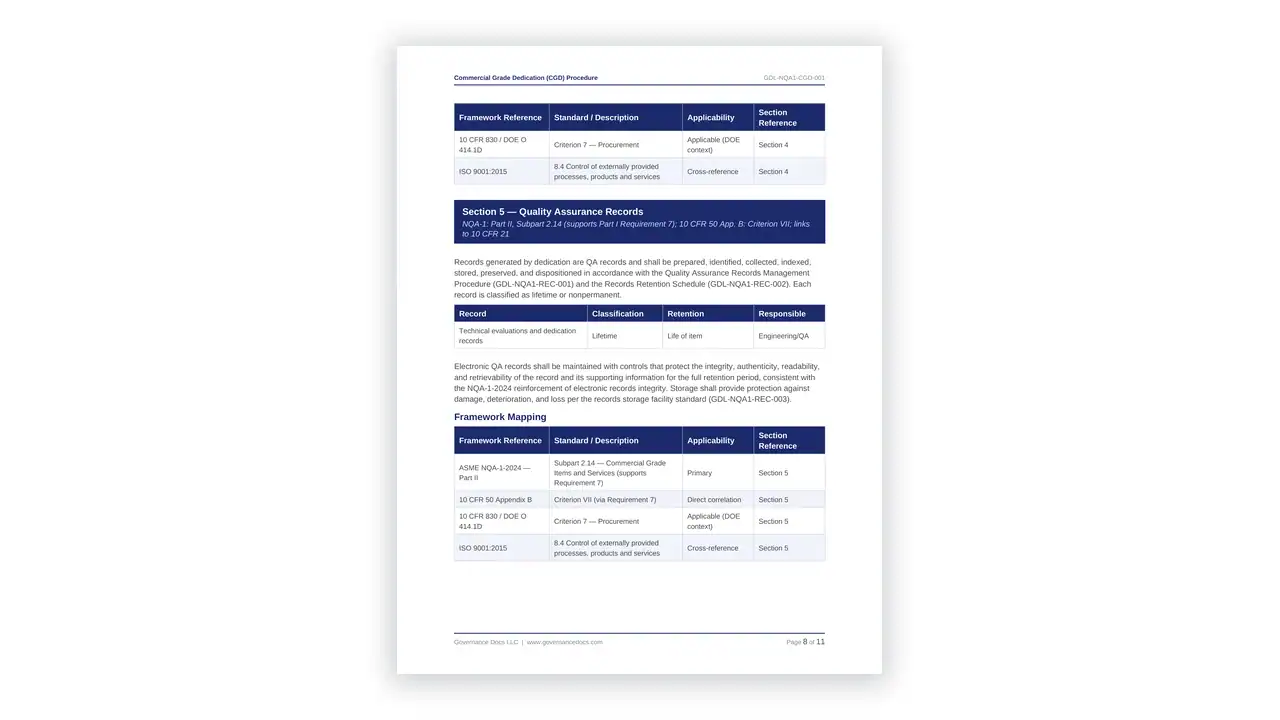
- 03 Part II, Supplemental Subparts – software quality assurance and the full software lifecycle set, commercial grade dedication, hoisting rigging and transporting, maintenance QA, and the facility subparts covering fluid system cleaning, packaging and shipping, structural concrete and steel, and mechanical item installation
- 04 Regulatory Mapping and Assessment – the NQA-1 to 10 CFR 50 Appendix B compliance matrix, the 10 CFR 830 and DOE O 414.1D matrix, an ISO 9001 cross-reference, a gap assessment workbook guide, a certification readiness checklist and an NRC Regulatory Guide 1.28 conformance and exceptions register
Why an NQA-1 quality assurance program is structured the way it is
NQA-1 exists because nuclear procurement cannot rely on commercial assurance alone. The 18 Part I requirements are not a maturity model – they are the minimum a customer audit will test, and the burden of proof sits with the supplier.
Two areas account for most findings. Commercial grade dedication is the first: taking an item produced under a commercial quality system and justifying its use in a safety-related application requires an auditable technical evaluation, critical characteristics and acceptance methods, all of which this pack provides as procedures rather than as guidance. The second is counterfeit, fraudulent and suspect items, where a supplier without a documented CFSI prevention procedure is increasingly not qualifiable at all.
The regulatory mapping section exists because NQA-1 is rarely the only thing being assessed. A commercial nuclear customer audits against 10 CFR 50 Appendix B; a DOE customer against 10 CFR 830 and DOE O 414.1D. The same NQA-1 quality assurance program satisfies both, provided you can show the mapping – which is what the compliance matrices do. ASME publishes the standard itself through its codes and standards catalogue.
Who needs NQA-1 quality assurance program
Suppliers seeking to be placed on an approved suppliers list for commercial nuclear or DOE work. Engineering, fabrication and testing firms whose customers require an NQA-1 compliant programme before a purchase order is raised. Advanced reactor and SMR developers standing up a quality programme for the first time. And software suppliers, who fall under the Part II software subpart and are frequently caught unprepared by it.
How the NQA-1 quality assurance program maps to the framework
Each of the 18 requirements has its own procedure rather than being consolidated into a manual, because customer audits are conducted requirement by requirement and a single document covering six requirements is hard to evidence against any of them. The Q-List and graded approach procedures sit at the front deliberately: getting safety classification wrong propagates through every downstream control.
Frequently asked questions
Which edition is this written to?
ASME NQA-1-2024. ASME revises NQA-1 on a roughly two-year cycle, so confirm with your customer which edition their purchase order invokes before you finalise the programme – contractual editions often lag the current one.
Does it cover software quality assurance?
Yes. The Part II software subpart is covered in full: SQA plan, lifecycle control, verification and validation, configuration management, problem reporting and acquired software dedication.
What about commercial grade dedication?
Five dedicated procedures – the CGD procedure itself, critical characteristics identification and acceptance, a technical evaluation plan template, a commercial grade survey procedure and a dedication record template.
Does this satisfy 10 CFR 50 Appendix B?
The programme is built to do so, and the compliance matrix maps each NQA-1 element to the corresponding Appendix B criterion. Your customer still audits the implementation.
How many documents are included?
105 editable Word procedures, indexed by a master index document, plus a licence file.
Which NQA-1 edition binds you
This pack is written to ASME NQA-1-2024. Two things are worth knowing before you buy, and most sellers say neither.
ASME has since published NQA-1-2026. A newer edition existing does not make your programme non-compliant, because NQA-1 binds through the edition named in your licence, your contract or your purchase order rather than through whatever ASME published most recently.
The NRC position is narrower still. Regulatory Guide 1.28 Revision 6 endorses NQA-1-2017, NQA-1-2019 and NQA-1-2022 for design and construction quality assurance programmes, and it excludes Subpart 2.19 from all three, directing licensees to NEI 14-05A for laboratory calibration and testing services instead. Neither the 2024 nor the 2026 edition is endorsed in that revision.
So confirm the edition your customer actually requires before you adopt one. The structure in this pack holds either way, because the 18 Part I requirements and the Part II subparts are stable across these editions, but the clause references need adjusting to the edition you are held to.
Related toolkits
Nuclear suppliers usually carry commercial certifications alongside NQA-1. See the ISO 9001 Toolkit for the commercial quality system the cross-reference matrix maps to, the AS 9100 Toolkit for aerospace work and the ISO 31000 Toolkit for enterprise risk. For configuration and change discipline across projects, see the Project Management Toolkit. Laboratories performing testing or calibration under the programme need the ISO 17025 toolkit.
Implementing for clients? The Consultant Package licenses all 86 toolkits and assessment tools on this site for unlimited client engagements, under one firm-wide licence. One payment of $1,399, no subscription and no per-client fee.
Delivery, format and licence
Your NQA-1 quality assurance program downloads immediately after checkout as native Microsoft Word and Excel files. Nothing is watermarked or locked, so you can rebrand the documents, bring them under your own document control and revise them for as long as you need them.
One-time purchase. No subscription and no annual renewal. Because the source files are yours, revising a procedure after an audit finding or a change of scope is an internal edit rather than another purchase.


Reviews
There are no reviews yet.