
FSSC 22000 is not a standard. It is a certification Scheme built from three layers – ISO 22000:2018, the prerequisite programme standard for your food chain category, and the FSSC Additional Requirements – and a certificate depends on all three. Most FSSC 22000 v7 documentation on the market covers one of them.
On this page:
- Four separate clocks, not one deadline
- What is inside the FSSC 22000 v7 documentation pack
- Thirteen of the eighteen requirement groups do not apply to everyone
- Who the FSSC 22000 v7 documentation pack is written for
- What the FSSC 22000 v7 documentation pack does not do
- Frequently asked questions
- Related toolkits
Four separate clocks, not one deadline
The Foundation has fixed the Version 7 transition dates and they are anchored to different events. Version 7.0 published in May 2026. The last date a Version 6 audit may be delivered is 30 April 2027. Upgrade audits run from 1 May 2027 to 30 April 2028. New certification body applications are accepted to V7 from 1 October 2026, and CB accreditation has to be extended to V7 before 1 May 2027. Upgrade packs and V7 certificates must be uploaded to the Assurance Platform by 30 June 2028, and remaining V6 certificates are withdrawn automatically after that date.
Every certified site in the world therefore has to be audited against Version 7 inside a twelve-month window, and has to have rebuilt its documentation before that window opens. Certificates still on Version 6 after 30 June 2028 disappear from the public register.
That is the reason to do this now rather than at renewal. A site that starts its FSSC 22000 v7 documentation rebuild when the upgrade audit is booked has left itself the wrong side of the work.
What is inside the FSSC 22000 v7 documentation pack
111 editable templates across the three Scheme layers, with every document stating which of the 13 food chain sub-categories it is written for.
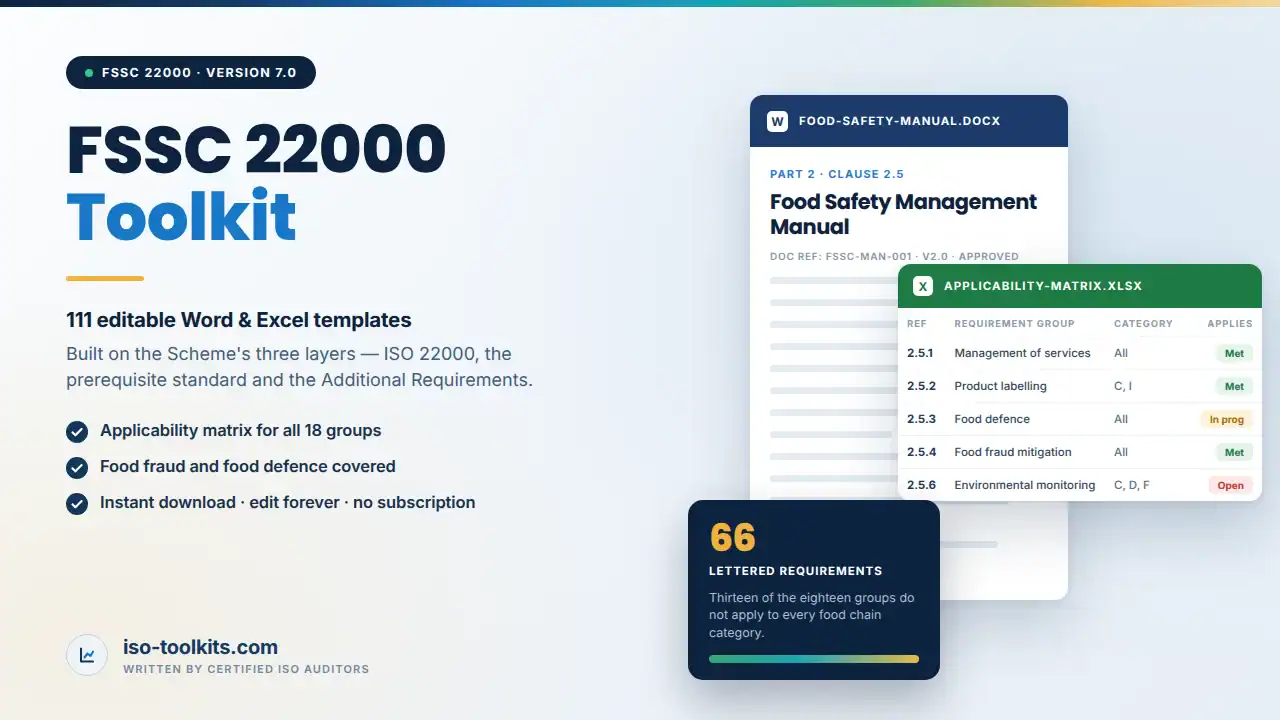
- Applicability matrix – 18 Additional Requirement groups against 13 categories, generated from the Scheme own wording, with columns for your determination and your reasoning.
- FSMS core – the ISO 22000:2018 layer: context, leadership, planning, support, operation, evaluation and improvement.
- Prerequisite programmes – written to the PRP standard applicable to your category rather than to a generic list.
- HACCP and hazard control – hazard analysis, CCP and OPRP determination, validation and verification.
- Food fraud – the vulnerability assessment and the mitigation plan.
- Food defence – the threat assessment and the plan.
- Allergen management – assessment, controls and validation.
- Environmental monitoring – for the eight categories that carry it, with the applicability recorded rather than assumed.
- Additional requirements – all 66 lettered requirements across the 18 groups, each tied to the categories it applies to.
- Eight pre-loaded workbooks – the applicability matrix, requirement registers, the verification schedule and the audit readiness checklists.
Thirteen of the eighteen requirement groups do not apply to everyone
This is the most expensive thing to get wrong, in both directions. Part 2 clause 2.5 sets 18 Additional Requirement groups containing 66 lettered requirements. Eight of the 18 are scoped to particular food chain categories by their own heading, and five more say all food chain categories while carrying category-conditional requirements inside them. Thirteen of 18 in all.
Environmental monitoring applies to eight of the thirteen categories. Traceability of edible carcass parts applies to primary conversion only. Food loss and waste applies to everyone except packaging manufacturers. Product design and development applies to everyone except transport and storage. Multi-site internal audit requirements apply to five categories. Subcategory FII carries no prerequisite programme standard at all.
Adopting a group your category does not carry commits you to evidence an auditor will then expect to see. Omitting one you do carry is a nonconformity. Recording why a group does not apply is what turns an empty folder into a defensible decision, and it is the first thing this FSSC 22000 v7 documentation asks you to do.
Who the FSSC 22000 v7 documentation pack is written for
- Certified sites planning their Version 7 upgrade audit.
- Sites seeking first certification who should start on Version 7 rather than Version 6.
- Food manufacturers, processors, packaging manufacturers, transport and storage operators and feed producers across the thirteen categories.
- Group and multi-site operations that carry the additional internal audit requirements.
What the FSSC 22000 v7 documentation pack does not do
It does not certify you. Only an accredited certification body can, after an audit.
It does not reprint the Scheme documents or ISO 22000. Those are yours to hold, and the Scheme documents are free from the Foundation.
It does not decide your category for you. The applicability matrix records the determination and the reasoning; the determination is yours to make.
Frequently asked questions
When do we have to be on Version 7?
Your upgrade audit has to fall between 1 May 2027 and 30 April 2028, with the certificate uploaded by 30 June 2028. Version 6 certificates are withdrawn automatically after that date.
Does it cover ISO 22000 as well?
Yes – the ISO 22000:2018 layer is one of the three, alongside the prerequisite programme standard and the Additional Requirements.
We are a packaging manufacturer. Is it relevant?
Yes. The applicability matrix is built exactly for this – it tells you which of the 18 groups your category carries and which it does not.
What formats are the files in?
Native Microsoft Word and Excel, fully editable, with placeholders marked throughout.
Related toolkits
Sites that also run HACCP as a standalone programme use the HACCP toolkit, and the ISO 22000 toolkit covers the management system on its own where the Scheme is not required. Quality functions often add the ISO 9001 toolkit. The Scheme documents are published free by the FSSC Foundation.
Implementing for clients? The Consultant Package licenses all 86 toolkits and assessment tools on this site for unlimited client engagements, under one firm-wide licence. One payment of $1,399, no subscription and no per-client fee.
Delivery, format and licence
The FSSC 22000 v7 documentation pack downloads immediately after checkout as native Microsoft Word and Excel files. Nothing is locked, nothing is a PDF you cannot edit, and no add-on or portal login is needed to open it. Every organisation-specific value is marked as a placeholder so you can see what still has to be decided.
One payment, no subscription and no annual renewal. The source files behind the FSSC 22000 v7 documentation pack are yours to adapt for your own organisation for as long as you need them, including future revisions of your own documents.


Reviews
There are no reviews yet.