
Retailers and brand owners often ask suppliers to hold BRCGS certification. At the audit, each clause is checked against your documents, your records and what the auditor sees on the production floor. These BRCGS Issue 9 templates give a food site a documented system with the same layout as the Standard. Folder 04 holds section 4, folder 05 holds section 5, and so on. When the auditor moves to a new section, you open the matching folder.
The pack covers the requirements in Part II, the audit protocol in Part III, the appendices a site acts on and the four position statements in F926. A pre-loaded self-assessment shows where to start.
On this page:
- Why BRCGS Issue 9 templates need to follow the Standard’s own structure
- What is inside the BRCGS Issue 9 templates pack
- Fundamental requirements, position statements and audit grading
- Who the BRCGS Issue 9 templates are written for
- What this pack does not do
- Frequently asked questions
- Related food safety toolkits
Why BRCGS Issue 9 templates need to follow the Standard’s own structure
A BRCGS audit works through the Standard section by section. If your documents are organised by department or by an older scheme, you have to translate between the two during the audit, and that is where gaps get missed. In this pack the folders use the Standard’s own numbering. A separate folder, 00, handles certification and the Part III audit protocol.
| Area of the Standard | Coverage in the pack |
|---|---|
| Part II requirements | 328 clauses in 72 subsections, sections 1 to 9 |
| Statements of intent | All 57, including the 12 fundamental requirements |
| Part III audit protocol | 25 blocks, including audit options, grading, non-conformities, recertification and unannounced audits |
| Appendices | 6 that a site acts on, including production risk zones and root cause analysis |
| Position statements | All 4 published in F926 |
Each Word document begins with a table listing the BRCGS references it answers. You can see straight away which clauses a procedure covers.
What is inside the BRCGS Issue 9 templates pack
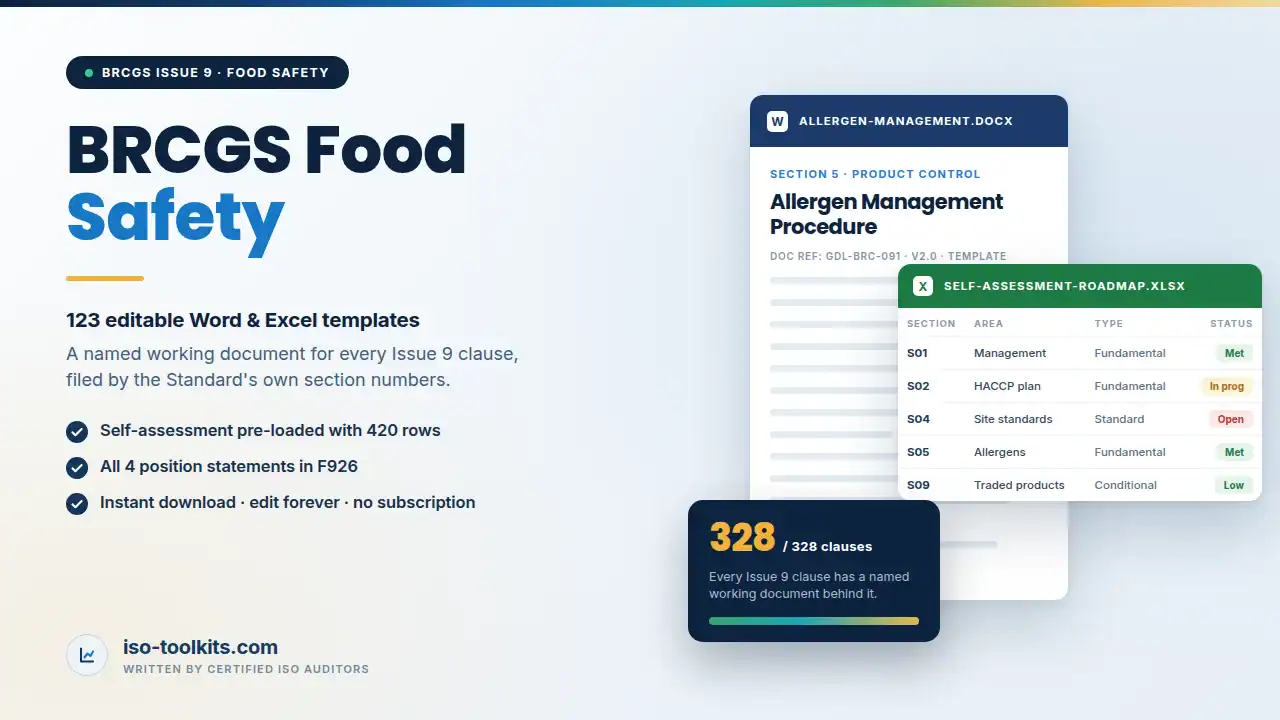
There are ten numbered folders, 123 files in total, each with a GDL-BRC reference from 001 to 123:
- 00 Certification and Audit (9) – the Issue 9 Self-Assessment and Implementation Roadmap, a scope and exclusions record, a procedure for choosing a certification body, blended and unannounced audit readiness, the Audit Grade and Recertification Calendar, and a non-conformity close-out tracker.
- 01 Senior Management Commitment (10) – the food safety and quality policy, the culture plan with an effectiveness tracker, the objectives register, management review, confidential reporting, and a register of legislation, registrations and position statements.
- 02 Food Safety Plan – HACCP (11) – the HACCP team charter, prerequisite programme register, hazard analysis workbook, CCP decision tree, validation report, monitoring and deviation record, and the annual review.
- 03 Food Safety and Quality System (27) – the Food Safety and Quality Manual, document and records control, internal audit, supplier approval, specifications, corrective action, traceability with mass balance, complaints, incident management and recall.
- 04 Site Standards (29) – site security and food defence, building fabric, equipment and maintenance, chemical, glass and sharps control, metal detector and X-ray testing, cleaning and CIP, environmental monitoring, pest management, storage and transport.
- 05 Product Control (14) – product development, shelf-life validation, labelling and artwork, allergen management, food fraud vulnerability, packaging, product testing, plus pet food and animal primary conversion procedures.
- 06 Process Control (7) – work instructions, quantity and deviation control, labelling and pack control with line clearance, and calibration.
- 07 Personnel (6) – the training and competency matrix, personal hygiene, the plaster test log, medical screening, and protective clothing and laundry.
- 08 Production Risk Zones (5) – zone segregation, the high-care and ambient high-care risk assessment, drain map and air handling, zone cleaning, and laundry validation.
- 09 Traded Products (5) – the traded products HACCP scope, the manufacturer register, specification and legality, assurance results, and a traceability test.
Placeholders are written as square-bracket tokens such as [Organisation Name], so one find-and-replace adds your company details across the pack.
Fundamental requirements, position statements and audit grading
The 12 fundamental requirements carry the most risk at audit. A major non-conformity against one of them means a new site does not get its certificate and a certificated site loses it. Only a further full audit puts that right. Any document that answers a fundamental requirement says so at the top. These requirements cover senior management commitment, the food safety plan, internal audits, supplier management, corrective and preventive action, traceability, layout and segregation, housekeeping and hygiene, allergens, control of operations, labelling and pack control, and training.
The PDF of the Standard is not the full set of rules. BRCGS position statements are binding, and they change text first printed in 2022. The pack is written to F926, which is dated 6 October 2026:
- Position Statement 1 – updates clause 1.1.10 and the voluntary unannounced audit protocol. Arrangements with the certification body must be in place before the audit window opens.
- Position Statement 2 – a site may not change certification body in the 4 months before its re-audit date.
- Position Statement 3 – changes the definition of an initial audit.
- Position Statement 4 – adds suitable protective footwear to clause 7.4.2, effective from 10 August 2026.
To find your starting point, use the self-assessment workbook. It comes pre-loaded with 420 rows, one for each clause, statement of intent, audit protocol block, appendix and position statement. Each row shows its fundamental and conditional flags and the document that answers it. The Audit Grade and Recertification Calendar takes your critical, major and minor counts and returns a grade using the Part III table. It also calculates your audit due date, the audit window and the unannounced year.
The workbooks calculate dates, totals and scores, but they never mark a record as passed or closed. You set each Status from a dropdown, and a Prompt column flags missing or overdue entries.
Who the BRCGS Issue 9 templates are written for
- Food manufacturers preparing for a first BRCGS Food Safety audit.
- Certificated sites rebuilding older documentation around Issue 9 and the current position statements.
- Technical and quality managers who need one place to track gaps, owners and due dates across every clause.
- Sites with high-care or ambient high-care zones, or with traded products, which need the conditional sections 8 and 9.
- Consultants and multi-site groups standardising documents across several facilities.
What this pack does not do
It does not certify your site. Only a certification body recognised by BRCGS can issue a certificate, after an audit. Your site still has to run the procedures, keep the records and pass that audit. The pack is not legal advice either, and the limits your site sets are left as placeholders. Any figure in a worked example is illustrative, not a legal limit.
The Standard itself is not included. It is BRCGS copyright, and clause 1.1.9 expects your site to hold a genuine current copy. The pack is independent of BRCGS and is not approved or endorsed by it. Requirements are described in our own words, alongside clause numbers and short names.
Sections 5.8, 5.9, 8 and 9 apply only to sites that carry out those activities. You can record a decision for each and set them aside if they do not apply. BRCGS is working on Issue 10, so check brcgs.com for later position statements.
Frequently asked questions
How many documents are included?
123 editable files – 78 Word documents and 45 Excel workbooks.
Which issue of the Standard do the files follow?
Issue 9 of the BRCGS Global Standard Food Safety, including all 4 position statements in F926. The legislation register lets you log any position statements published later.
Do we need sections 8 and 9?
Only if they apply to your site. Section 8 covers products that need higher-hygiene production zones. Section 9 covers traded products you choose to include in the audit. The Production Risk Zone Assessment helps you decide on section 8.
Where should we begin?
Start with the Issue 9 Self-Assessment and Implementation Roadmap, then the Food Safety and Quality Manual. Together they show what you already have and which clauses to work on first.
Are the files locked?
No. All files are native .docx and .xlsx, unlocked and unprotected. The workbooks have dropdowns and frozen headers, and the example rows are there to delete before use.
Related food safety toolkits
If you are certifying to a different scheme, see the FSSC 22000 v7 Documentation Pack or the SQF Edition 10 Documentation Pack. To build on the ISO standard, use the ISO 22000 Toolkit. If you only need HACCP plans, the HACCP Toolkit covers the Codex principles. The Standard itself is available from BRCGS.
Implementing for clients? The Consultant Package licenses all 91 toolkits and assessment tools on this site for unlimited client engagements, under one firm-wide licence. One payment of $1,399, no subscription and no per-client fee.
Delivery, format and licence
The brcgs issue 9 templates pack downloads immediately after checkout as native Microsoft Word and Excel files. Nothing is locked, nothing is a PDF you cannot edit, and no add-on or portal login is needed to open them. Every organisation-specific value is marked as a placeholder so you can see what still has to be decided.
One payment, no subscription and no annual renewal. The source files are yours to adapt for your own organisation for as long as you need them, including future revisions of your own documents.


Reviews
There are no reviews yet