
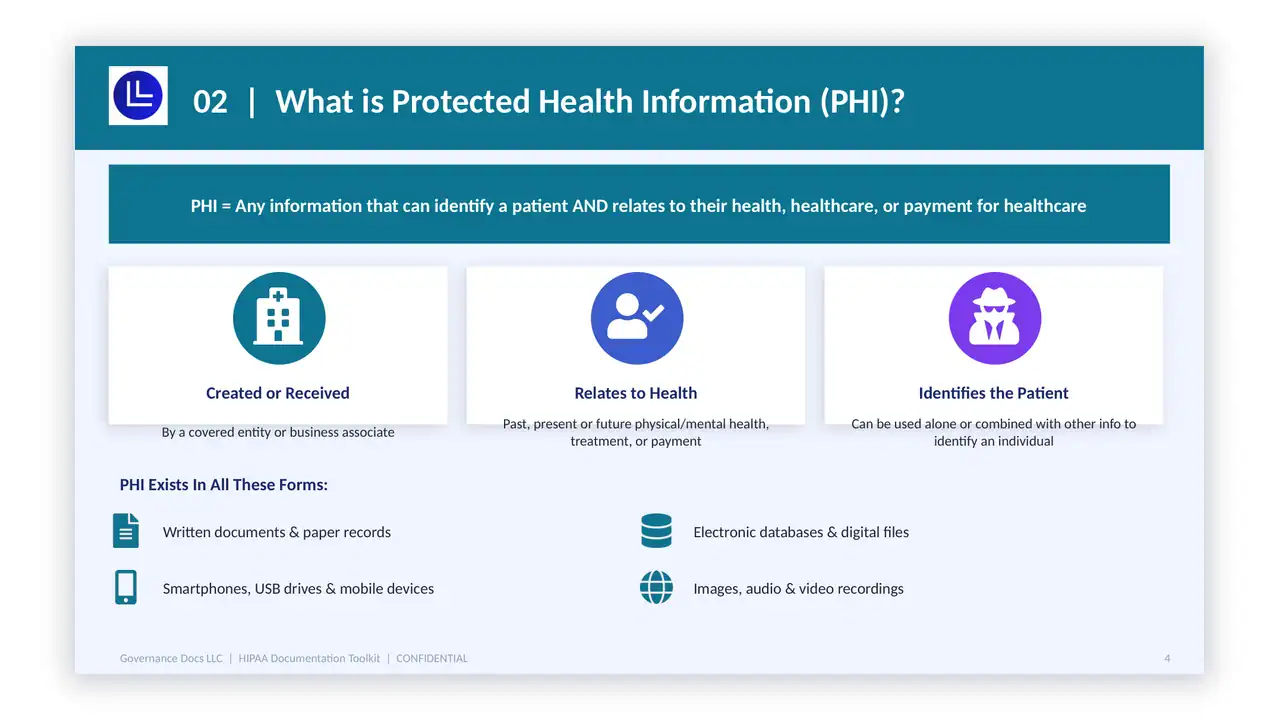
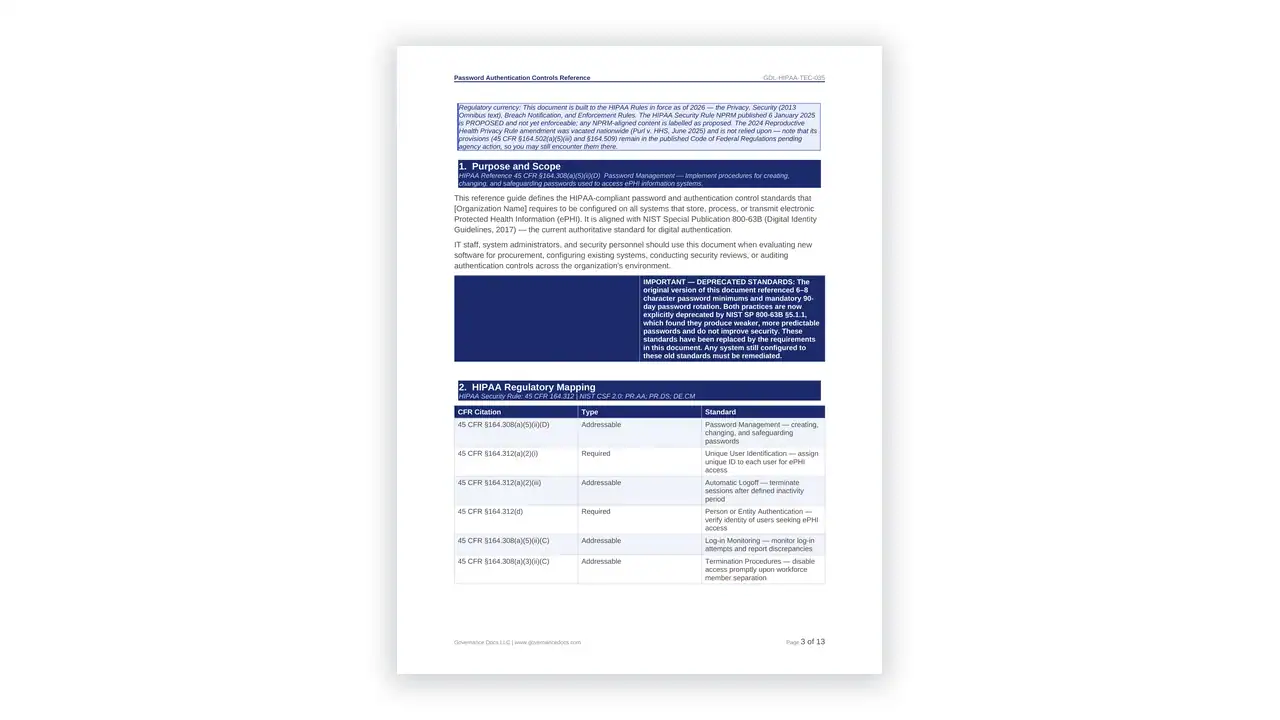
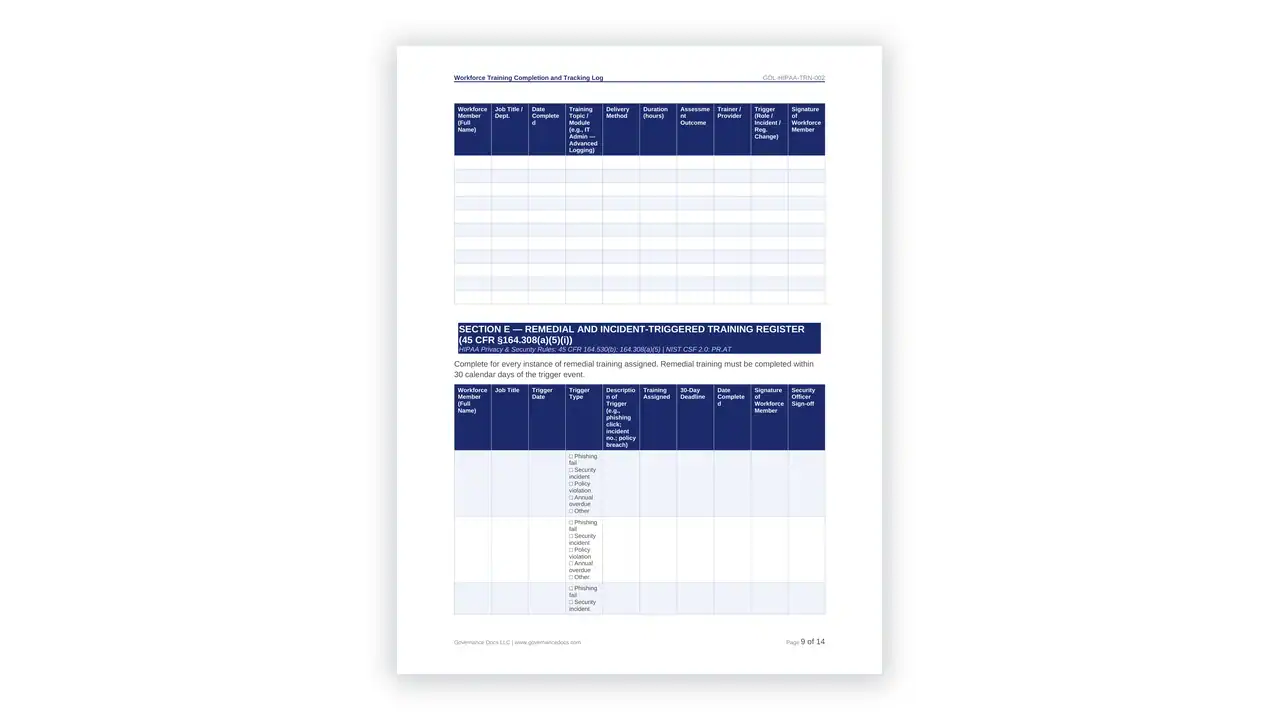
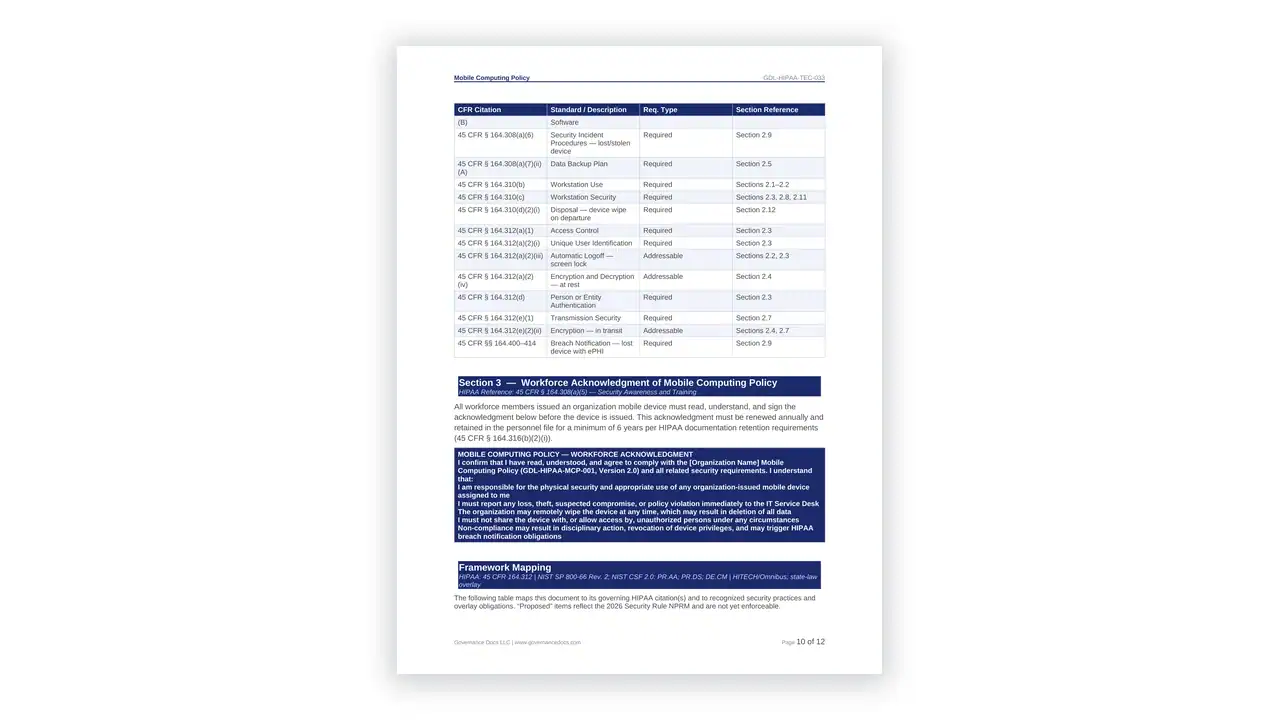
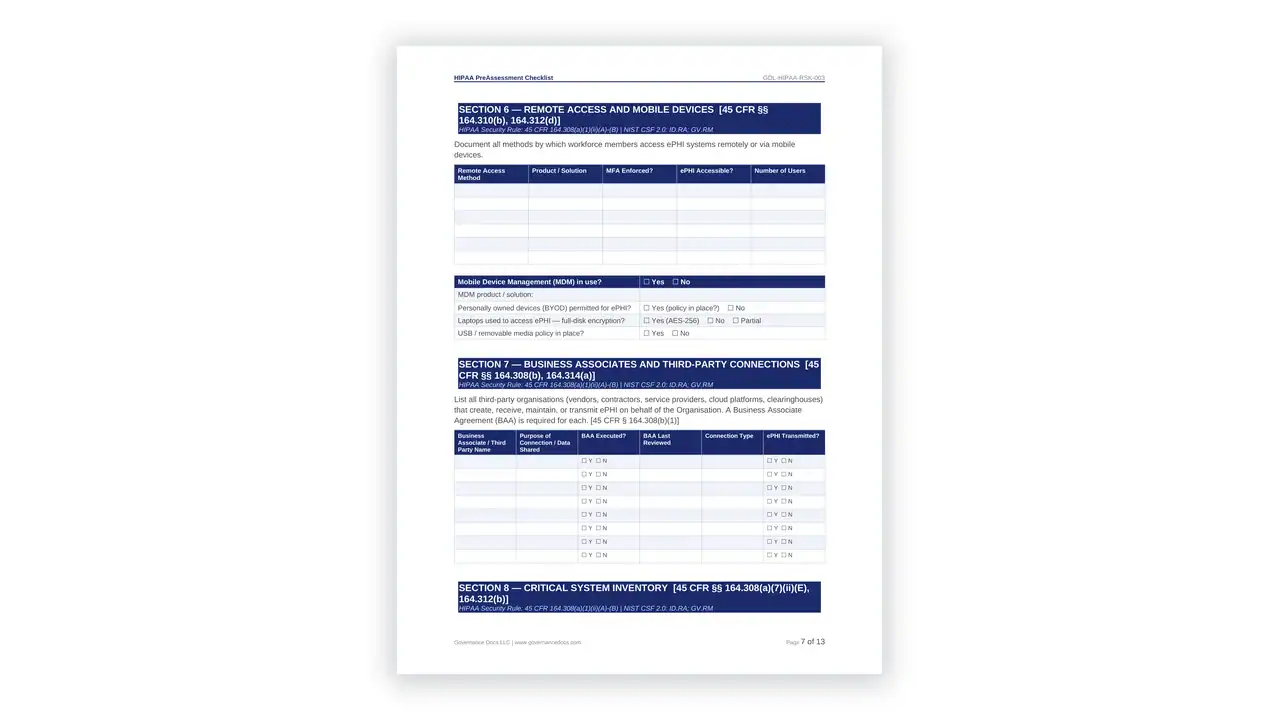
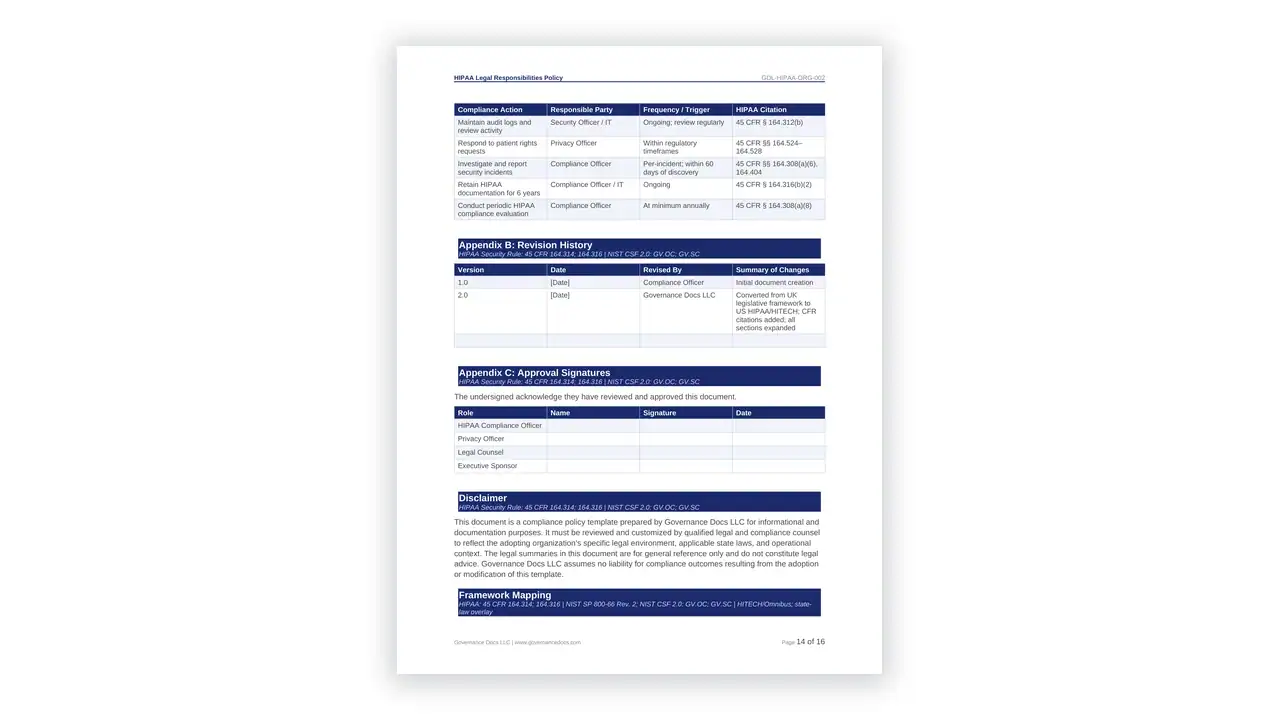
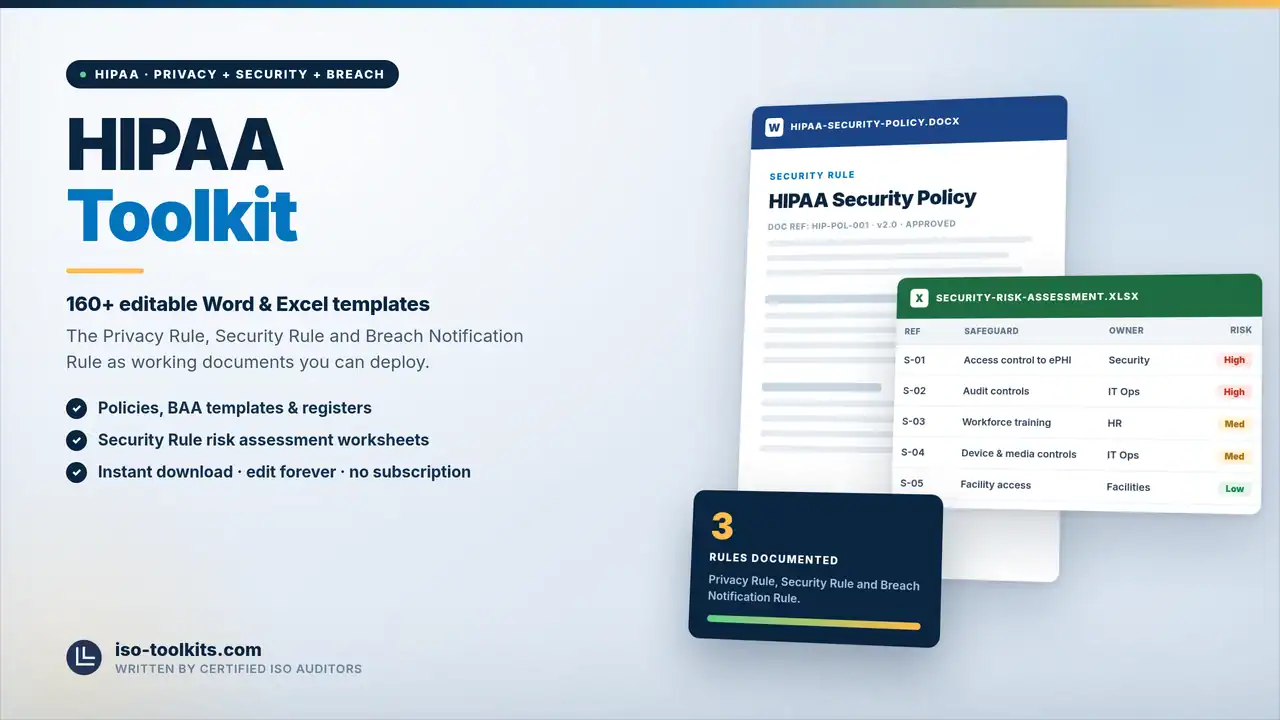
This pack is the HIPAA Security Rule documentation an OCR investigator or a covered entity due diligence review actually asks for, together with the Privacy Rule, individual rights and breach material around it. 165 editable files across fourteen numbered sections, downloadable the moment you check out. On this page:
- What is in the toolkit
- Why the security risk analysis anchors your HIPAA Security Rule documentation
- Who needs HIPAA Security Rule documentation
- How the documents map to the framework
- Frequently asked questions
- Related toolkits
What is in the HIPAA Security Rule documentation pack
The sections follow how a HIPAA programme is assessed rather than how the regulation is numbered:
- 00 Start Here and 01 Program Governance and Administration – the compliance programme, privacy and security officer appointments, policies on policies and the documentation retention position
- 02 Privacy Rule – uses and disclosures, minimum necessary, notice of privacy practices, authorisations and the de-identification position
- 03 Individual Rights – access, amendment, accounting of disclosures, restriction requests and the request handling procedures behind each
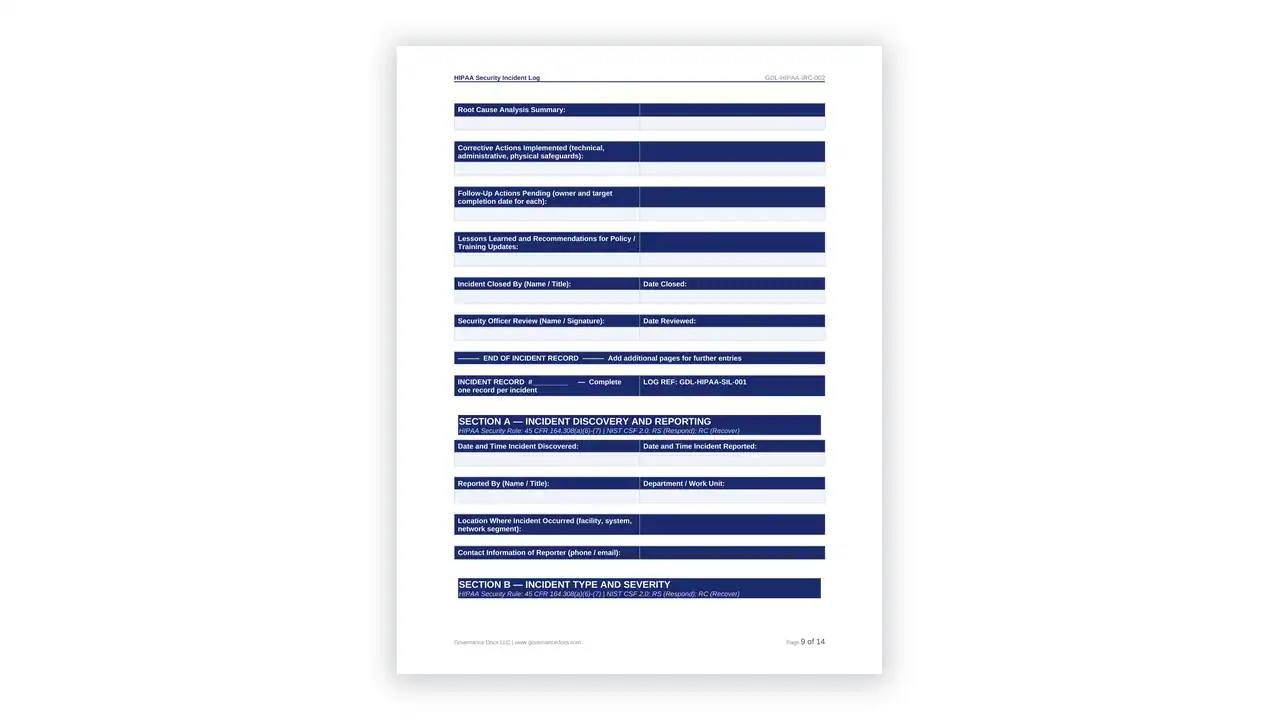
- 04 Administrative Safeguards – the largest section, covering security management process, assigned responsibility, workforce security, information access management, awareness training, incident procedures, contingency planning and evaluation
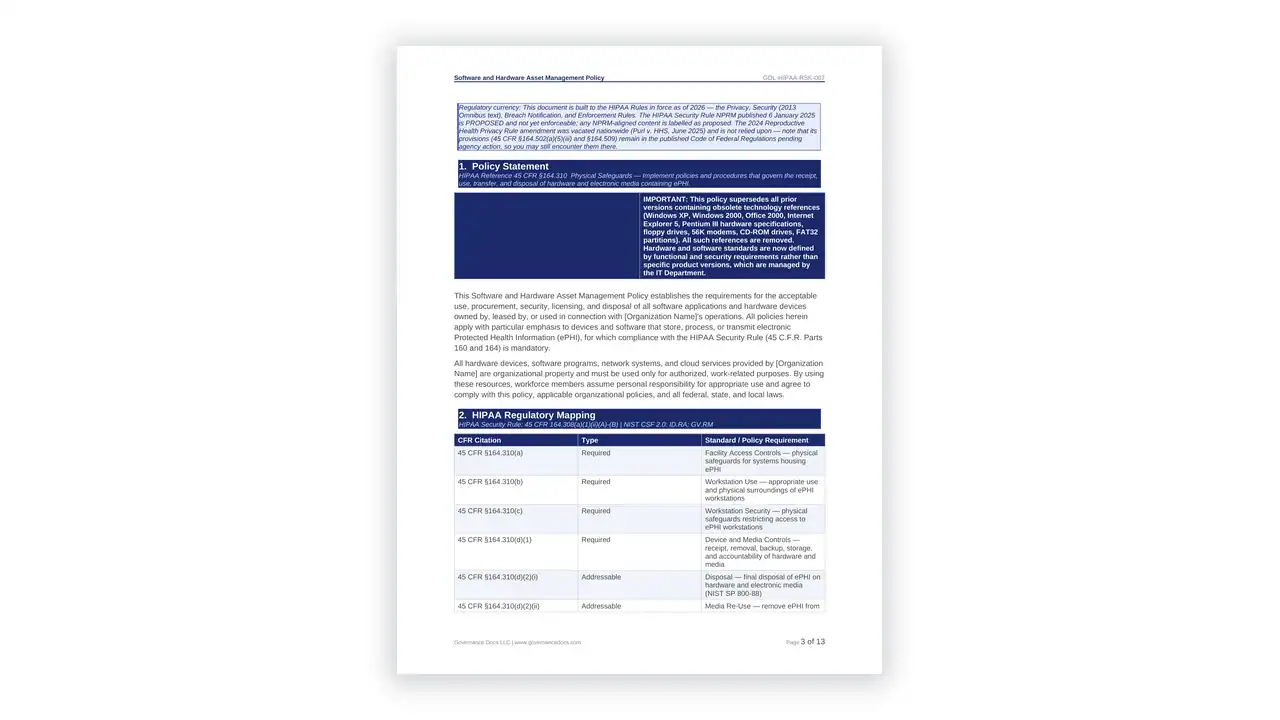
- 05 Physical Safeguards – facility access controls, workstation use and security, device and media controls
- 06 Technical Safeguards – access control, audit controls, integrity, authentication and transmission security
- 07 Organizational and Documentation – the requirements that sit outside the three safeguard categories but are assessed alongside them
- 08 Risk Analysis and Management – the security risk analysis as a worked example, the risk management plan and the remediation tracking
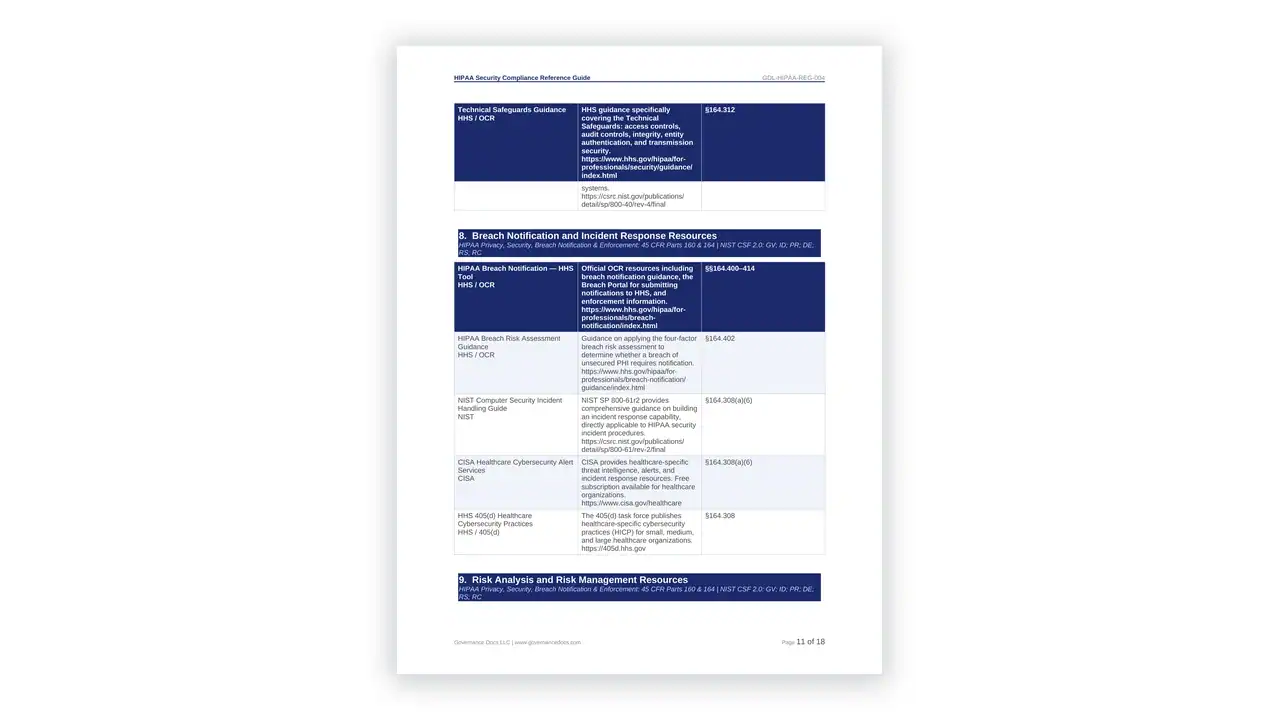
- 09 Breach Notification – the four-factor breach risk assessment, notification decision process, individual, media and Secretary notification, and the breach log
- 10 Business Associate Management – BAA templates, subcontractor flow-down, due diligence and the business associate register
- 11 Workforce Training and Awareness – training programme, role-based content and the records that prove it happened
- 12 Incident Response and Contingency – incident procedures, emergency mode operation, data backup and disaster recovery
- 13 Regulatory Mapping and Assessment – the compliance matrices and readiness checklists that tie the set together
Why the security risk analysis anchors your HIPAA Security Rule documentation
The Security Rule is built around a single required activity: an accurate and thorough assessment of the potential risks and vulnerabilities to electronic protected health information. Almost every OCR enforcement action of the last decade cites a missing or inadequate risk analysis.
It is also the requirement most often faked. A vendor questionnaire, a vulnerability scan, or a generic checklist is not a risk analysis – it has to cover all ePHI wherever it lives, identify threats and vulnerabilities, assess likelihood and impact, and feed a documented risk management plan. That is why the risk analysis here is a worked example rather than an empty template.
The second area that trips organisations is the addressable versus required distinction. Addressable does not mean optional: if you do not implement an addressable specification you must document why it was not reasonable and appropriate and what you did instead. That documented reasoning is part of your HIPAA Security Rule documentation, and its absence is what an investigator finds.
Who needs HIPAA Security Rule documentation
Covered entities – providers, health plans and clearinghouses – who need a documented programme rather than a folder of forms. Business associates, including SaaS vendors handling ePHI, whose covered entity customers now audit them properly. Organisations that have had a breach and discovered the risk analysis does not exist. And practices consolidating several sites onto one compliance programme.
How the HIPAA Security Rule documentation maps to the framework
HIPAA does not certify, which is why documentation quality is the only thing standing between you and an enforcement finding. The pack pairs each safeguard with the record that evidences it – training logs, access reviews, incident records, BAA register – because the Administrative Safeguards in particular are assessed on operation rather than on policy text.
Frequently asked questions
Does this cover both the Privacy Rule and the Security Rule?
Yes, along with the Breach Notification Rule and the organisational requirements. Section 02 covers Privacy, sections 04 to 06 cover the Security safeguards, and section 09 covers breach notification.
Is the security risk analysis a real assessment?
It is a worked example with methodology, threat and vulnerability identification, likelihood and impact scoring and the link into a risk management plan – not a blank form.
We are a business associate, not a covered entity. Is this relevant?
Yes. Business associates are directly liable for the Security Rule and much of the Breach Notification Rule. Section 10 also handles subcontractor flow-down, which is where most business associates are exposed.
What does addressable actually mean?
Not optional. If you do not implement an addressable specification you must document why it was not reasonable and appropriate and what compensating measure you used instead. That documentation is included.
How many documents are included?
165 editable files across fourteen sections – 163 Word documents, an Excel workbook and a training presentation.
Related toolkits
Healthcare security programmes usually carry more than HIPAA. See the HITRUST CSF Toolkit, which is increasingly what payers and health systems ask for, the SOC2 Toolkit for commercial assurance, the ISO 27001 Toolkit for international buyers and the NIST SP 800-53 Toolkit for federal control mapping. Practices that also handle customer financial information need the WISP toolkit for the FTC Safeguards Rule.
Implementing for clients? The Consultant Package licenses all 86 toolkits and assessment tools on this site for unlimited client engagements, under one firm-wide licence. One payment of $1,399, no subscription and no per-client fee.
Delivery, format and licence
Your HIPAA Security Rule documentation downloads immediately after checkout as native Microsoft Word and Excel files. Nothing is watermarked or locked, so you can rebrand the documents, bring them under your own document control and revise them for as long as you need them.
One-time purchase. No subscription and no annual renewal. Because the source files are yours, revising a procedure after an audit finding or a change of scope is an internal edit rather than another purchase.


Reviews
There are no reviews yet